
Ordering Number: AS22676
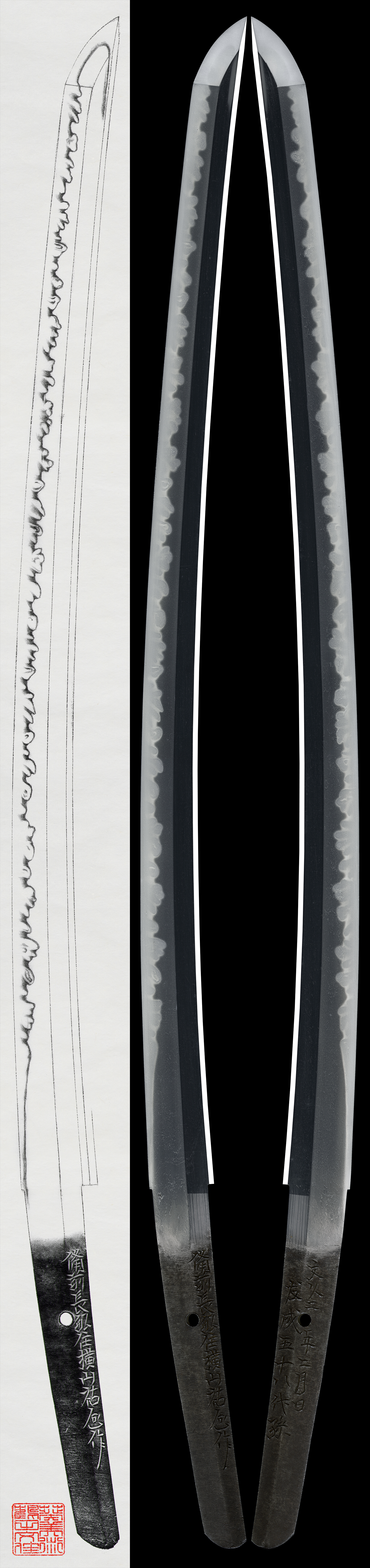
Wakizashi in Shirasaya with Koshirae (NBTHK Tokubetsu Hozon Token)
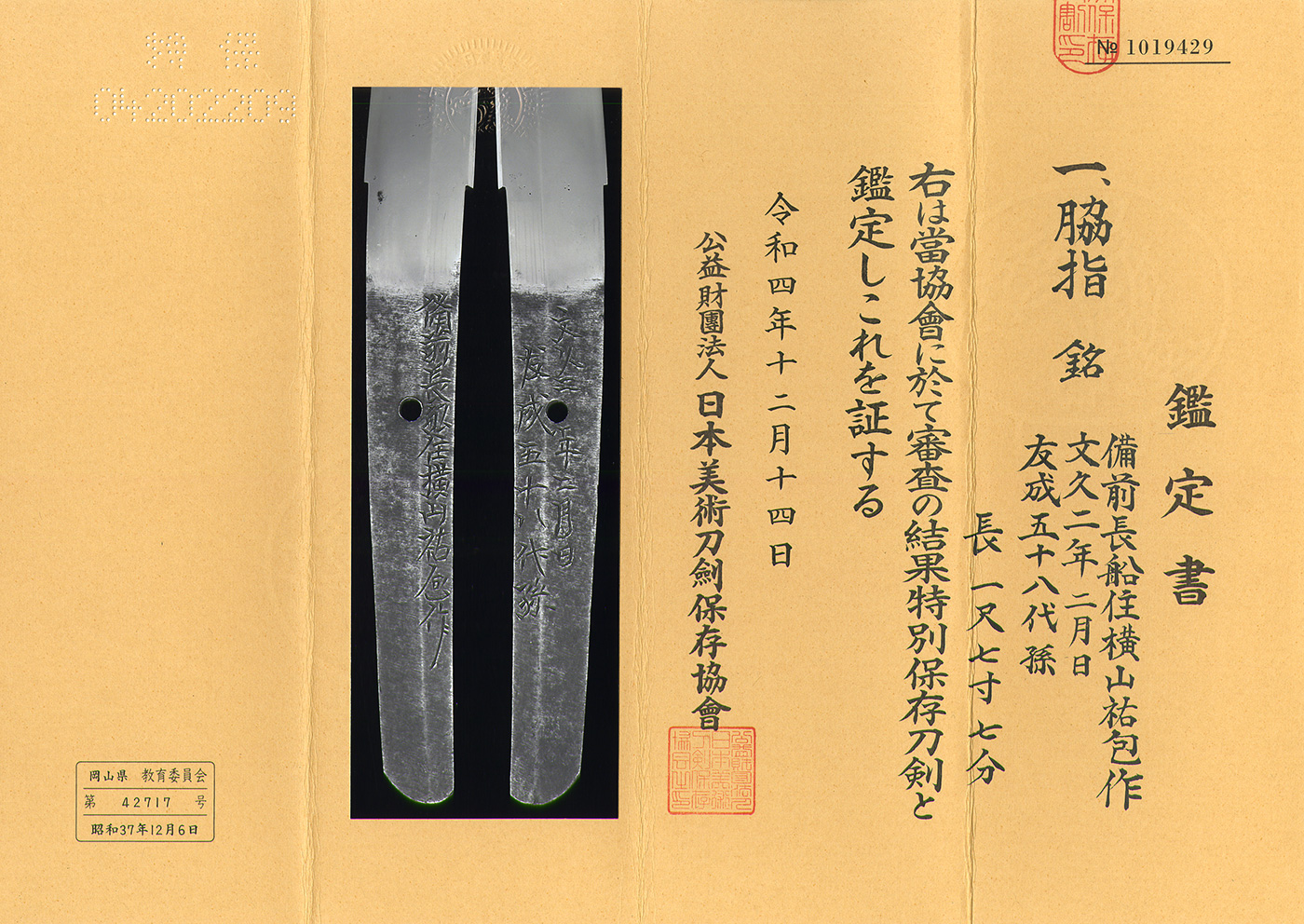
Signature: Bizen Osafune Ju Yokoyama Sukekane Saku
A day in the 2nd month of Bunkyu 2 (1862)
58th Generation Descendant of Tomonari
備前長船住横山祐包作
文久二年二月日
友成五十八代孫
Shinshinto: Chujo-saku: Bizen.
(We divide 4 sections for each sword as Saijyo Saku, Jyojyo Saku, Jyo Saku and Regular Saku).
This blade is ranked as Jyojyo Saku among the works of Bizen Osafune Ju Yokoyama Sukekane.
Habaki: Single copper habaki with gold iroe.
Blade Length: 53.7 cm (21.14 in).
Curvature: 1.4 cm (0.55 in).
Mekugi Hole: 1.
Width at Base (Motohaba): 2.95 cm (1.16 in).
Width at Yokote: 2.08 cm (0.82 in).
Thickness of rim (Kasane): 0.61 cm (0.24 in).
Sword Weight: 515 g.
Era: Edo period, Bunkyu 2 (1862).
Shape: A wakizashi of standard mihaba and kasane with deep curvature and an elongated kissaki, giving it a graceful and well-balanced appearance.
Jigane: Well-forged, tightly compact ko-itame hada forming a beautiful mujihada-like surface.
Hamon: Beginning as suguha from the hamachi, it transitions into an active gunome-midare in a nioi-deki style.
Features: Yokoyama Sukekane signed his works as the 58th Generation Descendant of Tomonari, while Yokoyama Sukenaga inscribed himself as the 57th Generation Descendant. Both swordsmiths produced distinctive hamon and were especially renowned for their elegant choji-midare.
Koshirae:
Tsuba: Round iron tsuba with openwork design. The rim is decorated with gold iroe.
Fuchikashira: Decorated with Kuyo crests and scrolling arabesque motifs in gold and silver.
Menuki: Figures and ox motif.
Saya (Scabbard): Decorative lacquered saya with a special finish.
Aoi Art’s Comment: The beautifully executed rounded choji hamon is particularly impressive. It is possible that this distinctive style of choji was first devised by Sukenaga. We have rarely encountered such a unique choji-midare, making this an outstanding work of exceptional quality.
NBTHK Tokubetsu Hozon Token Certificate.
AoiArt estimation paper: Whole Oshigata.
*Please note: The price does not include shipping fees.
Please note: the price does not include the shipping fees.
Auction Starting Price:500,000JPY
Place Bid





Related Items:
 Wakizashi: Mumei (Unsigned) (Yoshioka Ichimonji). (NBTHK Tokubetsu Hozon Token)
 Wakizashi:Bishu Osafune Norimitsu (4th generation) Dated: February, Eikyo 5 (1433) (NBTHK Tokubetsu Hozon Token)
 Wakizashi:Bizen Koku Osafune Yosazaemon Sukesada(NBTHK Tokubetsu Hozon Token)
 Wakizashi:Banshu Tegarayama Roku Fujiwara Ujishige Seitan Saku A day in the 2nd month of An'ei 5 (1776) Made for Koizumi Sadayoshi (NBTHK Tokubetsu Hozon Token)
 Wakizashi: Mumei(Unsigned)(Osafune Chikakage).(NBTHK Tokubetsu Hozon Token)
 Wakizashi: Mumei (attributed to Hatakeda Sanemori)e (43rd NBTHK Juyo Token)