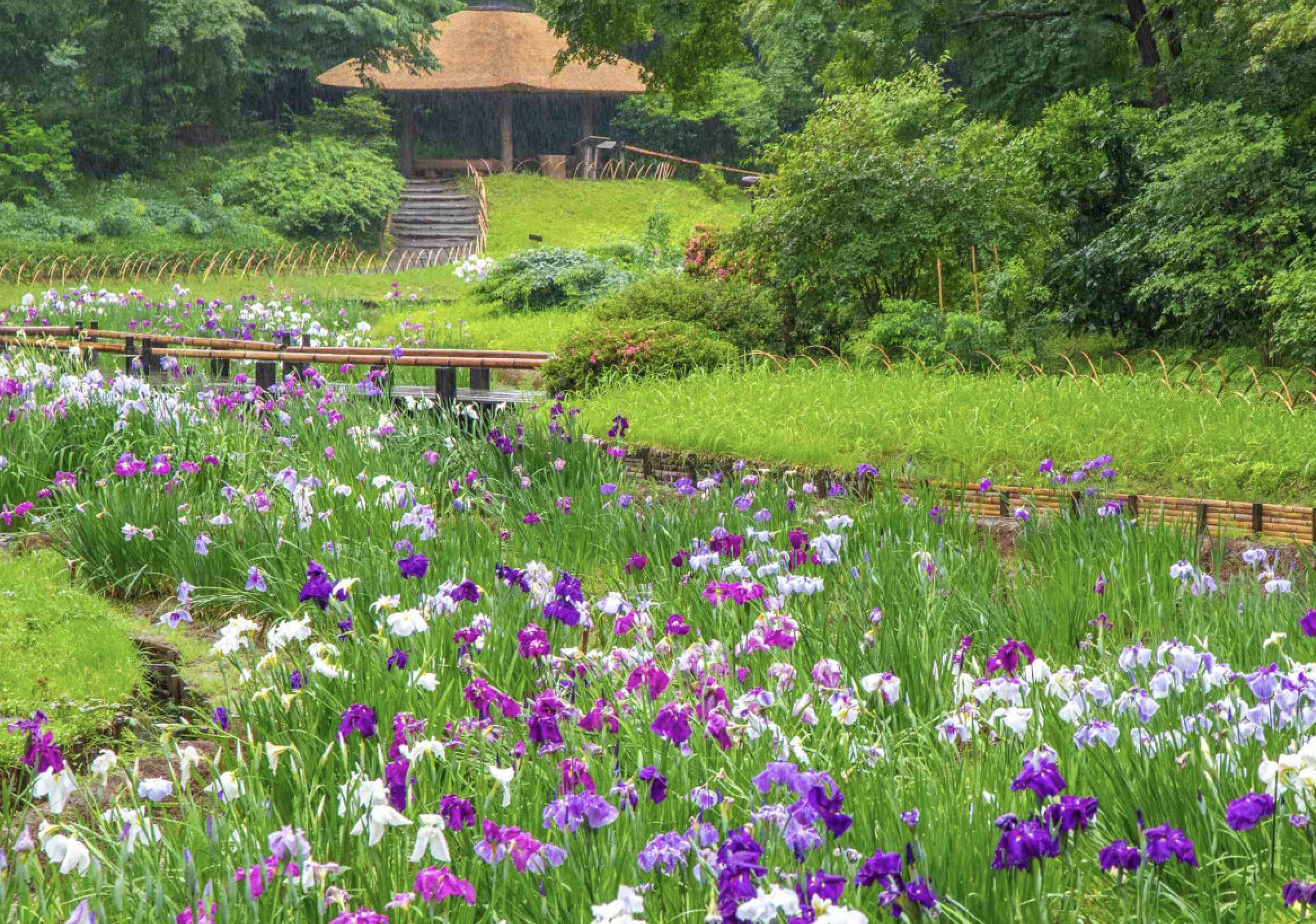
The weather has become quite hot, and as July and August approach, the nights will surely become even more uncomfortable.
Today, I would like to share with you how a Japanese sword is made and why it is such a remarkable work of art.
The primary material used to make a Japanese sword is iron. Traditionally, swordsmiths use iron sand, known as satetsu, as well as selected pieces of iron. The iron sand is collected from mountains and hills, then carefully washed in flowing water. Because iron sand is much heavier than ordinary sand or other impurities, it settles to the bottom while lighter materials are carried away by the current. The purified iron sand is then gathered and dried in the sun.
The next important step is making charcoal. Good charcoal is produced by slowly carbonizing wood while limiting the amount of oxygen. Afterward, the charcoal is broken into small pieces and placed into a furnace together with the iron sand. Air is continuously supplied with large bellows, raising the temperature to an extremely high level.
This process continues day and night for about two days. More charcoal and iron sand are repeatedly added until a large mass of steel is formed inside the furnace. When the furnace is dismantled, this precious steel block is removed. It is called tamahagane, the traditional steel used to create Japanese swords.
The quality of tamahagane varies, and the swordsmith carefully selects different portions for different purposes.
The finest steel becomes kawagane, or outer steel. It is heated until red-hot and then rapidly cooled, making it brittle enough to be broken into small pieces. These pieces are repeatedly folded and forged together, removing impurities while creating strong, beautiful steel.
Another type of steel, called shingane, is softer and more flexible. This softer core is wrapped inside the harder outer steel.
I often compare this structure to a Japanese sweet bun. The outer skin is the strong kawagane, while the filling inside represents the softer shingane. By combining these two different kinds of steel, a Japanese sword achieves both exceptional sharpness and remarkable durability.
Once the steel has been prepared, the swordsmith shapes the blade and creates the hamon, the beautiful temper pattern that gives every sword its unique character. Depending on the tradition he follows—whether Bizen, Yamato, Soshu, Yamashiro, or Mino—the appearance of the blade will differ.
Perhaps the most intense moment in sword making is the heat treatment, known as yaki-ire. The swordsmith heats the blade until it reaches the exact temperature, judging only by the color of the glowing steel. At precisely the right moment, he plunges it into water. In that single instant, the quality of the blade is largely determined.
After hardening, the blade is lightly polished so the swordsmith can examine the results. A professional polisher then performs the full polish, revealing the beauty hidden within the steel. A custom-made wooden scabbard, called a shirasaya, is crafted to protect the blade, and eventually a decorative mounting, known as koshirae, may also be made.
Only after all these steps has a Japanese sword truly been completed.
As you can see, creating a Japanese sword requires extraordinary time, patience, and dedication.
From collecting iron sand and producing charcoal, to making tamahagane, forging the steel, shaping the blade, polishing it, and crafting both the shirasaya and koshirae, every stage demands the highest level of skill and care.
Swordsmiths devote their lives to this craft. They endure the heat of summer and the cold of winter, always hoping that each blade will be worthy of their efforts.
When we admire a Japanese sword, we naturally appreciate the beauty of its steel and the elegance of its hamon. Yet behind that beauty lies the work of many skilled craftsmen and centuries of tradition.
Perhaps that is why, whenever I quietly gaze upon a fine Japanese sword, I feel a sense of peace and clarity in my heart.
******************
In recent years, the development of artificial intelligence (AI) has been nothing short of remarkable.
Today, AI can translate from one language to another almost instantly. It is no longer limited to simple word-for-word translation; it can produce natural, fluent, and well-written text that often sounds as though it were written by a native speaker. What once seemed impossible has now become an everyday reality.
I believe this technological progress is truly impressive. At the same time, however, I cannot help feeling a certain concern about where it may eventually lead us.
If AI continues to advance and more people come to depend on it for everything, we may reach a point where people no longer compete with one another through their own knowledge and creativity. Instead, AI systems may end up competing against other AI systems.
Financial markets may become one example. If everyone relies on AI to make investment decisions, machines could begin making countless decisions in fractions of a second, creating a world that ordinary people can neither understand nor control.
AI is also capable of solving highly complex mathematical problems almost instantly. While this is undoubtedly convenient, I sometimes wonder whether we may gradually lose the habit of thinking deeply for ourselves.
The legal profession provides another example. Becoming a lawyer requires years of study and experience, yet today AI can help ordinary people search laws, locate precedents, and organize information within seconds.
It can even identify exactly where a statement appears in a document and explain the reasoning behind a conclusion.
Of course, the final judgment must always remain in human hands. Nevertheless, I believe AI will continue to play an increasingly important role in hospitals, schools, businesses, and many other areas of society.
Universities will also need to adapt. In the future, education may place less emphasis on memorizing facts and more emphasis on learning how to think critically, make sound judgments, and use AI wisely.
At the same time, we continue to live in a world where wars have not disappeared.
Whenever war breaks out, new weapons and new technologies are developed. AI itself may become part of that process. Technology should exist to improve people's lives, yet history reminds us that it can also be used for destruction.
The war between Russia and Ukraine has continued for years, bringing immense suffering to countless people. I sincerely hope that peace will return as soon as possible.
Japan, too, must continue strengthening its relationships with other nations through dialogue, mutual understanding, and cooperation.
Our country is located in a region where security challenges continue to exist. Precisely because of this, I believe we must value peace while maintaining the wisdom and determination needed to protect it.
I have always admired Switzerland in this respect.
Many people think of Switzerland simply as a peaceful country. In reality, its peace has not come by chance. Over many generations, Switzerland has maintained the means to defend itself while consistently pursuing neutrality and peace.
There is much that Japan can learn from that example.
My greatest hope is that our country will continue to earn the trust of the world and remain a nation that values peace above all else.
******************
I will be turning 86 years old soon.
At this stage of life, I find myself thinking more often about what it truly means to live.
Every human being has desires. Even at my age, I cannot say that all of mine have disappeared. Compared with when I was younger, they have certainly become fewer, yet they are still there. Perhaps human desire remains with us until the very end of our lives.
As I have grown older, I have come to understand many things about life. Even so, desire itself is not something that simply fades away.
That is why I believe it is so important to cherish kindness, gratitude, and humility throughout our lives.
Life brings both happiness and disappointment. More often than not, things do not go exactly as we hope.
Yet I have come to believe that true happiness is found in the ordinary moments: enjoying good health, sharing time with family and friends, and quietly appreciating the beauty of a fine Japanese sword.
These simple blessings are treasures that should never be taken for granted.
Before I close, I would like to leave a few words for people of every generation.
To those who have reached their later years, I hope you will treasure the long journey you have shared with your loved ones. May you continue to enjoy good health and peaceful days together.
To husbands and wives, I encourage you to set aside time for each other. Visit a hot spring, enjoy a wonderful meal, and spend unhurried moments together. After many years of marriage, there is great joy in looking back and appreciating the life you have built side by side.
To the younger generation and to children, I would like to offer three simple words:
**Kindness. Cheerfulness. Simplicity.**
Treat others with kindness.
Live each day with a cheerful spirit.
Do not seek luxury above all else. Learn instead to appreciate a simple and honest life.
I believe these qualities will help shape you into people of strong character.
I also hope you will spend time in nature whenever you can.
Walk among the mountains, listen to the sound of rivers, observe the changing seasons, and appreciate the beauty of trees and flowers. Nature has a quiet way of teaching us patience, humility, and gratitude.
We now live in an age of extraordinary technological progress. While we should welcome innovation, I hope we never lose the qualities that make us truly human.
May we continue to value compassion, preserve our traditions, protect the beauty of nature, and strive for peace.
Thank you for taking the time to read these thoughts.
I wish each of you good health, lasting happiness, and peaceful days ahead.
With my sincere best wishes,
Kazushige Tsuruta*