
Ordering Number: AS26026.
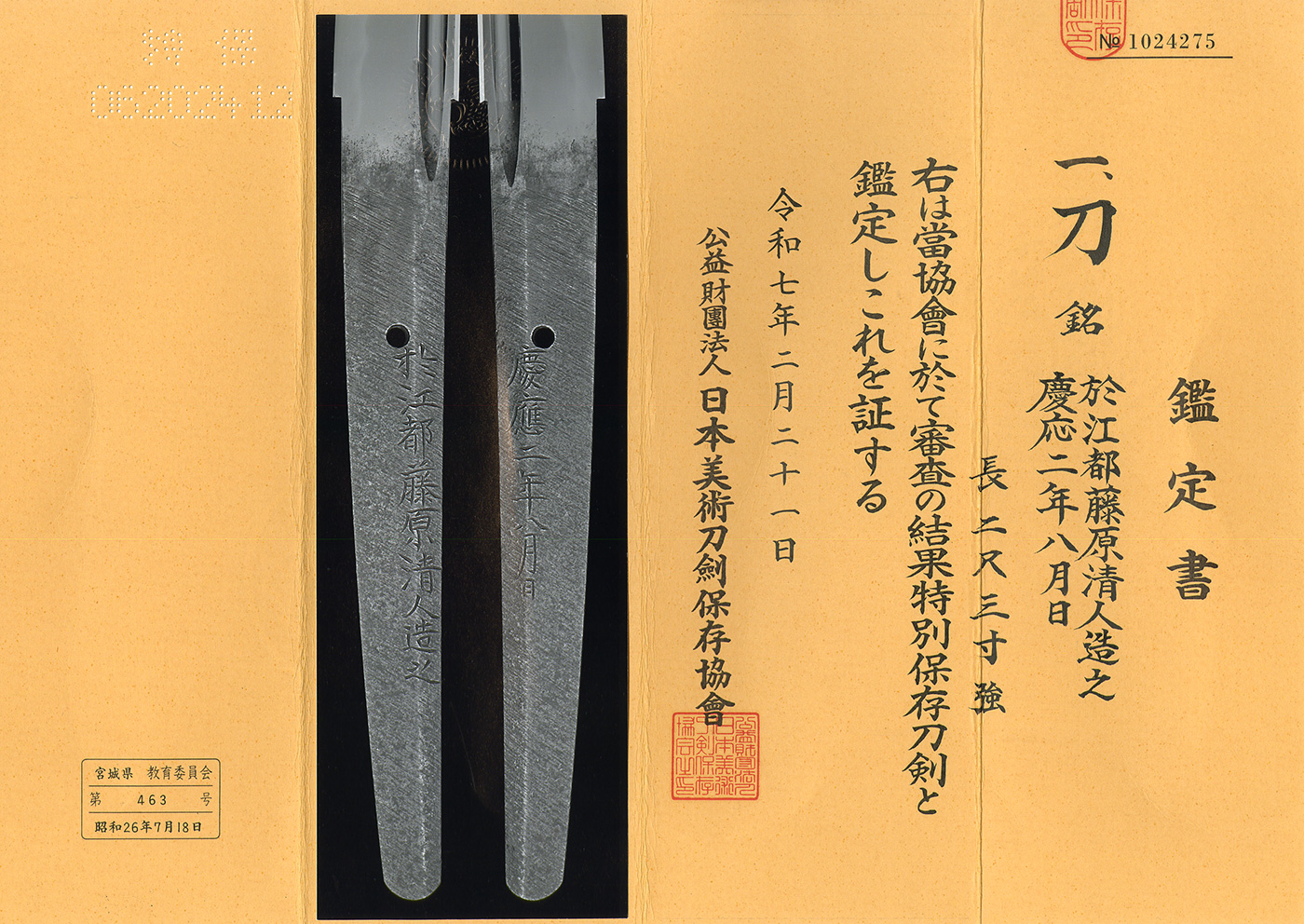
Katana in Shirasaya with Koshirae (NBTHK Tokubetsu Hozon Token).
Signature: Oite Koto Fujiwara Kiyondo Tsukuru Kore.
A day in August, Keio 2 (1866).
於江都藤原清人造之
慶應二年八月日
Shinshinto: Jyo Saku: Musashi.
(We divide 4 sections for each sword as Saijyo Saku, Jyojyo Saku, Jyo Saku and Regular Saku).
This work is ranked as Jyojyo Saku for Oite Koto Fujiwara Kiyondo.
Habaki: Gold-plated single habaki.
Blade Length: 70.3 cm (27.68 in).
Curvature: 1.36 cm (0.54 in).
Mekugi Hole: 1.
Width at Base (Motohaba): 3.26 cm (1.28 in).
Width at Yokote: 2.42 cm (0.95 in).
Thickness of rim (Kasane): 0.61 cm (0.24 in).
Sword Weight: 770 g.
Era: Edo period, around Keio era.
Shape: Wide mihaba with thick kasane, carved with bohi, and a long kissaki, forming a well-balanced shape.
Jigane: Well-refined Jigane
Hamon: Gunome-midare with a slightly rounded appearance; the boshi is midare-komi in the style reminiscent of his master Kiyomaro.
Features: After Kiyomaro’s death by suicide, it is said that there remained a considerable number of swords he had promised to deliver.
Kiyondo forged nearly 30 blades to repay these obligations on behalf of his master.
The inscription “Oite Koto” carved on the nakago by Kiyondo is extremely rare.
“Koto” is another name for Edo (present-day Tokyo).
In any case, his devotion to fulfilling his master’s commitments to the very end is truly admirable.
Koshirae:
Tsuba: Iron tate-maru shaped tsuba with raised rim, signed “Koreichi”.
Fuchikashira: The kashira is carved with a spiny lobster design with gold iro-e.
Saya (Scabbard): Vermilion and black lacquered saya with partial carved texture.
Menuki: Large menuki on shakudo nanako ground, carved with “Koreichi”.
Aoi Art’s Comment: Observing this koshirae evokes the era when Kiyondo created this work.
The menuki is engraved with “Koreichi,” and the large iron tsuba also bears the same signature.
There is no doubt this is a late Edo period work.
“Koto” is another name for Edo (present-day Tokyo), used to refer to the city under Tokugawa rule, and seen in works such as Hokusai’s “Thirty-Six Views of Mount Fuji: Mitsui Shop at Suruga-cho in Edo.”
It is also used in cultural contexts connecting Edo to modern Tokyo.
The long kissaki is characteristic of works favored by Kiyomaro, and similarly seen in works by his students Kiyondo and Kurihara Nobuhide.
His lifelong dedication to honoring his master’s promises is deeply moving.
Although the koshirae is not overly ornate, it carries significant meaning and may well have been made by Kiyondo himself.
There remains a slight initial edge, and the polish is in excellent condition.
We highly recommend preserving this piece together with its koshirae.
Historical Background: On August 20, Keio 2 (1866), the shogunate announced the mourning of Shogun Iemochi and proclaimed Tokugawa Yoshinobu as successor.
The following day, an edict was issued to suspend the war against Choshu under the pretext of Iemochi’s death.
Yoshinobu sought to govern through consultation with the daimyo.
NBTHK Tokubetsu Hozon Token.
AoiArt estimation paper: Whole Oshigata.
Please note: the price does not include the shipping fees.
Auction Starting Price:2,500,000JPY
Place Bid






Related Items:
 Katana:Bizen Suke Fujiwara Munetsugu Keio Gannen Hachigatsu Hi (August, 1865)(NBTHK Tokubetsu Hozon Token)
 Katana : Kun 4 Tou Kurihara Hikosaburo Akihide(NBTHK Hozon Token)(NBTHK Tokubetsu Kicho Token)
 Katana:Minamoto Moriyoshi (Mukansa Swordsmith). (NBTHK Tokubetsu Hozon Token)
 Katana: Naniwa ju Gassan Unryushi Sadakazu Kitae (Kokuin) (NBTHK Tokubetsu Hozon Token) (NBTHK Tokubetsu Kicho Token)
 Tachi:Osumi Toshihira Saku 大隈俊平作 (NBTHK Tokubetsu Hozon Token)
 Katana in Shirasaya with Koshirae (NBTHK Tokubetsu Hozon Token) Signature: Ishido Fujiwara Korekazu Seitan Kore