
Ordering Number: AS25748
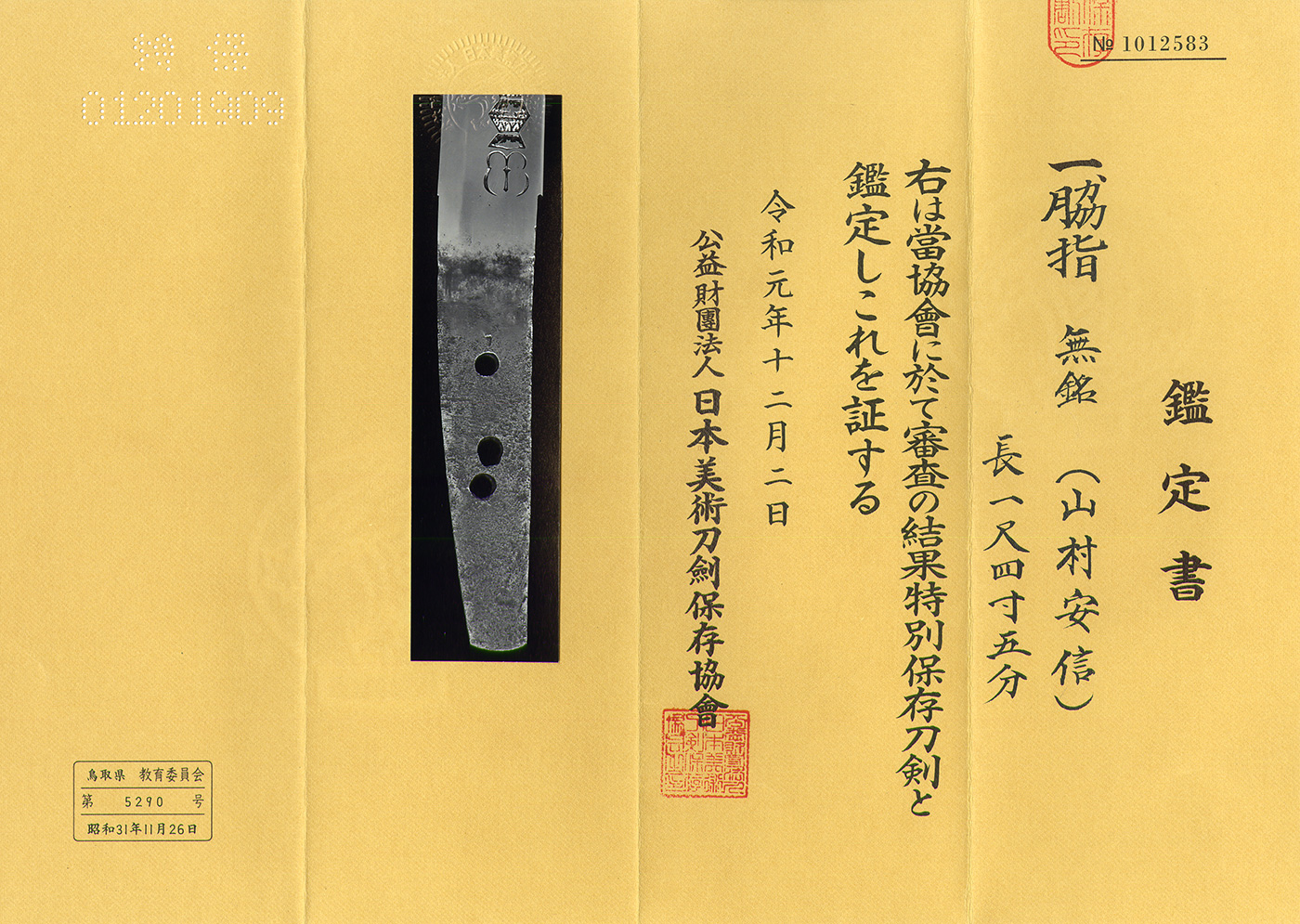
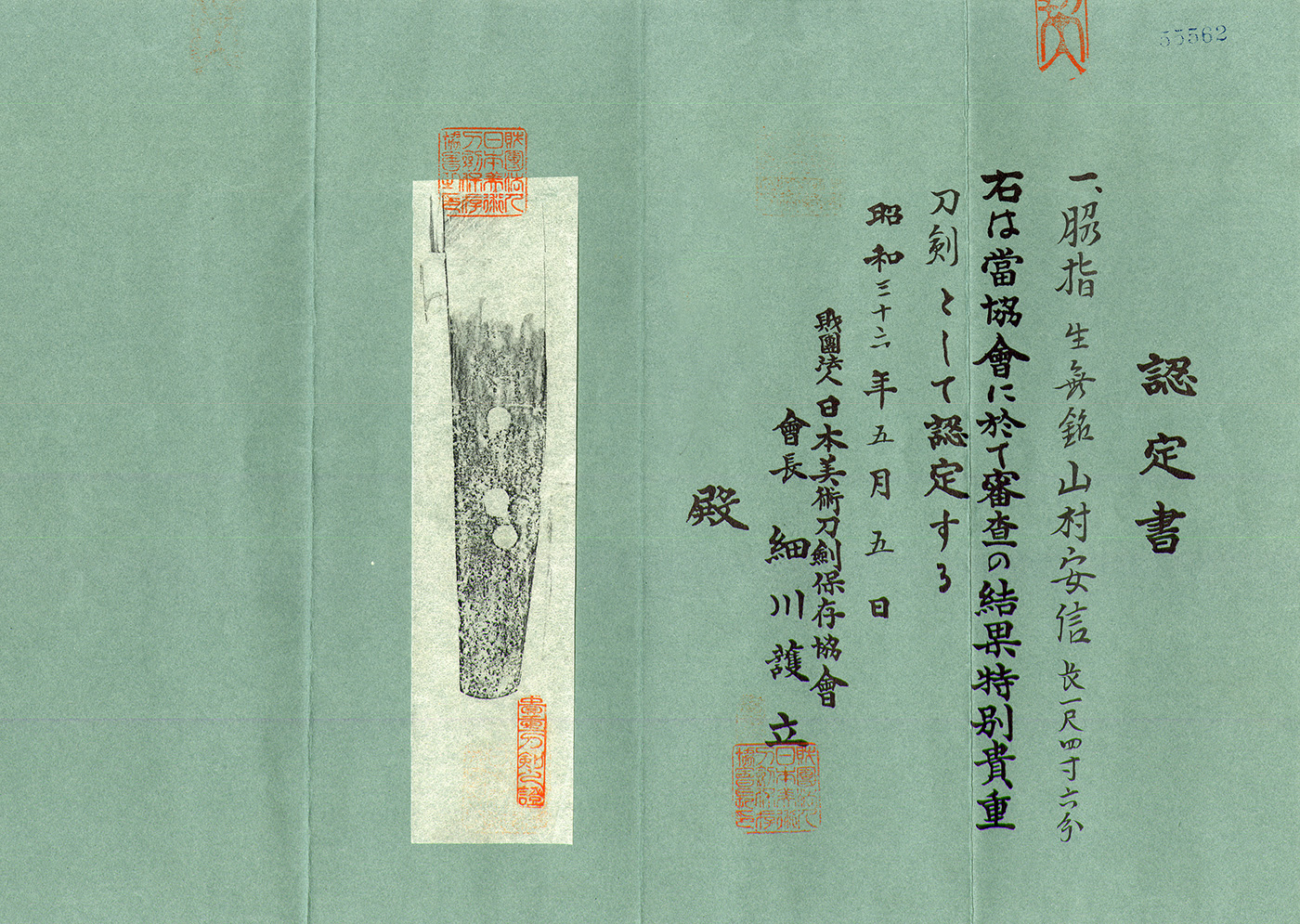
Wakizashi in Shirasaya, with Koshirae (NBTHK Tokubetsu Hozon Token) ((NBTHK Tokubetsu Kicho Token))
Signature: Mumei (Unsigned) (Yamamura Yasunobu)
無銘 (山村安信)
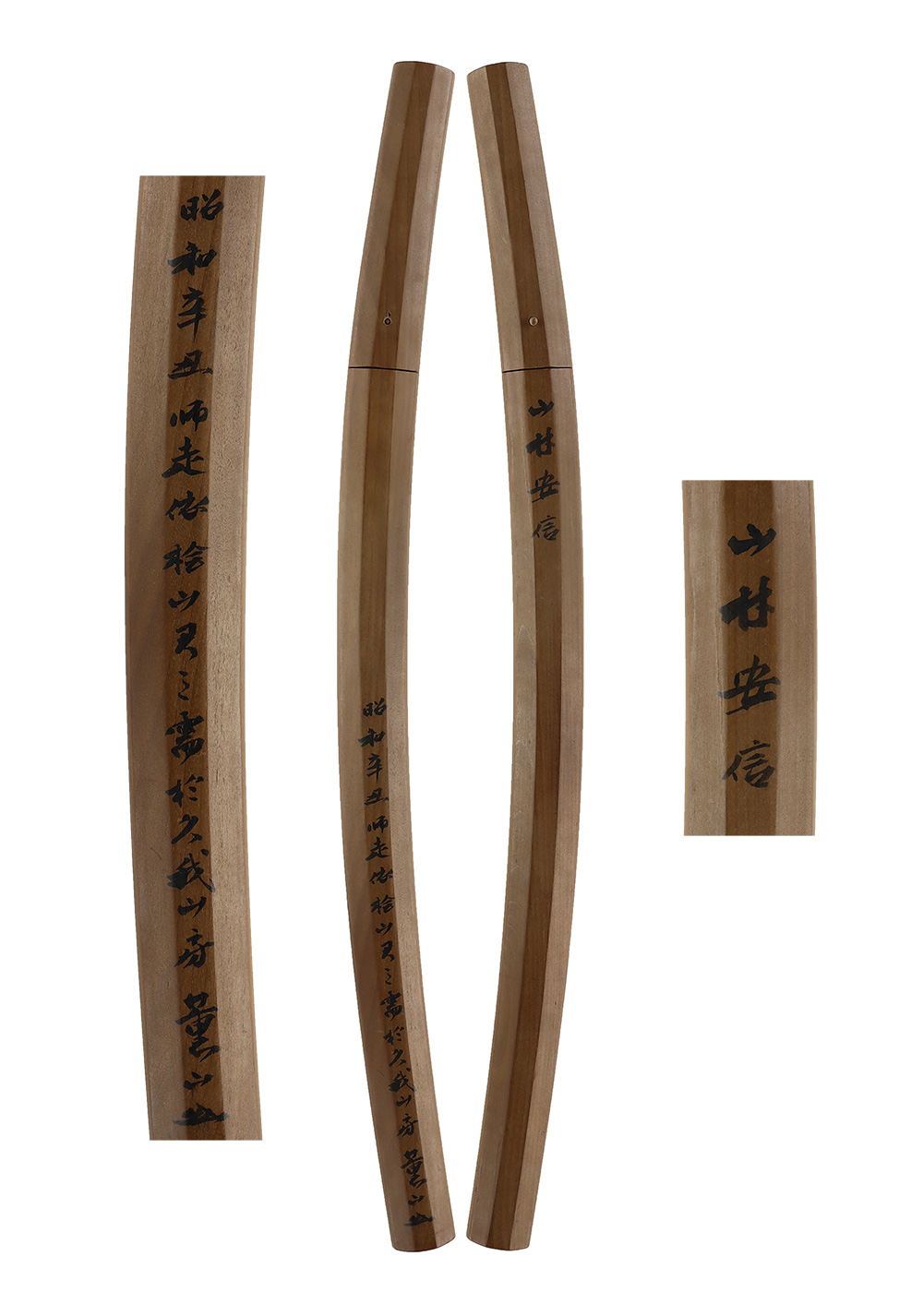
Sayagaki: Yamamura Yasunobu.
December, Showa Kanoto-Ushi (1961).
request of Mr. Hiyama.
At Kugasanbo.
Written by Dr. Kunzan (kao).
Chukoto: Chujo-saku: Etchu.
(We divide 4 sections for each sword as Saijyo Saku, Jyojyo Saku, Jyo Saku and Regular Saku).
This blade is ranked as Jyojyo Saku among swords designated NBTHK Tokubetsu Hozon Token.
Habaki: Single-layer gold-covered habaki.
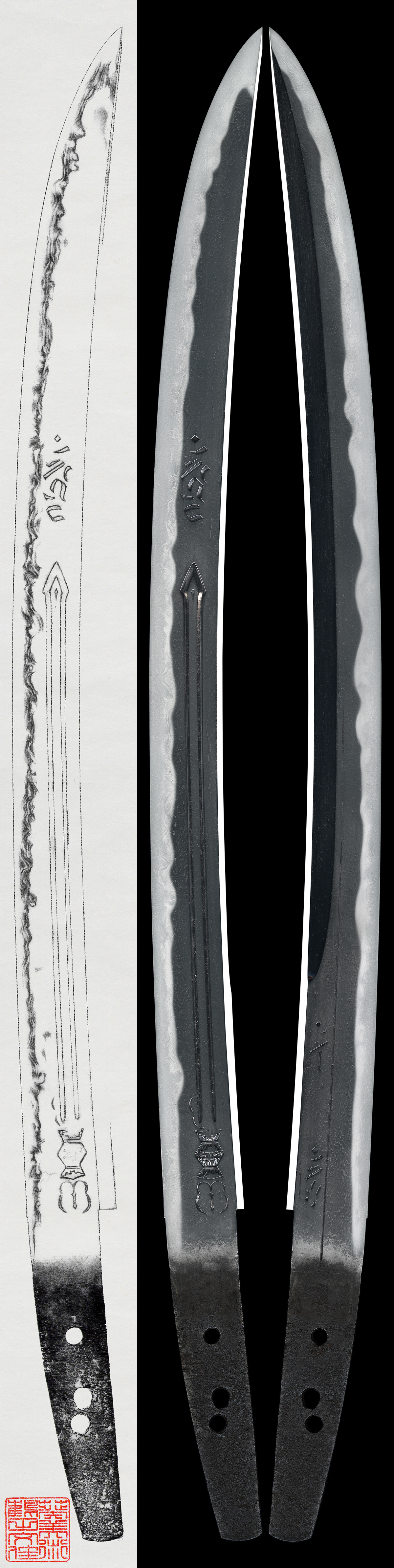
Blade Length: 44.0 cm (17.32 in).
Curvature: 1.2 cm (0.47 in).
Mekugi Hole: 3.
Width at Base (Motohaba): 2.81 cm (1.11 in).
Thickness of rim (Kasane): 0.57 cm (0.22 in).
Era: Muromachi period, around the Oei era (1394-1428).
Shape: Relatively thin kasane.
The omote is carved with a Sanskrit character, ken, and dokko.
The ura is carved with a Sanskrit character.
Jigane: Well-forged ko-itame hada producing a beautiful steel surface.
Utsuri appears clearly, and at first glance the workmanship resembles that of Morimitsu.
Hamon: Ko-nie-deki gunome-midare.
The boshi returns in a small round form (komaru).
Features: Yamamura Yasunobu was the son of Yamamura Masanobu.
It is said that members of the Yamamura school served as warriors while also engaging in sword forging.
He later used the names Masanobu and Nobukuni.
Koshirae:
Tsuba: Round brass tsuba carved with a design of clouds and a dragon.
A rare example of a Hirado tsuba.
Characters are engraved along the rim.
Signed: Hirado ju Kunishige zo.
Fuchikashira / Kurikata / Kaerizuno / Kojiri: Brass fittings carved with waves and dragons.
Saya (Scabbard): Black lacquered saya decorated with scattered straw motifs.
Menuki: Dragon in high relief with gold iroe.
Kozuka: Brass ground with nanako decoration and a carved plum tree design.
Including kogatana.
Historical Background: This work was made during the Muromachi period, around the Oei era, beginning in 1394.
The Muromachi Shogunate was established in Kyoto in 1338 by Ashikaga Takauji.
While continuing many policies of the Kamakura Shogunate, it flourished under the third shogun, Ashikaga Yoshimitsu, through the appointment of shugo daimyo to govern the provinces and through trade with Ming China.
The fourth shogun, Ashikaga Yoshimochi (in office: 1394-1423), is often associated with the cultural foundations of Japanese aesthetics that continue to influence modern Japan.
Although he was the legitimate son of Ashikaga Yoshimitsu, he was on poor terms with his father and refused entry to Ming envoys because of the tributary relationship with China.
He subsequently terminated trade and diplomatic relations with the Ming Dynasty.
The fifth shogun, Ashikaga Yoshikazu (in office: 1423-1425), became shogun at the age of 16.
Due to poor health and heavy drinking, he died at the age of 19.
After his retirement, Ashikaga Yoshimochi resumed responsibility for governmental affairs as acting leader.
NBTHK Tokubetsu Hozon Token.
NBTHK Tokubetsu Kicho Token.
AoiArt estimation paper: Whole Oshigata.
Overseas shipping charges are not included and will be charged separately.
Please note: the price does not include the shipping fees.
Auction Starting Price:480,000JPY
Sold




Related Items:
 Wakizashi:Kawabe Gihachiro Fujiwara Masahide (Kokuin). (NBTHK Tokubetsu Hozon Token)
 Wakizashi:Yamato Kami Yoshimichi (1st Generation) (NBTHK Tokubetsu Hozon Token)
 Wakizashi : (Orikaeshi-mei) Yoshimitsu (Province unknown, late Muromachi period).(NBTHK Hozon Token)
 Wakizashi: Daihoshi Hokyo Rai Kinmichi
 Wakizashi : Taira Nagamori 平長盛 (11th NBTHK Juyo Token)
 Wakizashi:Dewa Daijo Fujiwara Kunimichi(NBTHK Tokubetsu Hozon Token)