
Ordering Number: AS26028.
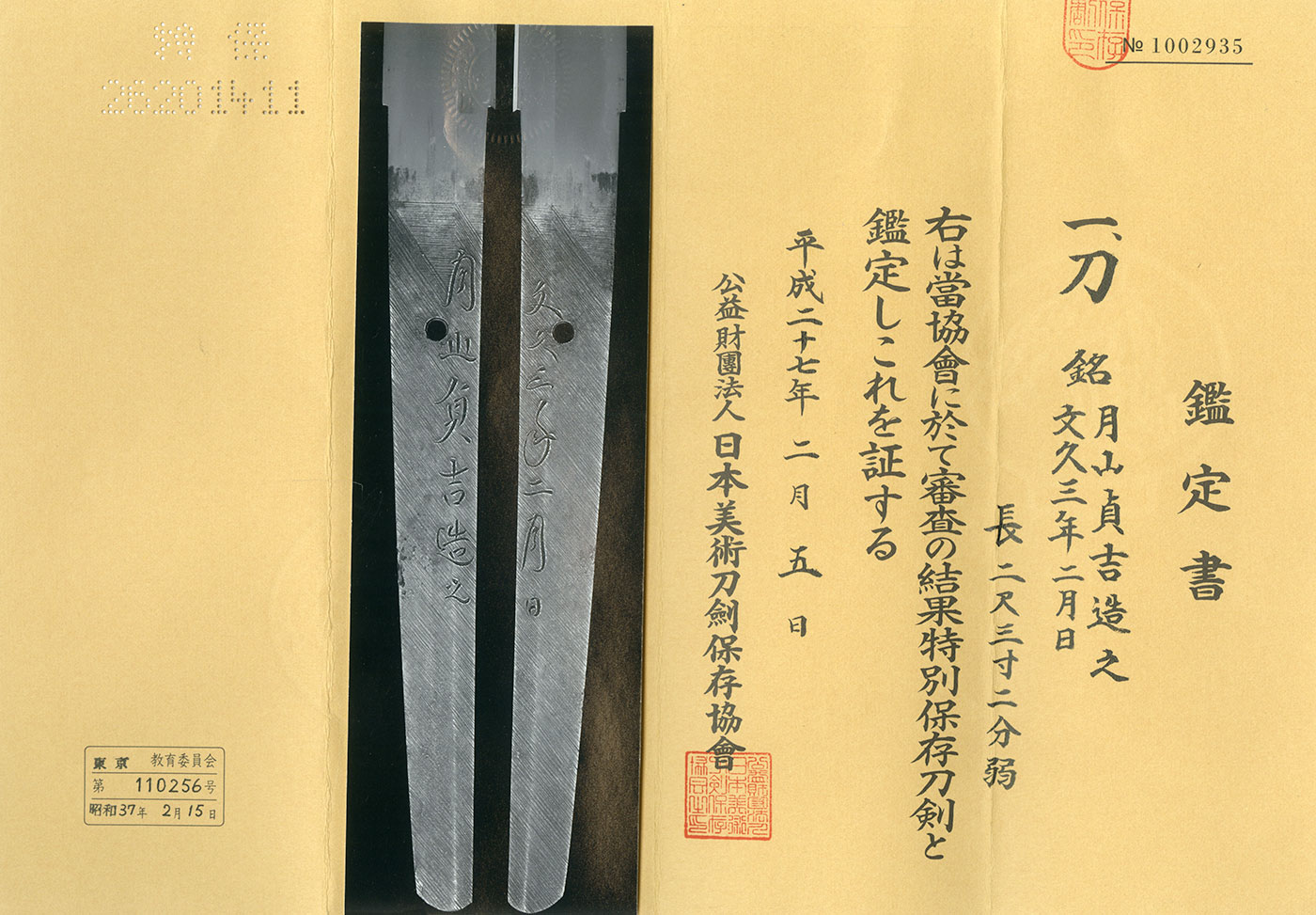
Katana in Shirasaya (NBTHK Tokubetsu Hozon Token) (Consignment Sale).
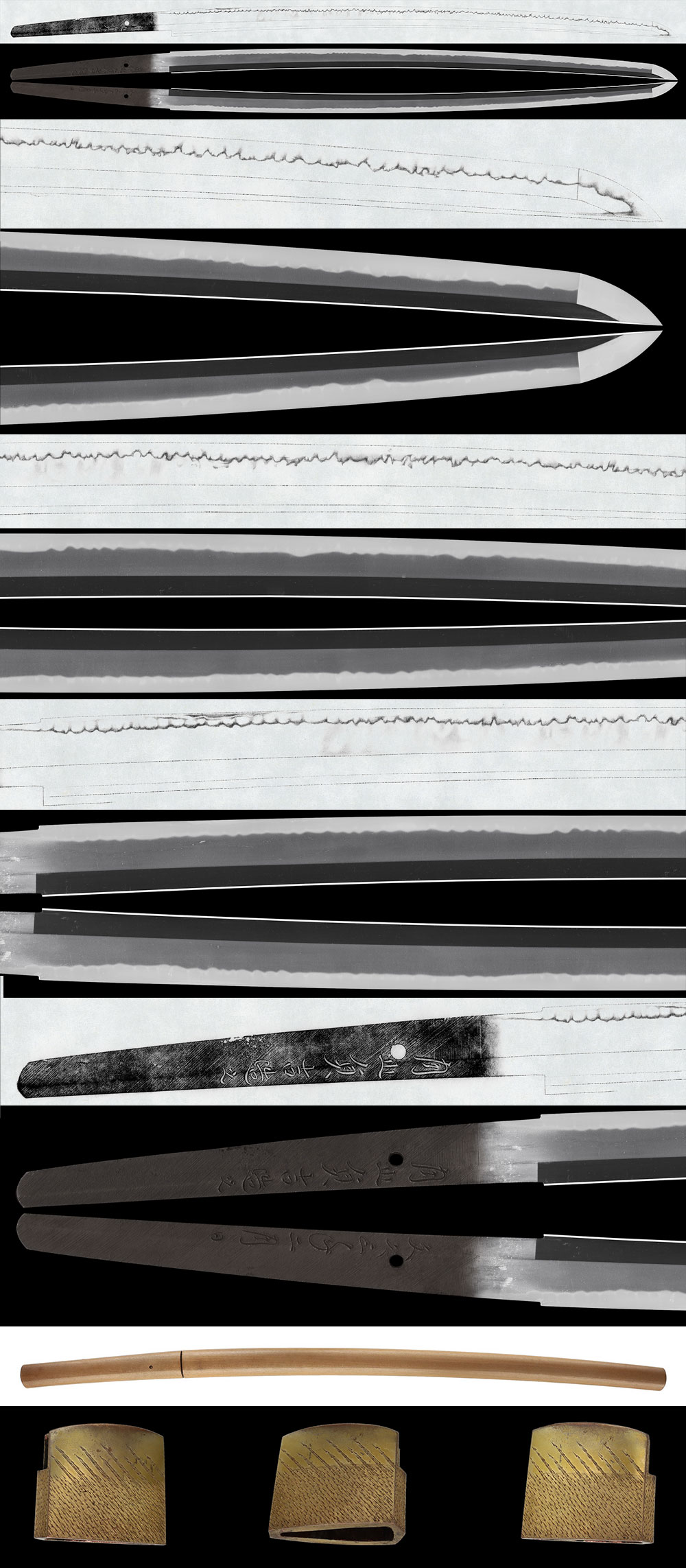
Signature: Gassan Sadayoshi Zo Kore.
Dated February, Bunkyu 3 (1863).
月山貞吉造之
文久三年二月日
Shinshinto: Jyo Saku: Settsu.
(We divide 4 sections for each sword as Saijyo Saku, Jyojyo Saku, Jyo Saku and Regular Saku).
This work is ranked as Jyojyo Saku for Gassan Sadayoshi.
Habaki: Single-layer plain copper with gold-colored finish.
Blade Length: 70.3 cm (27.68 in).
Curvature: 1.2 cm (0.47 in).
Mekugi Hole: 1.
Width at Base (Motohaba): 3.08 cm (1.21 in).
Width at Yokote: 1.97 cm (0.78 in).
Thickness of rim (Kasane): 0.65 cm (0.26 in).
Sword Weight: 700g.
Era: Late Edo period, around Bunkyu (1863).
Shape: Standard proportions in both mihaba and kasane.
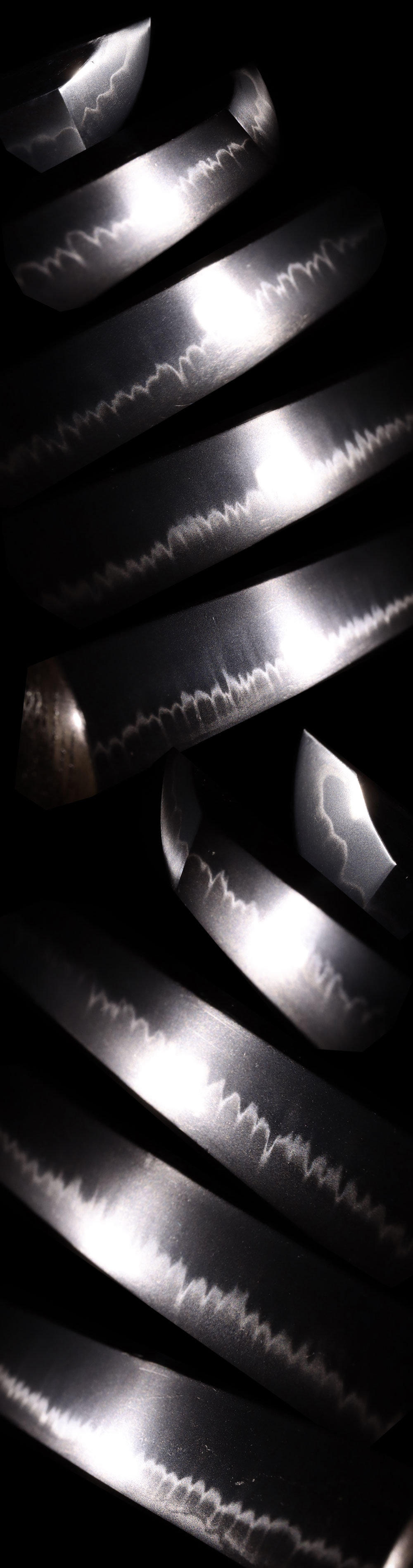
Jigane: Fine ko-itame well packed and thoroughly forged.
Hamon: Nioi-deki suguha with small ashi, with kinsuji working within the hamon. The boshi is midare-komi and returns in a rounded form.
Features: Gassan Sadayoshi was in the lineage of Dewa Gassan and Suishinshi Masahide, also known as Yahachiro, and resided in Osaka.
There exists a work dated Tenpo 6 (1835).
He passed away in Meiji 3 (1870) at the age of 70.
Gassan Sadayoshi was the teacher of Gassan Sadakazu and Gassan Sadakatsu, and is said to have taught Sadakazu the fundamentals.
It is thought that he repeatedly attempted to produce the Gassan-hada.
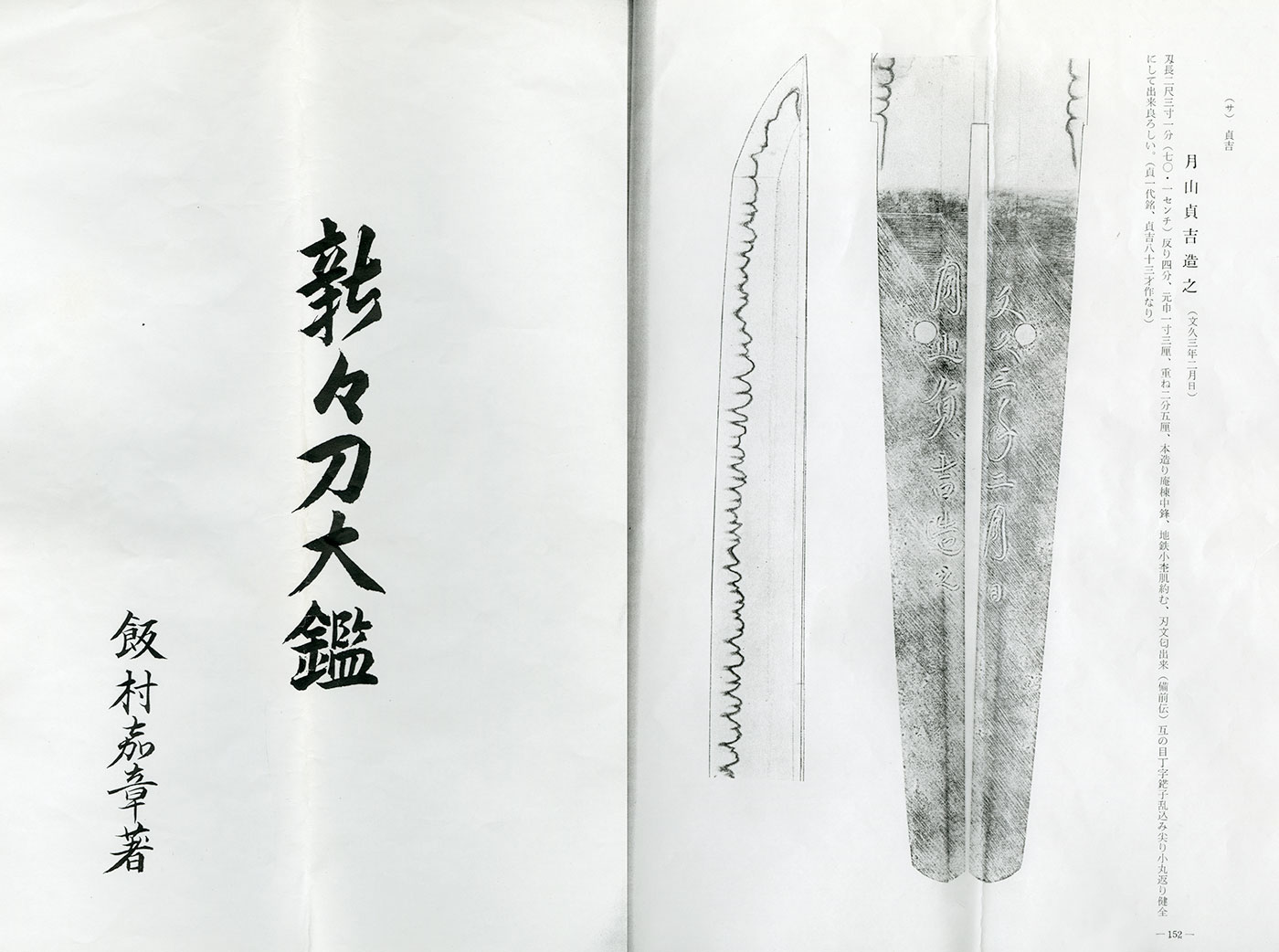
According to the Shinshinto Taikan, this work is considered a daimei (signed on behalf) by Sadakazu, made when Sadayoshi was 83 years old.
Historical Background: The Bunkyu era (1861–1864) of the Edo period corresponds to the turbulent Bakumatsu period, between the Man’en and Genji eras.
It was the time of Emperor Komei and the 14th shogun Tokugawa Iemochi.
Events such as the Bunkyu Reforms led by Shimazu Hisamitsu and the Coup of August 18 intensified the conflict between forces seeking to restore shogunal authority and those advocating opening the country or revering the emperor, placing this era at the height of political unrest.
Listed in Shinshinto Taikan, page 152.
NBTHK Tokubetsu Hozon Token.
AoiArt estimation paper: Whole Oshigata.
Please note: The price does not include the international shipping fees.
Auction Starting Price:1,000,000JPY
Place Bid



Related Items:
 Katana: Naniwa ju Gassan Unryushi Sadakazu Kitae (Kokuin) (NBTHK Tokubetsu Hozon Token) (NBTHK Tokubetsu Kicho Token)
 Katana:Osaka Ju Gassan Sadakatsu (Kao) (NBTHK Tokubetsu Hozon Token)
 Katana: Chōjusai Tsunatoshi (1863)(NBTHK Tokubetsu Hozon Token)
 Katana: Osaka Ju Gassan Sadakatsu Kinsaku (Kao)(NBTHK Tokubetsu Hozon Token)
 Katana: Oite Koufu Chojyusai Tsunatoshi Chounsai Koretoshi
 Katana:Naniwa Ju Gassan Sadakatsu Kinsaku (written seal mark) (NBTHK Hoozn Token)