
Ordering Number: AS26228
Tachi in Shirasaya with Koshirae (the 50th NBTHK Juyo Token)
Signature: Mumei (Unsigned) (Den Tametsugu 為継)
Koto: Wazamono: Jo-saku: Etchu: Oan.
(We divide 4 sections for each sword as Saijyo Saku, Jyojyo Saku, Jyo Saku and Regular Saku).
This blade is ranked as Saijyo Saku among the works attributed to Mumei (Den Tametsugu).
Habaki: Single gold-foiled habaki
Blade Length: 70.0cm (27.56in)
Curvature: 2.5cm (0.98in)
Mekugi-ana: 2
Motohaba: 3.10cm (1.22in)
Sakihaba: 2.08cm (0.82in)
Kasane: 0.78cm (0.31in)
Weight: 785g
Era: Nanbokucho period, circa 14th century
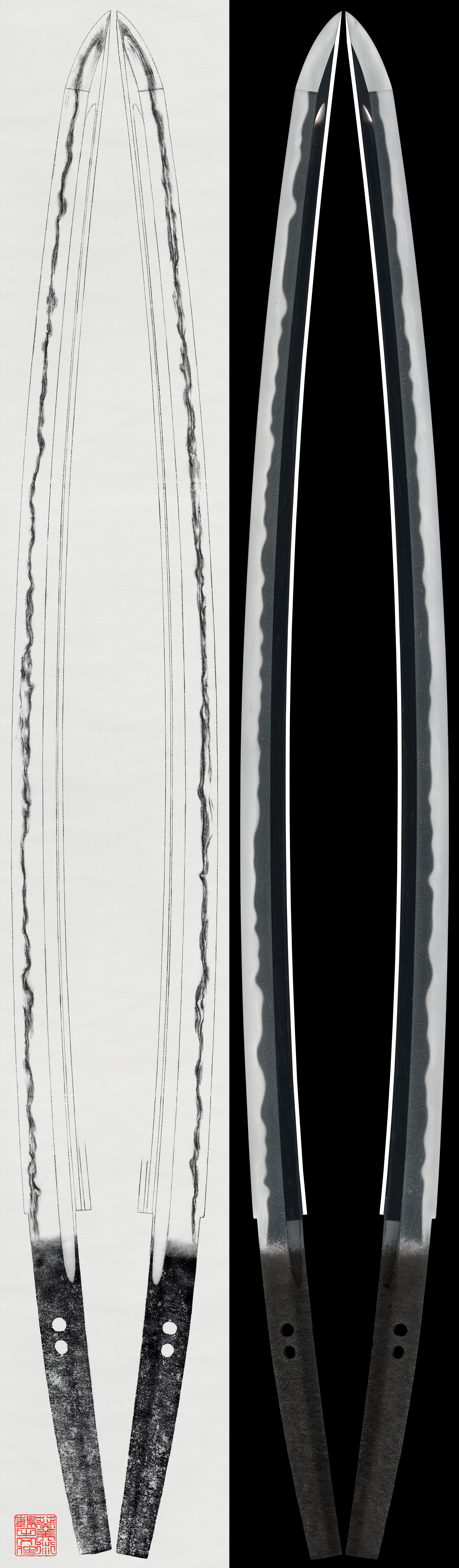
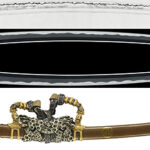
Shape: O-suriage mumei. Bohi grooves are carved on both sides of the blade. It has deep curvature and an elongated kissaki, resulting in a well-balanced and impressive shape. The blade has an iori-mune.
Jigane: Well-forged steel with a slightly dark appearance, the grain pattern clearly visible throughout.
Hamon: Nioi-deki with active chikei, while kinsuji are visible within the temper. The boshi shows sunagashi and hakikake activities.
Features: Tametsugu is said to have been either a disciple of Go Yoshihiro or of Norishige. He is also believed to have later moved to Fuwa District in Mino Province. This blade is an outstanding example of the Soshu tradition. The jigane displays a distinctive dark tone with abundant chikei, creating a remarkably dynamic appearance. The workmanship of this sword can truly be described as a masterpiece.
Koshirae: Han(half)-tachi koshirae
Tsuba: Round iron tsuba decorated with family crests and ornamental patterns in brass inlay. The rim is fitted with a brass fukurin.
Fuchikashira: Brass ground decorated with engraved patterns.
Kojiri: Brass ground decorated with engraved patterns.
Saya (Scabbard): Aogai-chirashi lacquered saya.
Menuki: Plum blossom design carved in brass.
Historical Background: In 1963, Japan was described as being in the midst of the Nanbokucho period, while in Europe it was a turbulent year in which the Ottoman Empire established its capital.
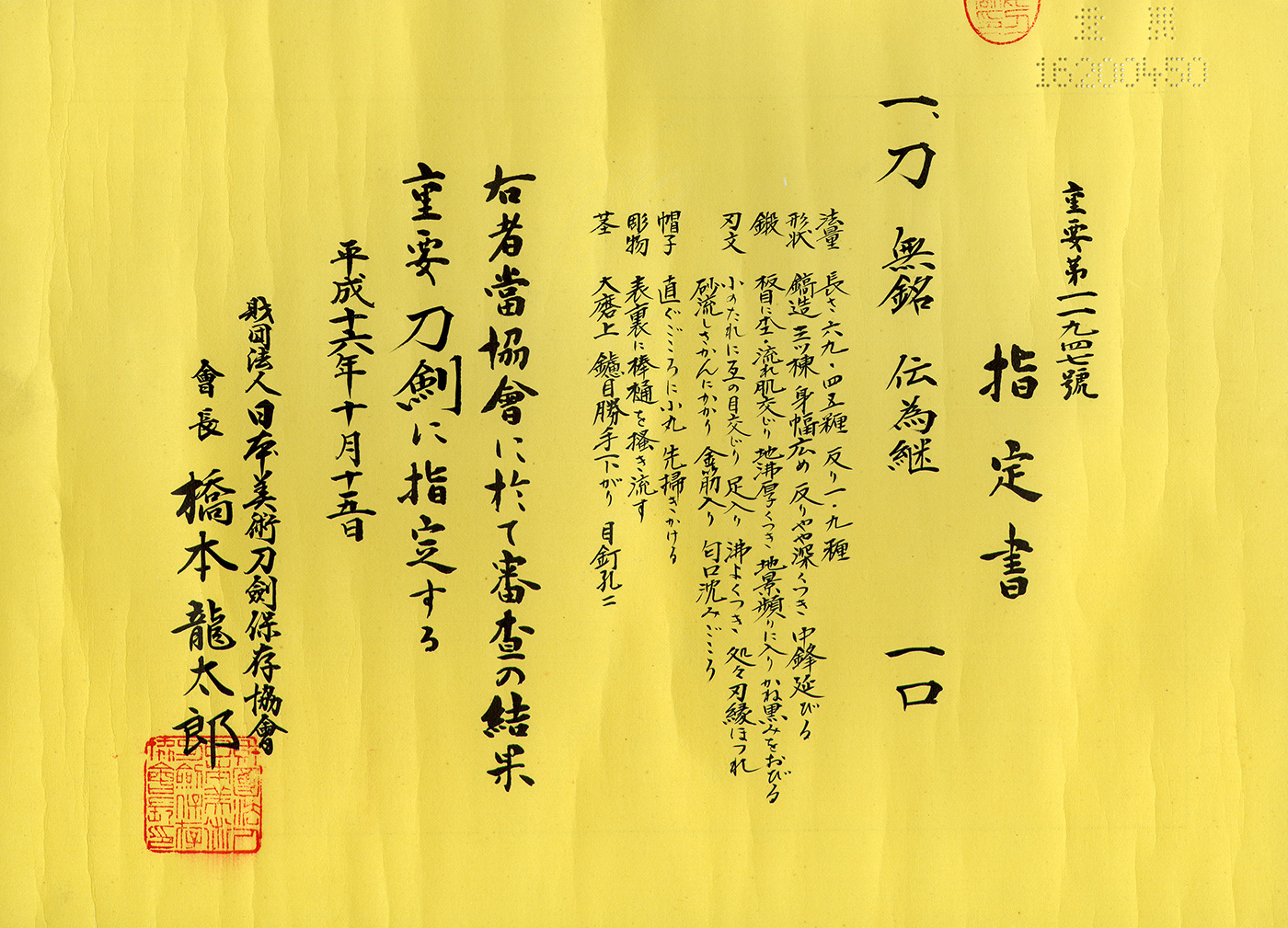
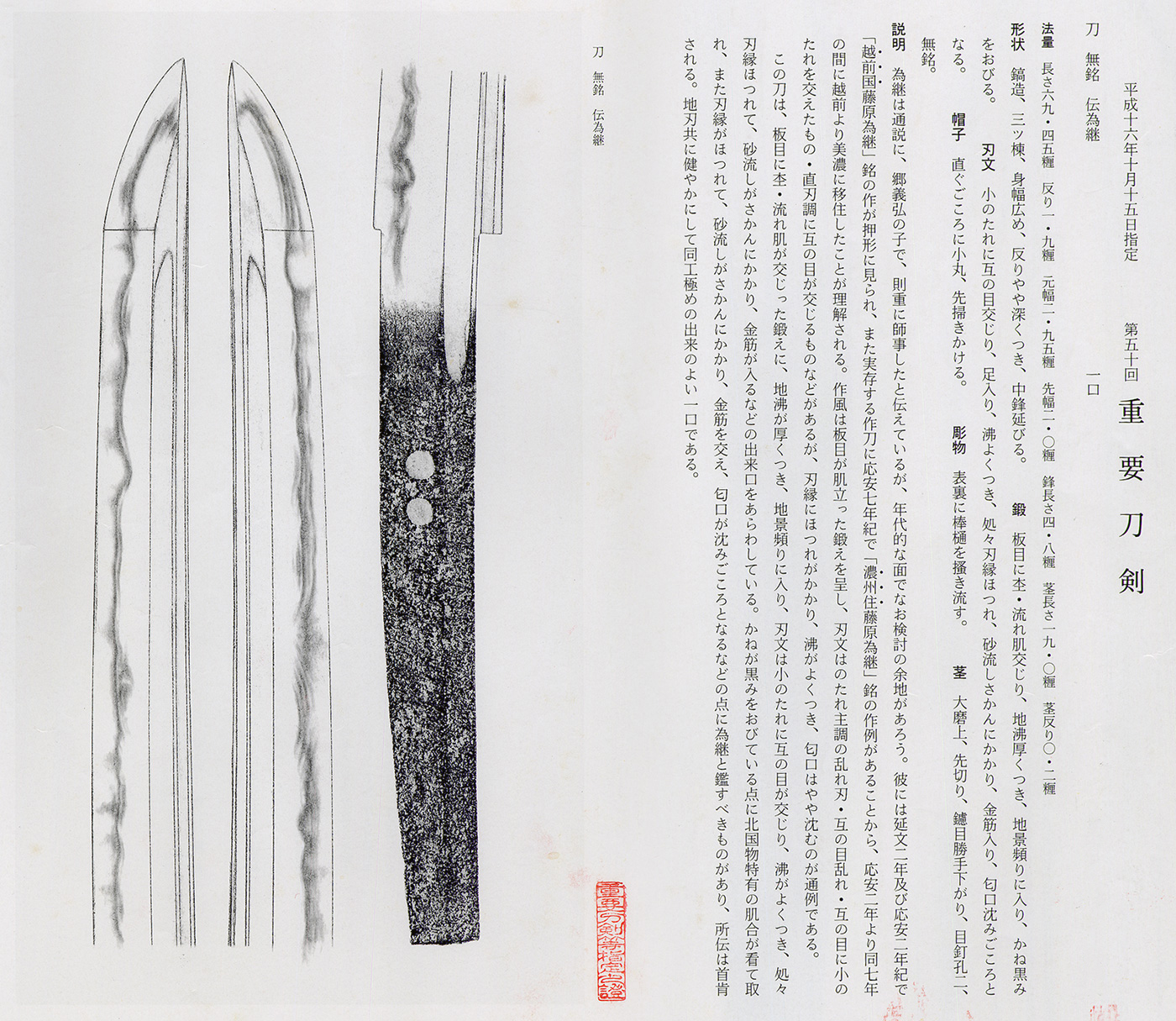
50th NBTHK Juyo Certificate
AoiArt estimation paper: Whole Oshigata
Please note: the price does not include the shipping fees.
Auction Starting Price:4,200,000JPY
Place Bid



Related Items:
 Katana: Mumei(Unsigned)(Nariie)(68th NBTHK Juyo Token)
 Tachi: Norinari (Ko-Ichimonji)(69th NBTHK Juyo Token)
 Katana:Mumei(Unsigned) (Sa Yoshisada 左吉貞) (65th NBTHK Juyo Token)
 Katana: Mumei(Unsigned) (Aoe school)(the 70th NBTHK Juyo Token)
 Katana: Mumei (Aoe school)(the 25th Juyo Token)
 Tachi : Bishu Osafune Yukihisa (NBTHK Tokubetsu Hozon Token)