
Ordering Number: 26051
Katana in Shirasaya(NBTHK Tokubetsu Hozon Token)
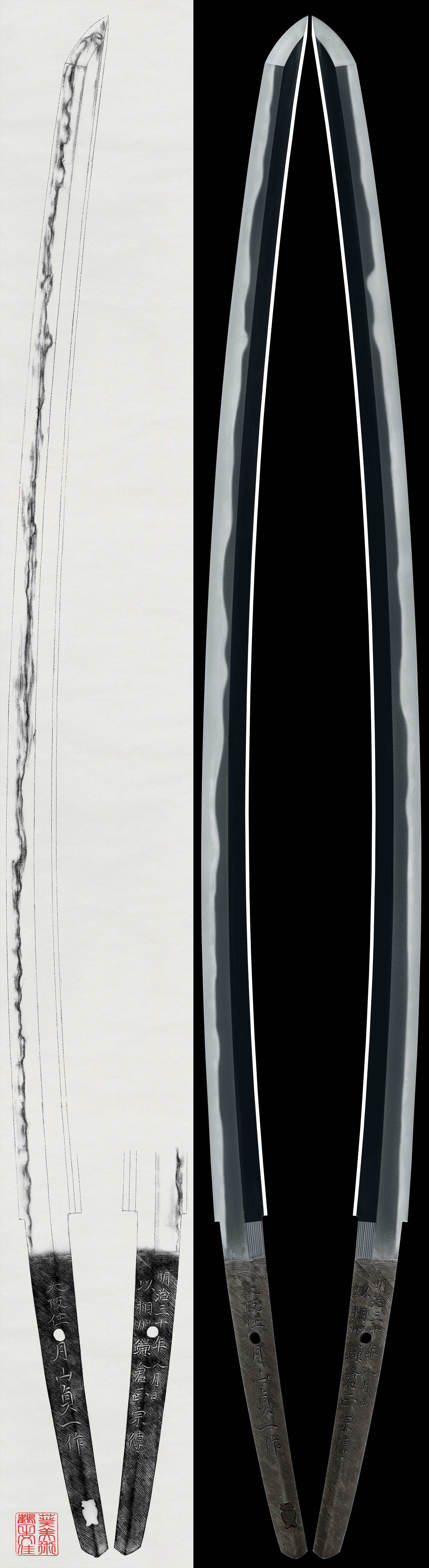
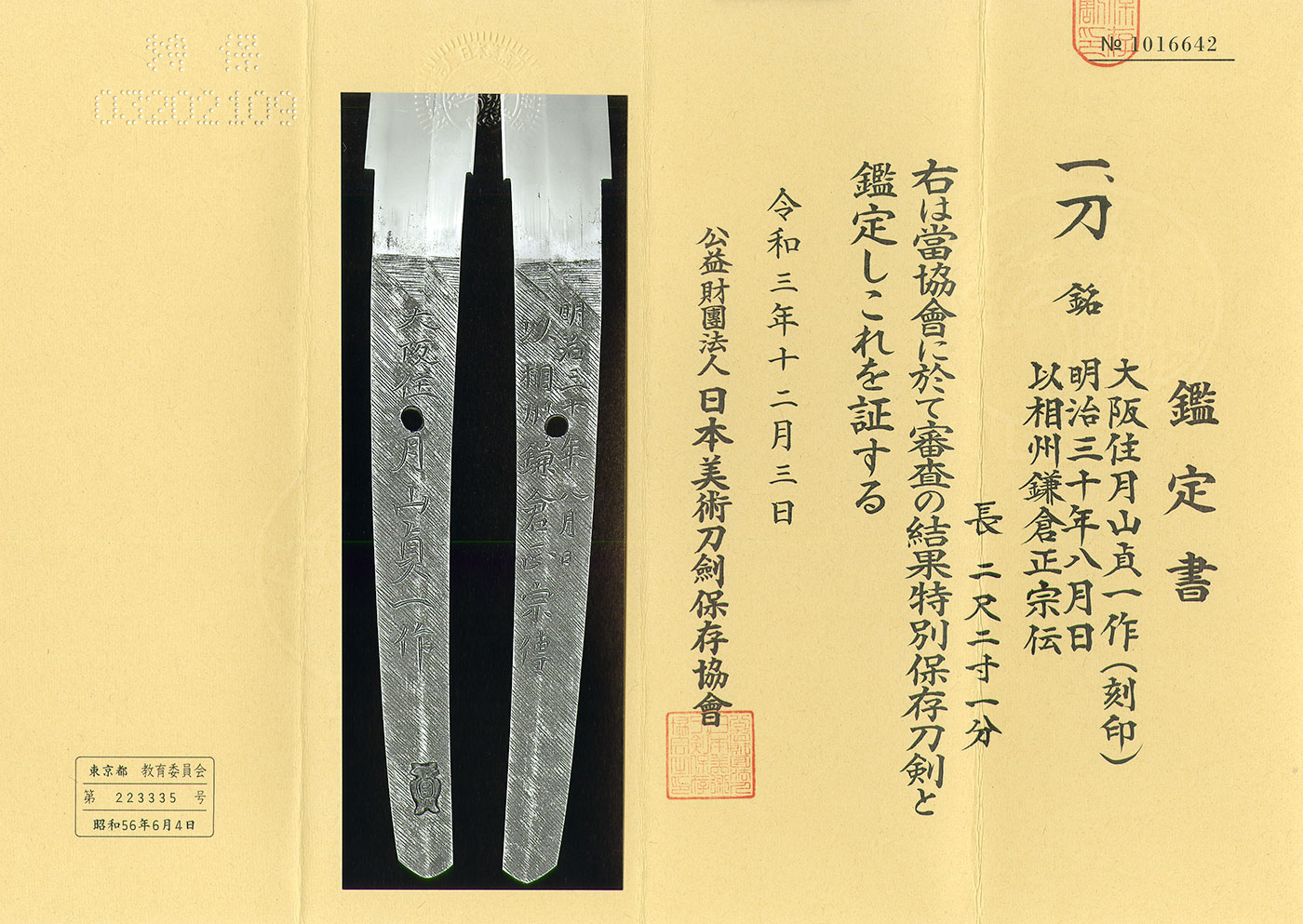
Signature : Osaka Gassan Sadakazu Saku(stamped)
Meiji 30 Nen 8 Gatsu Hi
Motte Soushu Kamakura Masamune Den
大阪月山貞一作(刻印)
明治三十年八月日 以相州鎌倉正宗伝
(Translation: Made by Osaka Gassan Sadakazu in August, Meiji 30. It was made by Soushu Kamakura Masamuneden.)
(We divide 4 sections for each sword as Saijyo saku, Jyo-jyo saku, Jyo saku, and regular saku)
This sword belongs to Jyo Jyo Saku ranking.
The blade was 26.37polished.
Habaki: Gold foiled double habaki.
Blade length: 67.0 cm or 26.37inches.
Sori:2.0 cm or 0.78inches.
Mekugi: 1
Width at the hamachi: 2.85cm or 1.12inches.
Width at the Kissaki: 2.0 cm or 0.78inches.
Kasane: 0.64 cm or 0.39inches.
The weight of the sword: 640 grams.
Era: Meiji 30.
Shape: the blade is broad and has longer Kissaki and Ububa left. Sori is deep and Kissaki is long: beautiful shape.
Jigane: Koitamehada filled with lines: finally becomes plain.
Hamon: Niedeki Gunomemidare. Ashi works well, Kinsuji also works. Boshi turns back round.
Special Feature:The word “Motte Soshu Kamakura Masamune Den” is engraved on the Nakago. Gassan Minamoto Sadakazu(Sadakazu the 2nd) was born in Meiji 40(1907) in Osaka-city, as the 3rd son of Gassan Sadakatsu. He started making swords at the age of 13. His first Mei is Sadamitsu. He exhibited his work for the first time in the 1st Osaka-city Art Institute Exhibition, and he got an award there, again for the first time. After that Japan has lost the WW2 and GHQ banned making swords. However, he opened a new Dojo in Miwa, Sakurai-city in Showa40. Next year, he succeeded the name “Sadakazu”, and he got the best award in Shinsaku Meitoten Exhibition in the 3 successive years. In Showa 46, he was accredited as the important intangible cultural property, and in Showa 54, he got the Order of the Rising Sun, Gold Rays with Rosette. He kept on making swords until Heisei 7.(1995) This work is a work after he had been accredited as the important intangible cultural property. The body is broad and thick, well balanced compared to the body. Jigane is clear and elaborate. It has an engraving of “Motte Soshu Kamakura Masamune Den”
From Aoi Art: From Meiji 28 til 28, the demands for the Gunto were really high because of a series of wars such as Russia-Japan War or China-Japan War. When Gassan Sadakatsu became 70 years old, Gassan Sadakatsu made almost all the works instead of his father. Fortunately, Sadakatsu had mastered Soshuden, Masamekitae, Gassan Ayasugihada, and Soshu Kamakura Masamuneden like this work, so he could succeed his father. However, those days Sadakazu haven’t quitted yet.
NBTHK Tokubetsu Hozon Token
Aoi Art estimation paper: whole Oshigata
Please note: The price does not include the international shipping fees.
Price:2,500,000JPY
Order Form




Related Items:
 Katana: Naniwa ju Gassan Unryushi Sadakazu Kitae (Kokuin) (NBTHK Tokubetsu Hozon Token) (NBTHK Tokubetsu Kicho Token)
 Tachi: Naniwa Ju Gassan Sadakatsu Kinsaku (1937) (NBTHK Tokubetsu Hozon Token)
 Katana: Mumei(Unsigned) (Den Shintogo)(NBTHK Tokubetsu Hozon Token)
 Katana: Mumei (Unsigned)(Yamato-Shizu) (16th NBTHK Juyo Token)
 Tachi:Sueyuki (Den Bungo, Late Kamakura period)(NBTHK Tokubetsu Hozon Token)
 Katana: Chikushu Ju So Tsutomu(NBTHK Tokubetsu Hozon Token)