
Ordering Number:25777.
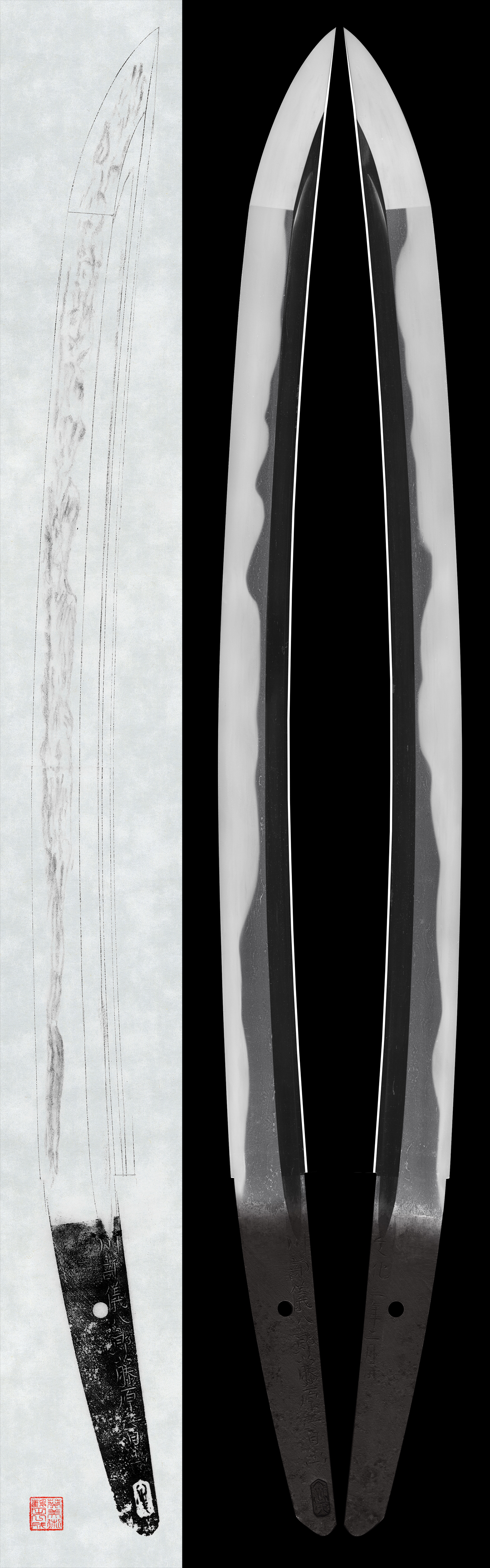
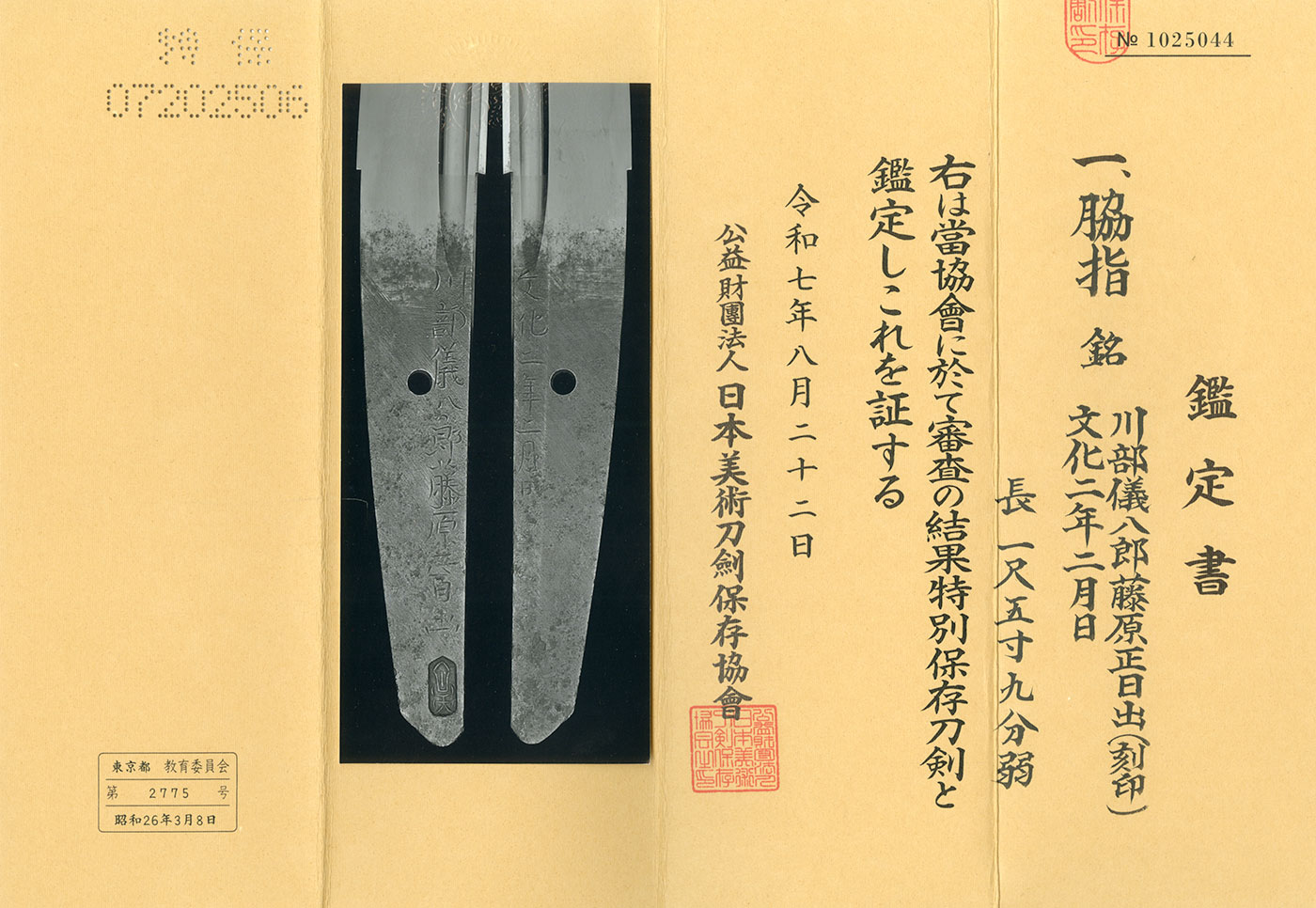
Wakizashi: in Shirasaya (NBTHK Tokubetsu Hozon Token).
Signature: Kawabe Gihachiro Fujiwara Masahide (Kokuin).
Dated March, 1805.
川部儀八郎藤原正日出(刻印)
文化二年三月日
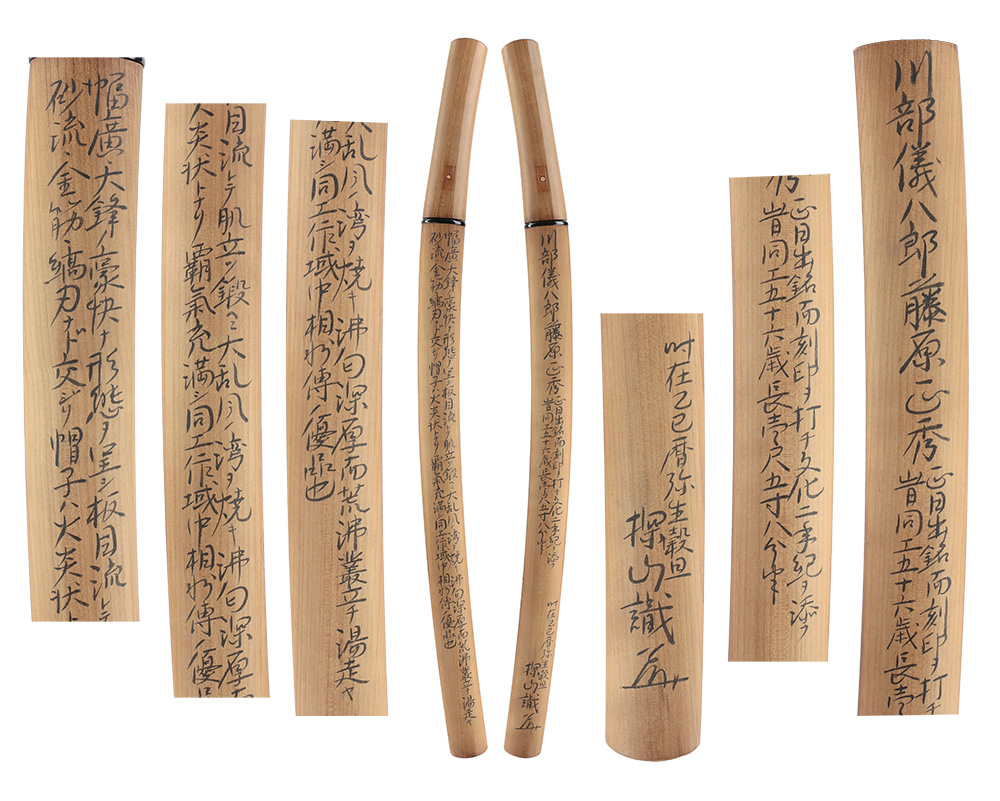
Sayagaki: Mr.Tanobe-sensei.
Kawabe Gihachiro Fujiwara Masahide, bearing inscription and stamped mark, with a date of 1805.
At age 56, blade length 1 shaku 5 sun 8 bu han.
Written in the year of Kinoto-mi, third month, by Tanzan (kao).
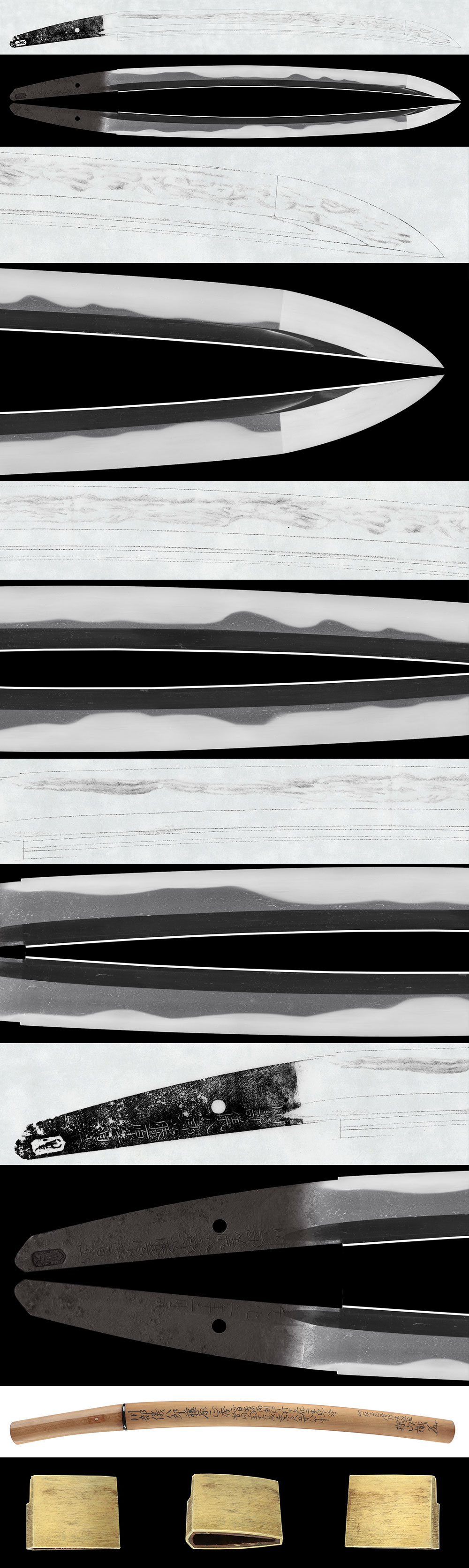
It shows a bold shape with wide width and large kissaki, flowing itame hada standing out, with a large midare-style notare hamon, deep nioiguchi with strong nie activity, including yubashiri, sunagashi, kinsuji, and striped temper patterns, and a boshi forming a flame-like shape, full of vigor, representing an उत्कृष्ट Soshu tradition work among his oeuvre.
Shinshinto: Saijyo Saku: Musashi.
(We divide 4 sections for each sword as Saijyo Saku, Jyojyo Saku, Jyo Saku and Regular Saku).
The workmanship of this piece is ranked as Jyojyo Saku for Kawabe Gihachiro Fujiwara Masahide.
Habaki: Gold-plated single layer.
Blade Length: 1 shaku 5 sun 9 bu 0 rin.
Curvature: 4 bu 0 rin.
Mekugi Hole: 1.
Width at Base (Motohaba): 3.28 cm (1.29 in).
Width at Tip (Sakihaba): 2.91 cm (1.15 in).
Thickness of rim (Kasane): 0.66 cm (0.26 in).
Sword Weight: 500 g.
Era: Edo period, Bunka era (1805).
Shape: Wide mihaba with thick kasane, bohi carved on both sides, and a large extended kissaki.
Jigane: Fine ko-itame hada, tightly forged, producing a refined steel surface.
Hamon:Notare hamon is tempered. Sunagashi and kinsuji are present.
Features: Kawabe Gihachiro Fujiwara Masahide was a retainer of the Yamagata domain in Uzen, also known as Kawabe Gihachiro.
Aoi Art’s Comment: Early works of Kawabe Gihachiro Fujiwara Masahide often feature deep nioiguchi and a bold style. In his later period, smaller gunome-midare patterns become more common. This is considered to be a result of his intention to prevent breakage rather than for aesthetic appreciation. This work has a wide mihaba, thick kasane, a three-ridge construction, bohi carvings, and a large extended kissaki, forming a solid and top-class masterpiece.
Historical Background: Bunka 2 corresponds to 1805. It is an era in the late Edo period, under the rule of the 11th shogun Tokugawa Ienari, and corresponds to the zodiac year of Kinoto-Ushi. This was a time when townspeople culture (Kasei culture) flourished. This is an early work of Masahide.
NBTHK Tokubetsu Hozon Token.
AoiArt estimation paper: Whole Oshigata.
Please note: The price does not include the international shipping fees.
Price:1,750,000JPY
Order Form



Related Items:
 Wakizashi:Banshu Tegarayama Roku Fujiwara Ujishige Seitan Saku A day in the 2nd month of An'ei 5 (1776) Made for Koizumi Sadayoshi (NBTHK Tokubetsu Hozon Token)
 Wakizashi:Ozaki Nagato no Kami Fujiwara Suketaka A day in the eighth month of Kansei 11 (1799). (NBTHK Tokubetsu Hozon Token)
 Wakizashi: Ushu Shonai Ju Naokazu An Auspicious Day in October, Keiō 2, Hinoe-Tora (1866) (NBTHK Tokubetsu Hozon Token) (NBTHK Tokubetsu Kicho Token)
 Wakizashi:Naniwa Gassan Unryushi Sadakazu Kokuin 浪華月山雲龍子貞一刻印 Keio 1 Nen 10 Gatsu Hi (October 1865) 慶応元年十月日 (NBTHK Tokubetsu Hozon Token)
 Wakizashi:Dewa Kami Fujiwara Sukenobu (NBTHK Tokubetsu Hozon Token)
 Wakizashi:Dewa Daijo Fujiwara Kunimichi(NBTHK Tokubetsu Hozon Token)