
Previous answer is
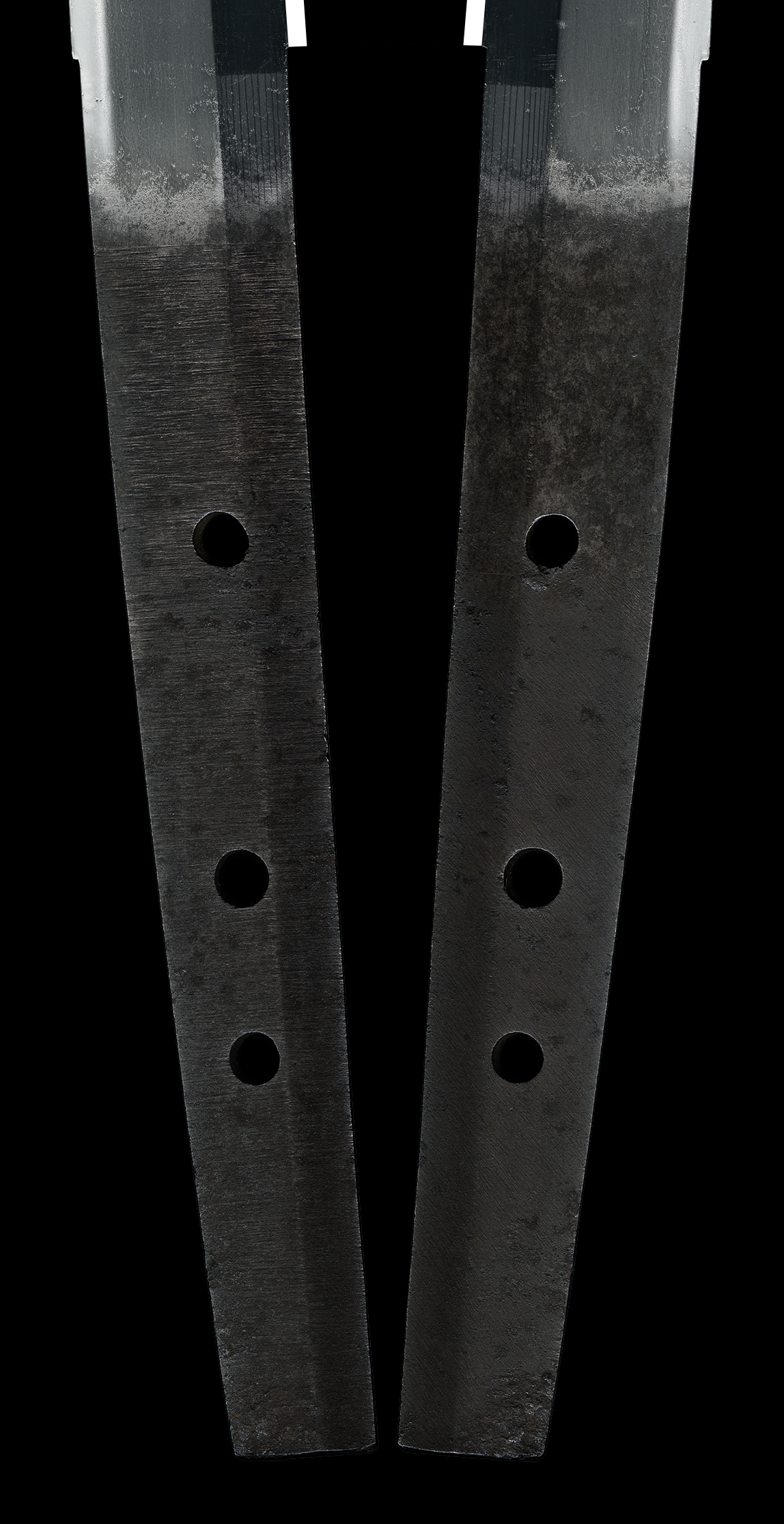
Mumei(Unsigned) (Tegai)
無銘(手掻)
Features: The Yamato Tegai school is said to have originated from swordsmiths who resided outside the Tengaimon gate in front of Todaiji Temple in Nara and were likely affiliated with the temple. The founder of the Tegai school is considered to be Kanenaga of the mid Kamakura period. The school prospered the most among Yamato traditions and is characterized by bright and clear jigane with strong nie activity.
This work is not merely a simple suguha; it shows active ko-ashi and yo, with kuichigai-ba and a deep nioiguchi. The hamon resembles that of Kanenaga of the Tegai school. A faint utsuri appears, giving the blade an elegant and refined impression.
=====================================
Appraisal Quiz #890 (March 28tht, 2026)
Who made this sword do you think ?
=====================================


Blade Length: 72.1 cm (28.39 in)
Curvature: 1.4 cm (0.55 in)
Mekugi Hole: 2
Width at Base (Motohaba): 3.11 cm (1.22 in)
Width at Tip: 2.06 cm (0.81 in)
Thickness of rim (Kasane): 0.64 cm (0.25 in)
Sword Weight: 680 g
Shape: Slightly wide blade with solid thickness, good length, and well-proportioned shape. Bo-hi grooves (futasuji-hi) are carved on both sides.
Jigane: Fine itame well forged with visible utsuri.
Hamon: Nie-based, with gunome-midare mixed with choji-midare. The temper line becomes irregular toward the kissaki, showing variation in height and forming a well-executed work.
=====================================
Answer will be posted at next Appraisal Quiz.
=====================================
(Please acknowledge not replying to mail about Appraisal Quiz by our convenience.)