
Ordering number:25727
Wakizashi: Shirasaya with Koshirae (NBTHK Tokubetsu Hozon Token)
Signature: Chikuzen Daijo Fujiwara NaoTane (Kao) (Engraved with “Oshiteru”)
Date: February, Koka 4 (1847)
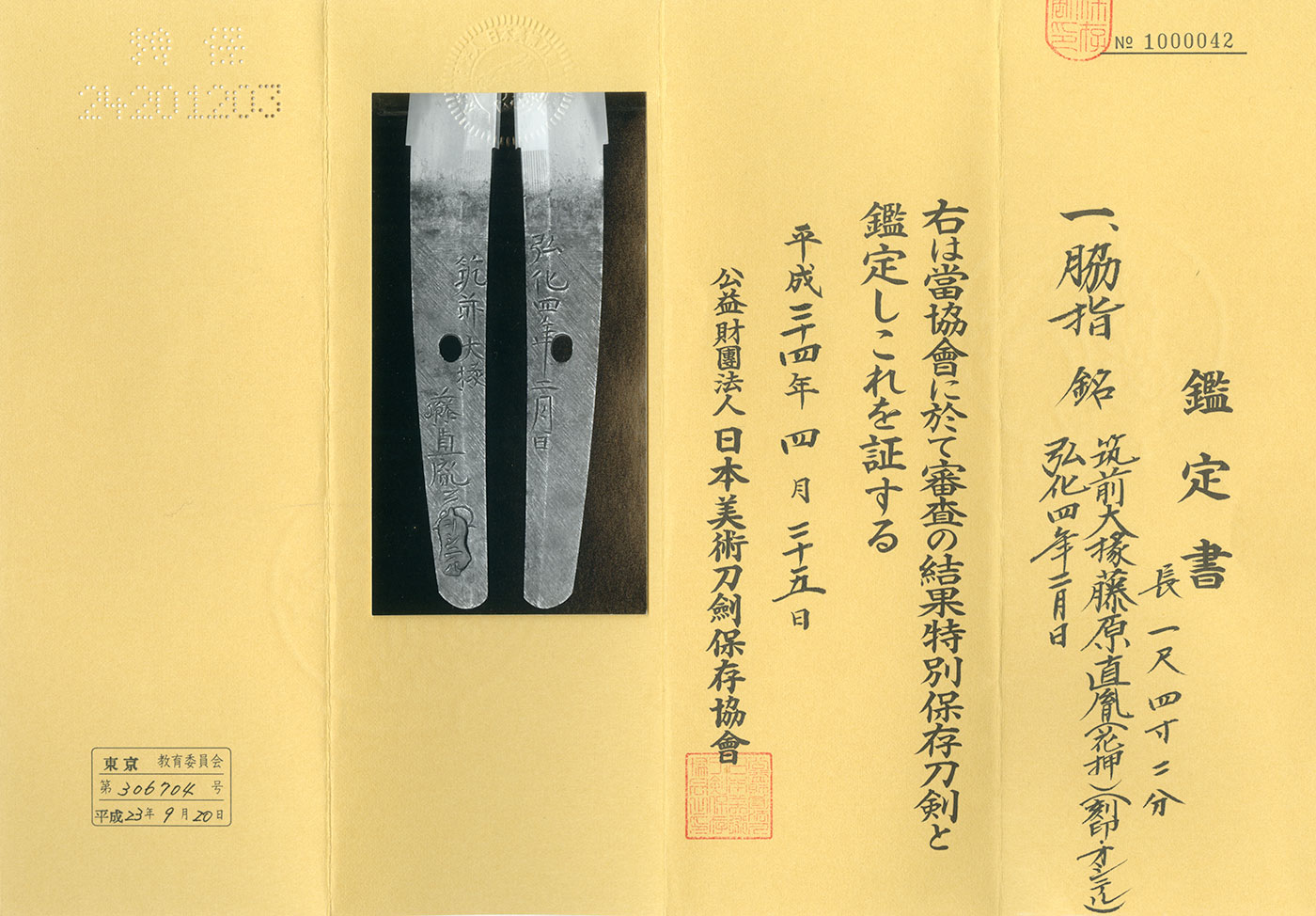
筑前大掾藤原直胤(花押)(刻印・オシテル)
弘化四年二月日
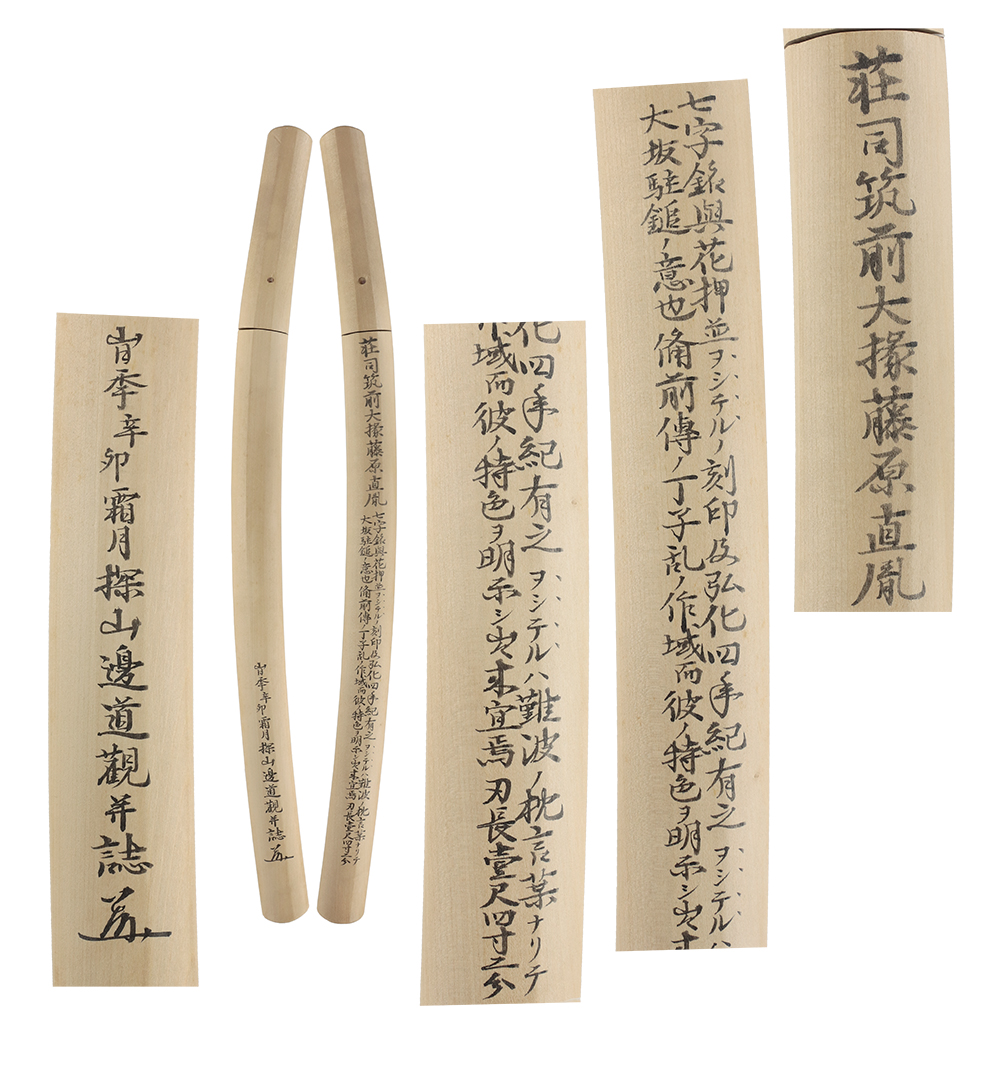
Sayagaki by Mr. Tanobe:
Shoji Chikuzen Daijo Fujiwara Naotane.
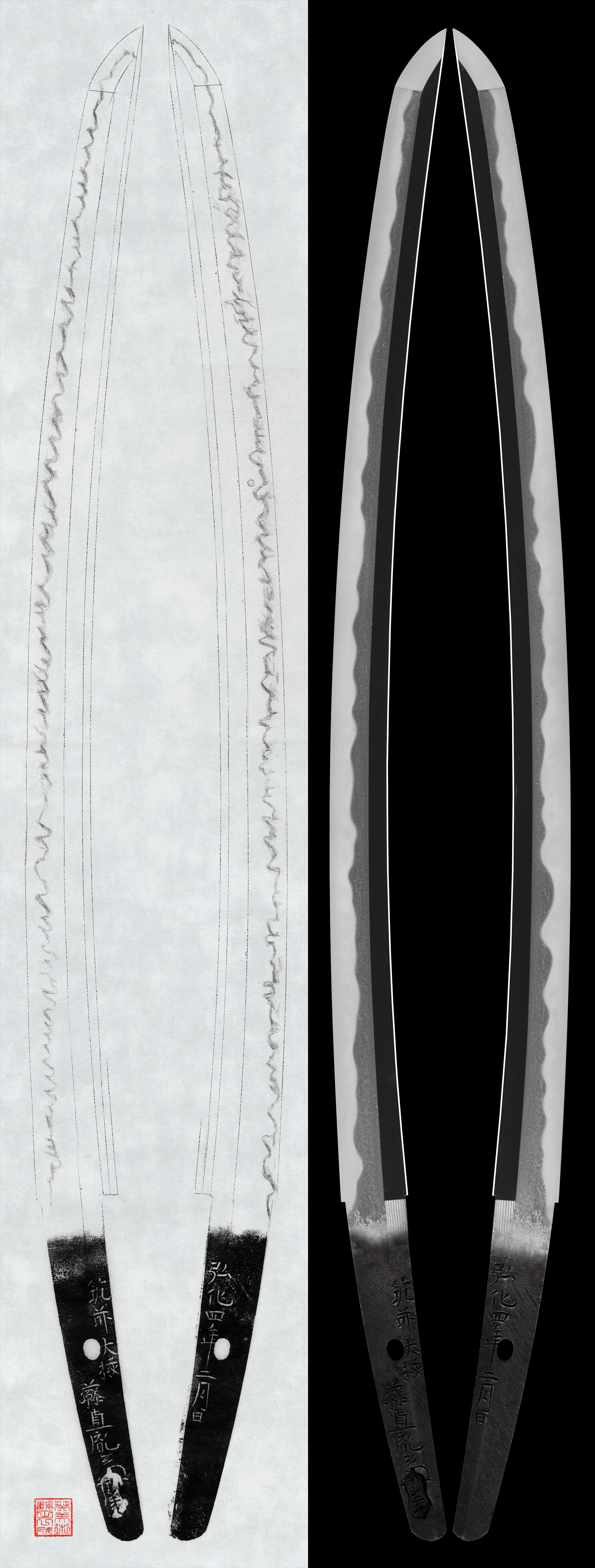
The seven-character mei, kao, and the engraved mark “Oshiteru” as well as the inscription of Koka 4 are present.
“Oshiteru” is a pillow word for Naniwa (Osaka), indicating that he was stationed there.
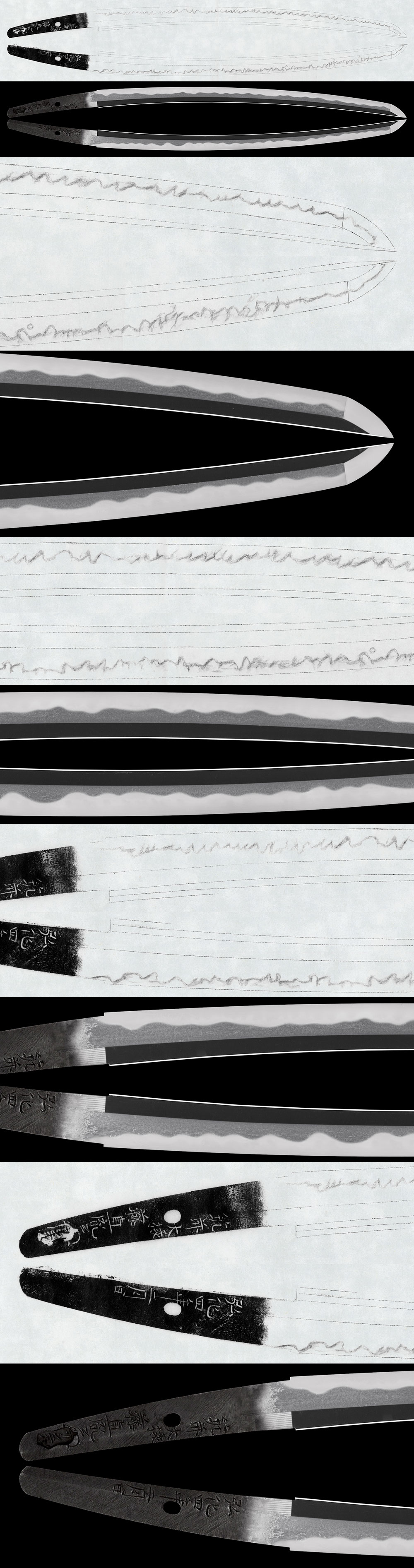
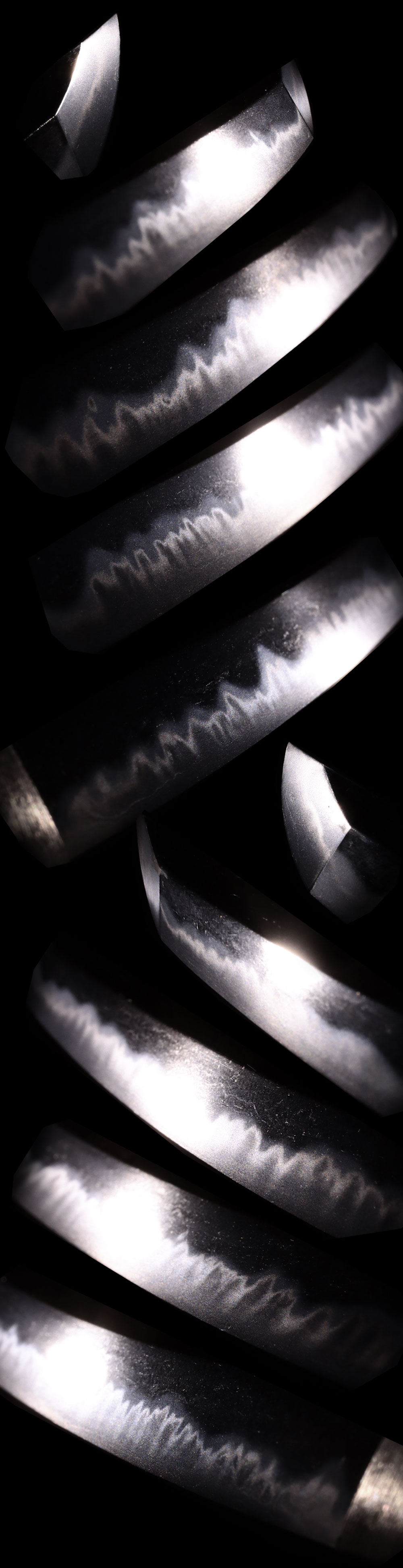
This piece shows characteristics of the Bizen-den style with choji-midare hamon, clearly demonstrating its features.
Blade length: 1 shaku 4 sun 2 bu.
Inscribed by Tanzan Hendo Kan (Kao).
Shinshinto: Saijyo Saku: Musashi Province
We divide 4 sections for each sword as Saijyo Saku, Jyojyo Saku, Jyo Saku and Regular Saku.
This work is ranked as Jyojyo Saku (second highest) for Chikuzen Daijo Fujiwara Naotane.
Habaki: Single-layered, silver
Blade Length: 43.2 cm (17.01 in)
Curvature: 1.3 cm (0.51 in)
Mekugi Hole: 1
Width at Base (Motohaba): 2.53 cm (0.99 in)
Width at Tip (Sakihaba): 1.66 cm (0.65 in)
Thickness of Rim (Kasane): 0.52 cm (0.20 in)
Sword Weight: 280 g
Era: Late Edo period, 1847 (Koka 4)
Shape: The blade has a slightly narrow width and thickness, with an elegant shape typical of Naotane's wakizashi.
Jigane: Itame-hada well-forged with visible grain and ji-nie.
Hamon: Choji-midare.
A bright and clear hamon with deep ashi and thick nioiguchi.
The boshi is deeply notched and returns in a small round shape.
Features: Taikei Naotane was born in Dewa province and known as Shoji Minohyoe.
He studied under Suishinshi Masahide and served under Lord Akimoto with his master.
In Bunsei 4 (1821), he was granted the title of Chikuzen Daijo.
Later, he moved to Edo and re-entered Masahide’s school, mastering Bizen-den, Soshu-den, Mino-den, and Yamato-den.
While Masahide promoted the revival of kotō styles, Naotane forged his own unique path by producing jigane with swirling patterns, creating works quite distinct from his master.
Koshirae:
Tsuba: Plain copper base with engraved bird design, decorated with gold inlay.
Fuchikashira: Plain copper base with high-relief carving of deer motifs, decorated with gold inlay.
Saya: Glossy black lacquered saya (kuro-roiro).
Menuki: High-relief carvings of locusts and dragonflies.
Kogai: Shakudo nanako ground with floral motif in high relief, decorated with gold and silver inlay.
Kozuka: Shakudo nanako ground with floral motif in high relief, decorated with gold and silver inlay.
With kogatana (small knife).
Aoi Art’s Comment: Taikei Naotane is one of the most renowned smiths of the late Edo period, excelling in Bizen-den, Soshu-den, Mino-den, and Yamato-den.
Works engraved with the “Oshiteru” mark are rare.
“Oshiteru” is a pillow word for Naniwa (Osaka), meaning he was based in Osaka.
This piece is a long and deeply curved reproduction of a kotō-style blade.
It is a work that might be mistaken for a copy of Ko-Bizen or Kuniyuki.
I once saw an Important Art Object by Naotane in the Soshu-den style, and it was outstanding.
This piece also resembles kotō works and is highly recommended.
As the Bakumatsu period approached, iron quality gradually improved through the Bunka, Bunsei, and Tenpo eras.
Anticipating increasingly intense warfare, domains began to demand more swords.
It is believed this led to greater efforts to produce superior blades.
NBTHK Tokubetsu Hozon Token
Aoi Art estimation paper
Whole Oshigata
Please note: the price does not include the shipping fees.
Price:1,500,000JPY
Order Form



Related Items:
 Wakizashi:Bishu Osafune Norimitsu (4th generation) Dated: February, Eikyo 5 (1433) (NBTHK Tokubetsu Hozon Token)
 Wakizashi: Mumei (attributed to Hatakeda Sanemori)e (43rd NBTHK Juyo Token)
 Wakizashi:Tanba no Kami Yoshimichi (Osaka 3rd) (NBTHK Hozon Token)
 Wakizashi: Higashiyama ju Yoshihira (NBTHK Tokubetsu Hozon Token)
 Wakizashi:Dewa Daijo Fujiwara Kunimichi(NBTHK Tokubetsu Hozon Token)
 Wakizashi:Chikuzen Jyu Minamoto Nobukuni Yoshimasa.(NBTHK Hozon Token)