
Ordering Number: AS26438
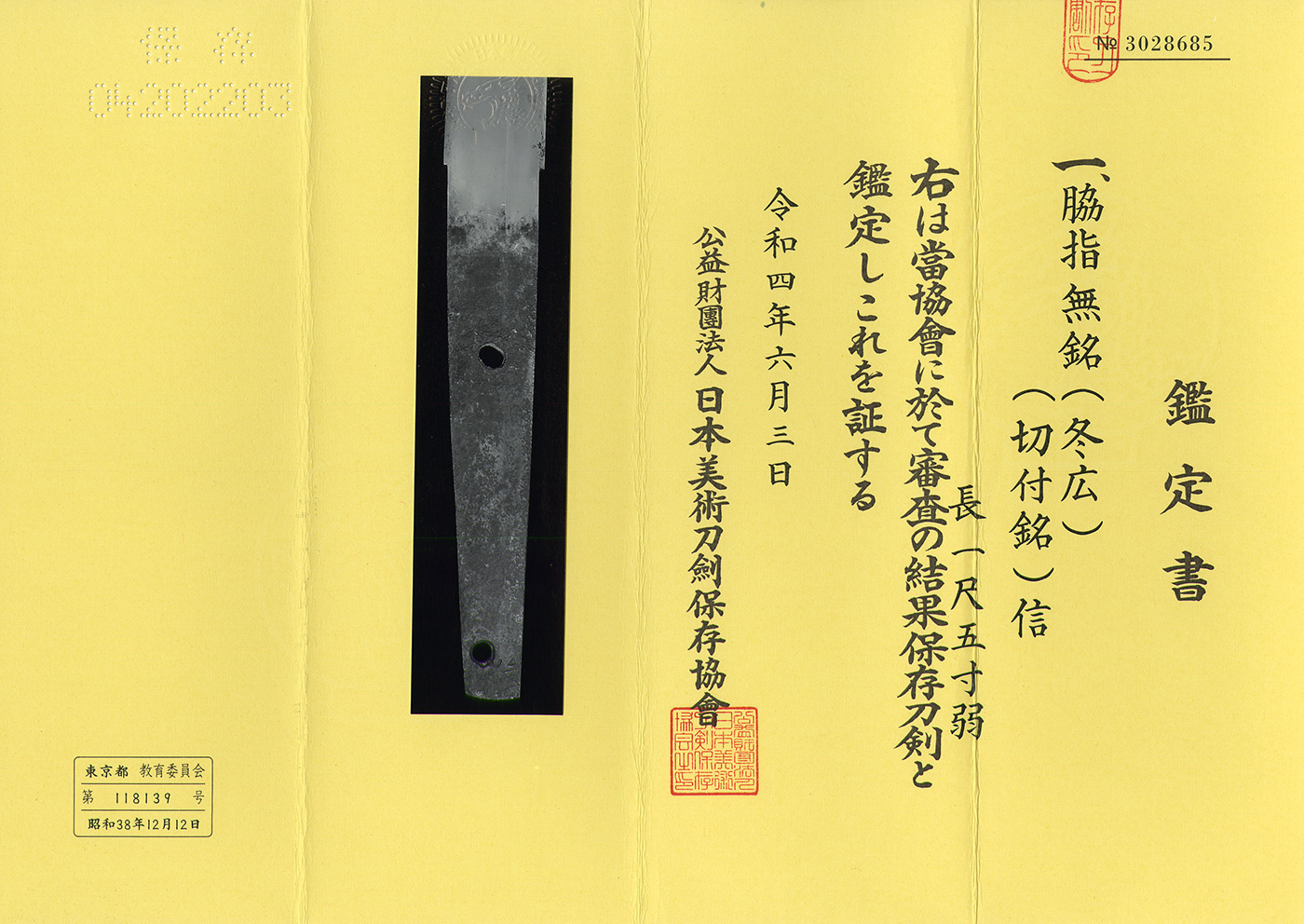
Wakizashi in Shirasaya with Koshirae (NBTHK Hozon Token)
Signature: Mumei (Attributed to Fuyuhiro).
Kiritsuke-mei (Later-added Inscription): Nobu.
無銘(冬広)
(切付銘)信
(We divide 4 sections for each sword as Saijyo Saku, Jyojyo Saku, Jyo Saku and Regular Saku).
This blade is ranked as Jyo Saku among works attributed to Fuyuhiro.
Habaki: Single silver-foiled habaki.
Blade Length: 45.4 cm (17.87 in).
Curvature: 1.2 cm (0.47 in).
Mekugi Hole: 2.
Width at Base (Motohaba): 2.7 cm (1.06 in).
Width at Yokote: 2.0 cm (0.79 in).
Thickness of rim (Kasane): 0.6 cm (0.24 in).
Sword Weight: 380 g.
Era: Muromachi period, around the Tenbun era (1532–1555).
Shape: A wakizashi with standard mihaba and kasane.
The blade has undergone suriage (shortening) and machi-okuri (relocation of the notches at the base).
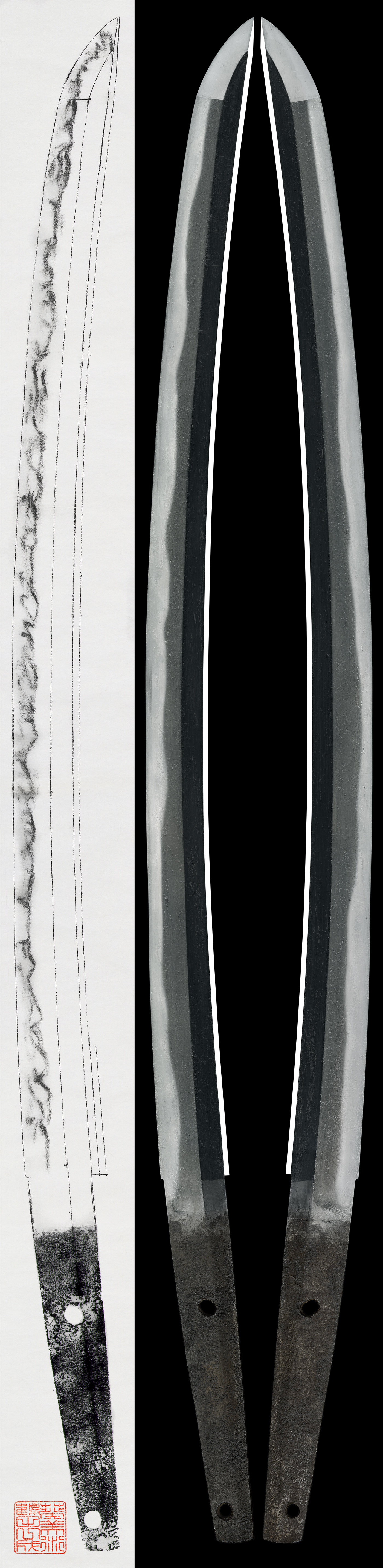
Jigane: Well-forged itame hada with a pronounced grain pattern and visible ji-nie.
Hamon: Nie-deki notare mixed with gunome.
The boshi displays a notare pattern.
Features: Fuyuhiro was a swordsmith from Wakasa Province who is said to have been the son of Soshu Hirotsugu.
He was also known as Kyuemon.
The Fuyuhiro school continued from around the middle Muromachi period until the late Edo period, with its tradition spreading from Wakasa to Hoki, Izumo, and Bizen Provinces.
Koshirae:
Tsuba: A shakudo tsuba carved with an oni (demon) and human figures, decorated with gold and copper iroe.
The rim is finished with gold iroe.
Fuchi: Shakudo fuchi featuring a wave design carved in high relief.
Signature: Jukichi Saku.
Kashira: Horn.
Saya (Scabbard): Kaerugawa (textured ray-skin) saya.
Menuki: Carved with plum trees and Japanese bush warblers (uguisu), decorated with gold and copper iroe.
Kozuka: An iron kozuka carved with a human figure and decorated with gold iroe.
Kogatana: Signed Masatsune.
Historical Background: In 1532, during the Muromachi period, several significant political events took place in Japan.
Change of Era Name (1532): On July 29, 1532, the Japanese era name was changed from Kyoroku to Tenbun.
The Death of Miyoshi Motonaga (1532): In June or July 1532, the influential military leader Miyoshi Motonaga was forced to commit suicide at Kenponji Temple in Sakai.
His death resulted from political maneuvering by Hosokawa Harumoto and attacks by forces including those led by Kizawa Nagamasa.
NBTHK Hozon Token.
AoiArt estimation paper: Whole Oshigata.
*Please note: The price does not include shipping fees.
Please note: the price does not include the shipping fees.
Auction Starting Price:480,000JPY
Place Bid





Related Items:
 Wakizashi: Higashiyama ju Yoshihira (NBTHK Tokubetsu Hozon Token)
 Wakizashi :Mutsu no Kami Daido (NBTHK Hozon Token)
 Wakizashi: Hizen Dewa no Kami Fujiwara Yukihiro (First Generation)(NBTHK Hozon Token)
 Wakizashi:Mumei (Sue-Mihara) (NBTHK Tokubetsu Kicho Token)
 Wakizashi:Bishu Osafune Norimitsu (4th generation) Dated: February, Eikyo 5 (1433) (NBTHK Tokubetsu Hozon Token)
 Wakizashi:Mumei (Kongo Byoe) (NBTHK Hozon Token)