
Ordering Number: AS25838
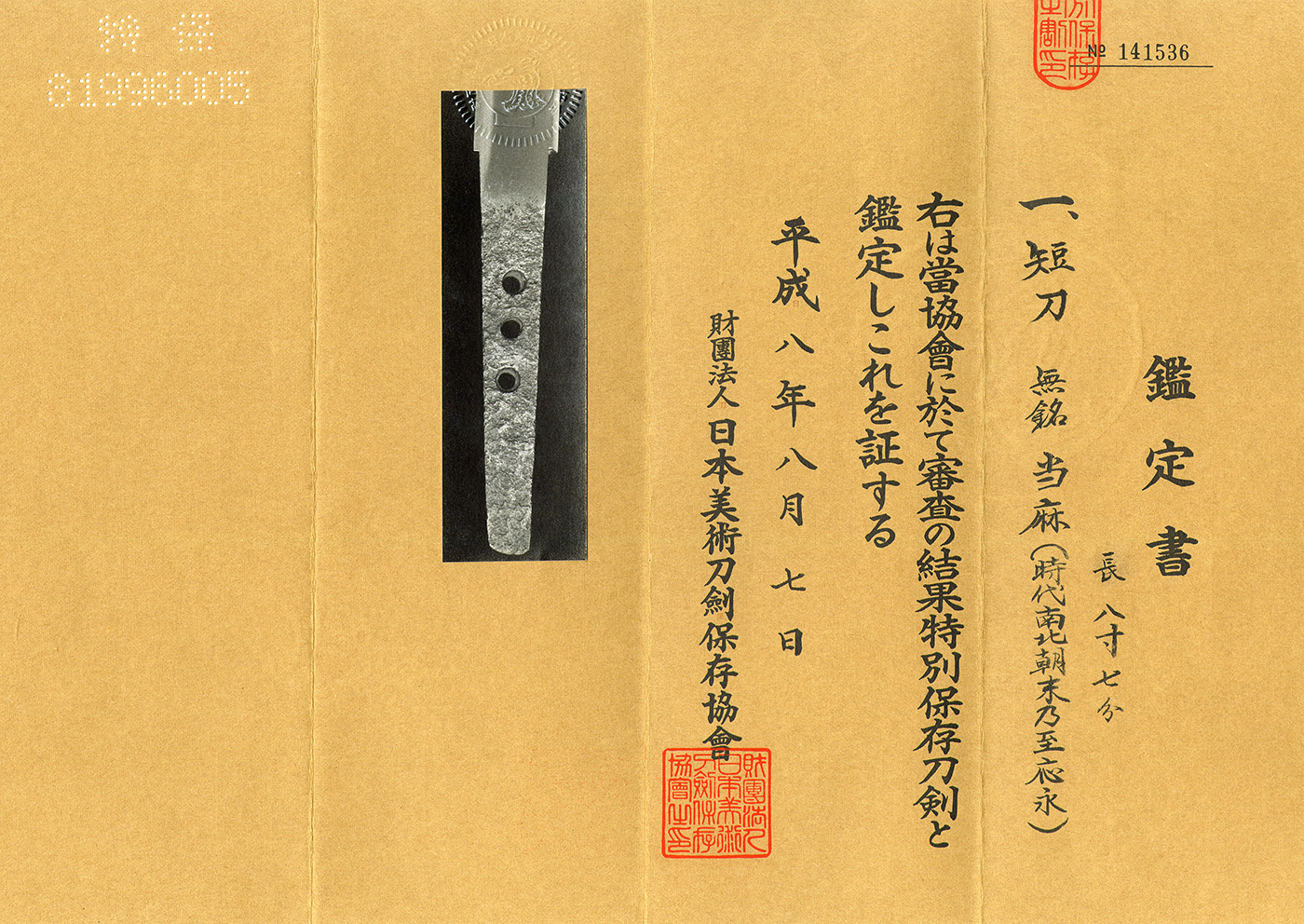
Tanto in Shirasaya with Koshirae (NBTHK Tokubetsu Hozon Token)(Consignment Sale).
Signature: Mumei(Unsigned)(Taima)(Late Nanbokucho period to Oei era (1394-1428)).
無銘(当麻)(時代南北朝末乃至応永)
(We divide 4 sections for each sword as Saijyo Saku, Jyojyo Saku, Jyo Saku and Regular Saku).
This work is ranked as Jyojyo Saku for Mumei (Taima).
Habaki: Gold foiled double Habaki.
Blade Length: 26.5 cm (10.43 in).
Curvature: 0.0 cm (0.00 in).
Mekugi Hole: 3.
Width at Base (Motohaba): 2.27 cm (0.89 in).
Thickness (Kasane): 0.63 cm (0.25 in).
Sword Weight: 165 grams.
Era: Around the late Nanbokucho period (1336-1392).
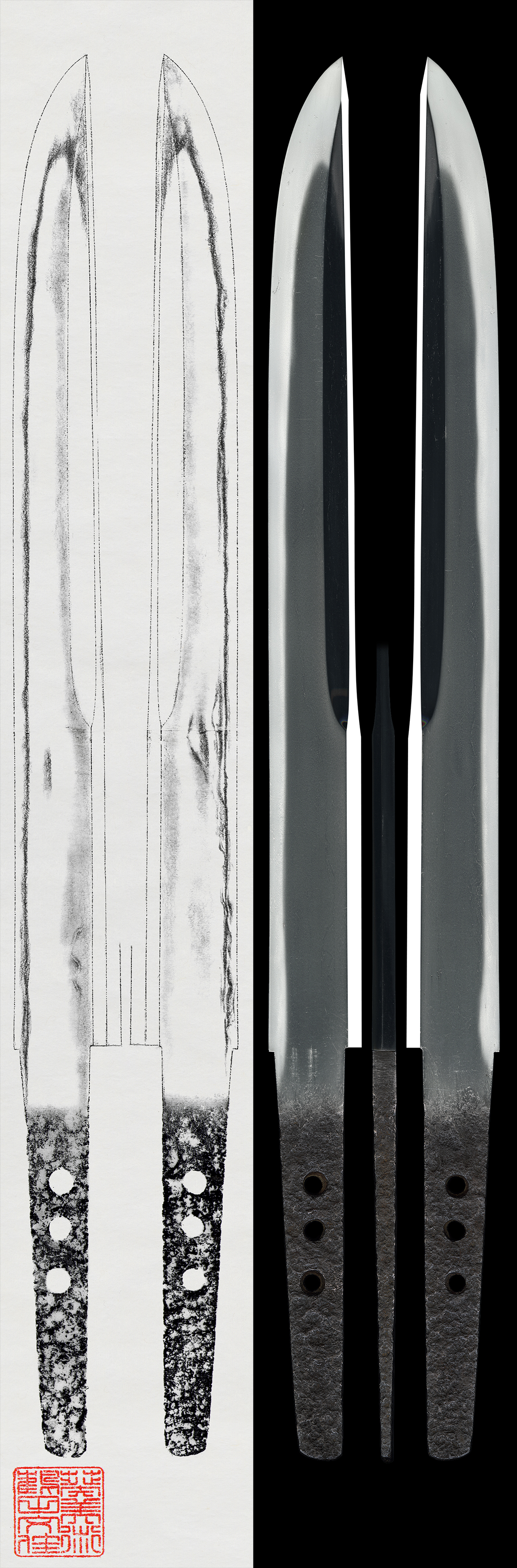
Shape: The blade has a Kanmuri-otoshi style shape with the shinogi-ji area shaved down from the middle.
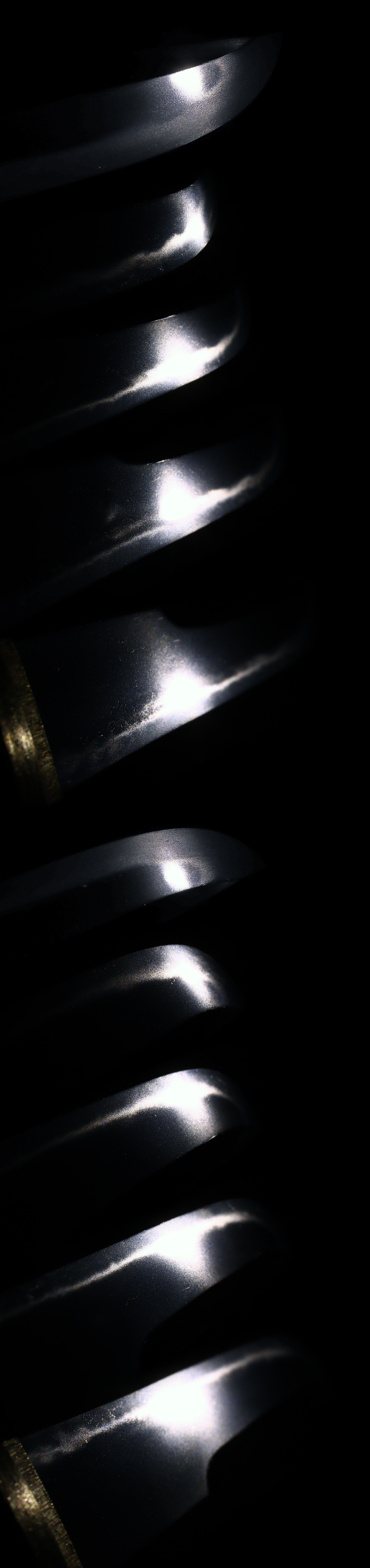
Jigane: Itame-hada forging, tightly forged and very beautiful.
Hamon: Straight temper line, the nioiguchi becomes deep from the monouchi, with a deep kaeri and faint utsuri appearing.
Features: Taima is a school of swordsmiths active in Yamato from the late Kamakura period to the Nanbokucho period, traditionally said to have originated with Kuniyuki.
Large temples of the time organized warrior monks, and the Yamato-den swordsmiths belonged to various temples.
It is said that the Taima school smiths were affiliated with Taima-dera Temple.
There are few signed works in this school, and many are attributed as mumei.
Koshirae: Made by Mr. Takayama Ichino (Mukansa).
Tsuba: Black roiro lacquered saya.
Menuki: Three-star Ichimonji crest depicted on shakudo ground.
Kozuka: Design of a rabbit.
Kogatana: Signature: Sagami no Kami Masatsune Nyudo.
NBTHK Tokubetsu Hozon Token.
AoiArt estimation paper: Whole Oshigata.
Auction Starting Price:1,700,000JPY
Place Bid




Related Items:
 Tanto:◻︎Shige (Kaneshige / Tegai) Dated: August, Oei 7 (1400)(NBTHK Tokubetsu Hozon Token) (Consignment Sale)
 Wakizashi (Sunnobi Tanto): Bishu Osafune Motomitsu ◻︎Wa Shi Gatsu ◻︎ (Interpreted as: Bunna 4th year, 5th month [May, 1355]) (Tokubetsu Hozon Token)
 Tanto: Munetsugu (Province unknown, Shinshinto period)(NBTHK Hozon Token)
 Tanto: Sakuyou Bakkashi Hosokawa Masayoshi(NBTHK Tokubetsu Hozon Token)
 Tanto:Gassan Sadayoshi Saku Inscription: Banzairaku (NBTHK Tokubetsu Hozon Token)
 Tanto:Gassan Sadakatsu Kinsaku(Kao)(NBTHK Tokubetsu Hozon Token)