
Ordering Number: AS25060
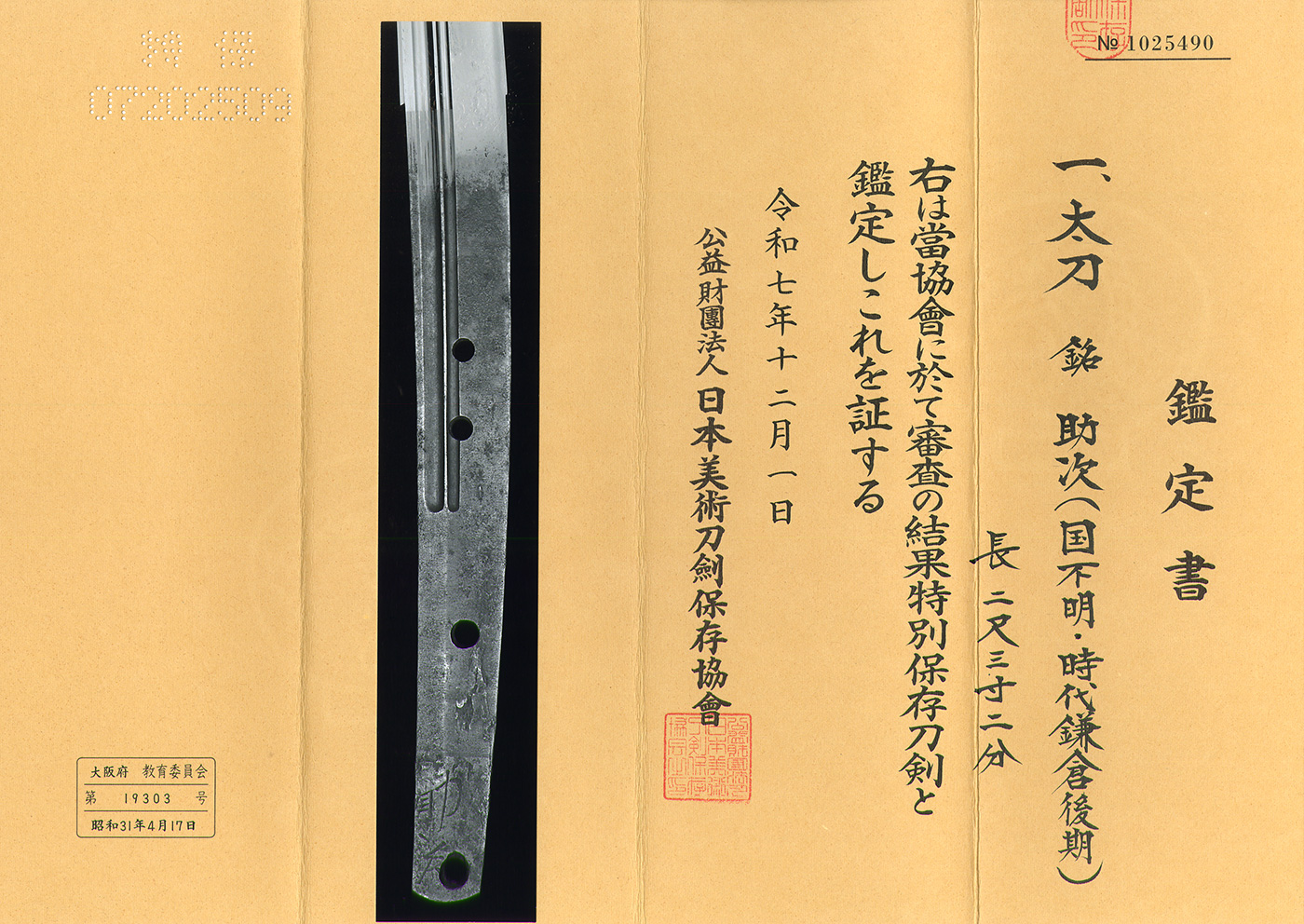
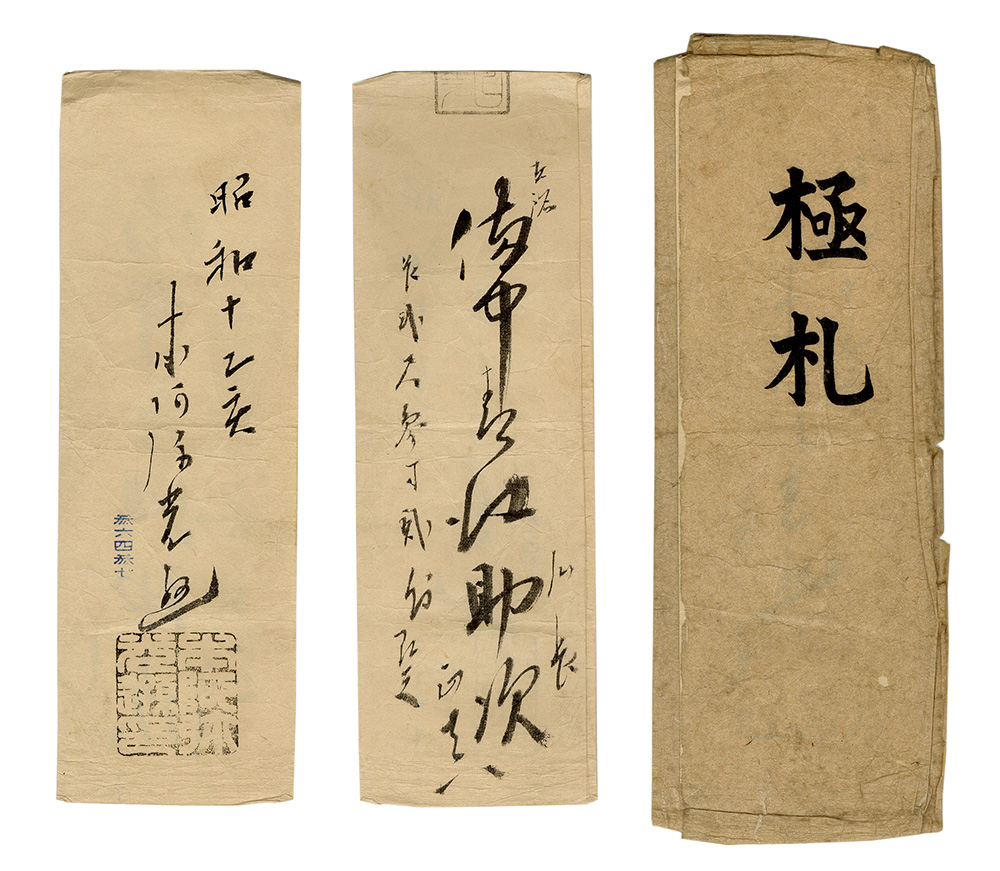
Tachi in Shirasaya with Tachi Koshirae (NBTHK Tokubetsu Hozon Token) (Koshirae: NBTHK Hozon Tosogu)
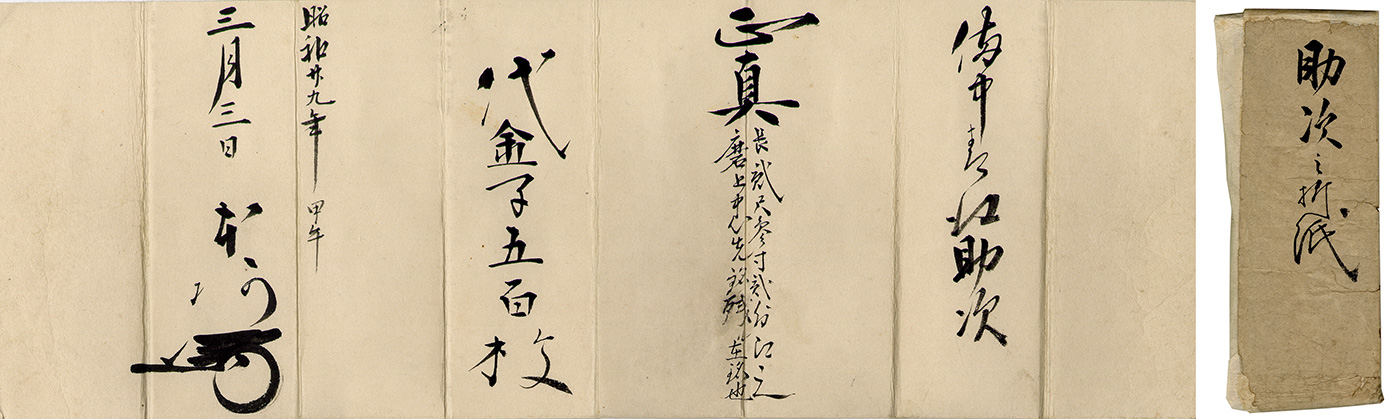
Signature: Suketsugu (Province Unknown, Late Kamakura Period)
助次(国不明・時代鎌倉後期)
(We divide 4 sections for each sword as Saijyo Saku, Jyojyo Saku, Jyo Saku and Regular Saku).
This blade is ranked as Jyojyo Saku among the works of Suketsugu.
Habaki: Gold iroe habaki.
Blade Length: 2 shaku 3 sun 3 bu 5 rin, approximately 70.76 cm (27.86 in).
Curvature: 8 bu, approximately 2.42 cm (0.95 in).
Mekugi Hole: 4.
Width at Base (Motohaba): 2.84 cm (1.12 in).
Width at Yokote: 1.64 cm (0.65 in).
Thickness of rim (Kasane): 0.68 cm (0.27 in).
Sword Weight: 575 g.
Era: Late Kamakura period.
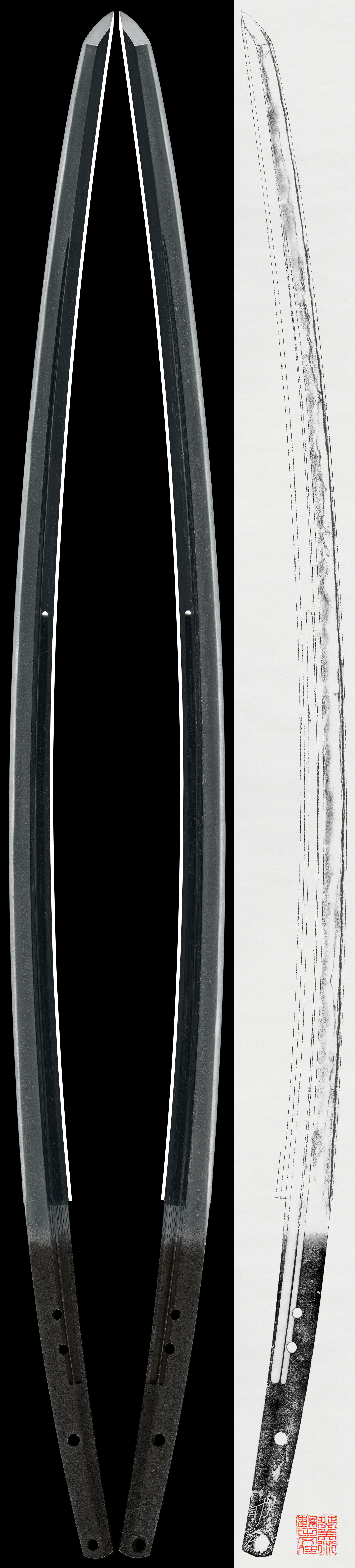
Shape: Although the blade has undergone suriage (shortening) and machi-okuri (relocation of the notches at the base), the signature remains completely intact.
Bo-hi and additional grooves are carved on both sides of the blade.
Jigane: Utsuri is visible in the jigane.
Hamon: Suguha hamon.
Features: The Japanese Sword Museum has attributed this sword to the late Kamakura period, although the province of origin remains unidentified.
Among the most famous swordsmiths named Suketsugu are those associated with the Ko-Aoe school of Bitchu Province and the Yoshioka Ichimonji school of Bizen Province.
Swordsmiths bearing the name Suketsugu were also active in other regions, including Yamato and Mino Provinces.
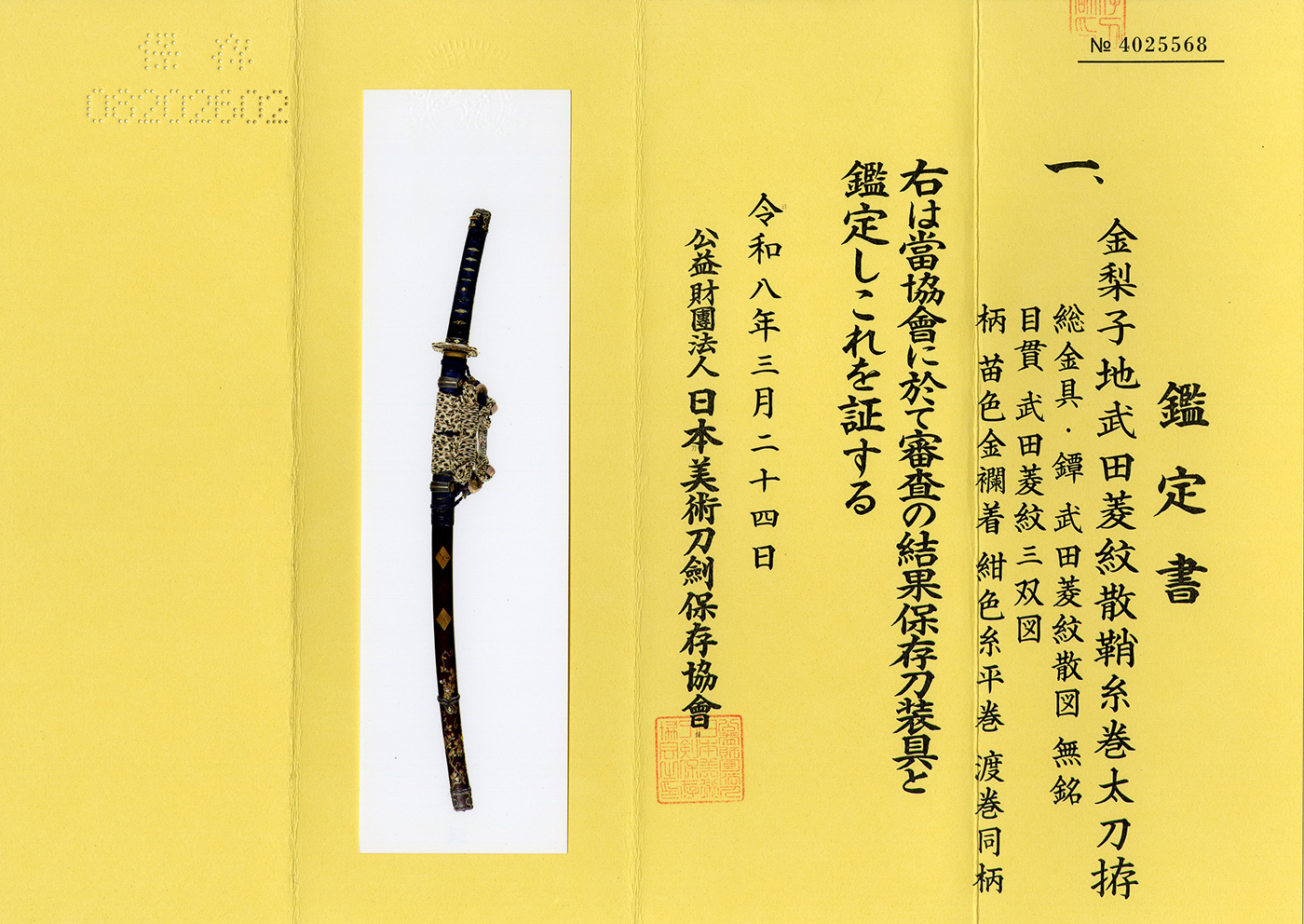
Itomaki Tachi Koshirae (NBTHK Hozon Tosogu)
Saya (Scabbard): Gold nashiji lacquer decorated with scattered Takeda diamond crests (Takeda-bishi mon).
Metal Fittings: A complete set of metal fittings, including the tsuba, decorated with scattered Takeda-bishi crests.
Unsigned (Mumei).
Tsuka (Handle): Covered with light green brocade fabric woven with gold threads, featuring a flat wrapping of dark blue silk cord.
The watamaki (wrapping around the upper portion of the scabbard) matches the handle wrapping.
Historical Background: The Mongol Invasions of Japan (1274 and 1281)
In 1274 and 1281, large military forces of the Mongol-led Yuan dynasty attempted to invade Japan.
These invasions are known as the Bun'ei and Koan campaigns.
Although the Kamakura shogunate successfully repelled both invasions, it was unable to reward the participating samurai with new lands or sufficient compensation.
As a result, dissatisfaction among the warrior class increased.
In 1333, Emperor Go-Daigo led a movement to overthrow the Kamakura shogunate.
Prominent military leaders, including Ashikaga Takauji and Nitta Yoshisada, joined the campaign against the shogunate.
Their combined efforts ultimately brought about the collapse of the Kamakura shogunate in 1333.
NBTHK Tokubetsu Hozon Token.
Koshirae: NBTHK Hozon Tosogu.
AoiArt estimation paper: Whole Oshigata.
Please note: the price does not include the shipping fees.
Auction Starting Price:3,200,000JPY
Place Bid





Related Items:
 Tachi:Sueyuki (Den Bungo, Late Kamakura period)(NBTHK Tokubetsu Hozon Token)
 Katana:Jakushu Ju Fuyuhiro A day in the 2nd month of Bunsei 5 (1822) (NBTHK Hozon Token)(Koshirae: NBTHK Tokubetsu Hozon Tosogu.)
 Katana:Mumei (attributed to Den Ayakoji)(NBTHK Tokubetsu Hozon Token)(Koshirae: NBTHK Tokubetsu Kicho Tosogu)
 Katana:: Mumei(Unsigned) (attributed to Den Taima) (17th NBTHK Juyo Token)
 Katana: Mumei (Ko-Mihara) (Tokubetsu Hozon Token)
 Katana: Mumei (Unsigned) (Tegai 手掻) (NBTHK Tokubetsu Hozon Token)(Koshirae: NBTHK Tokubetsu Kicho Tosogu)