
Ordering Number: AS26489
Katana in Shirasaya (38th NBTHK Juyo Token)
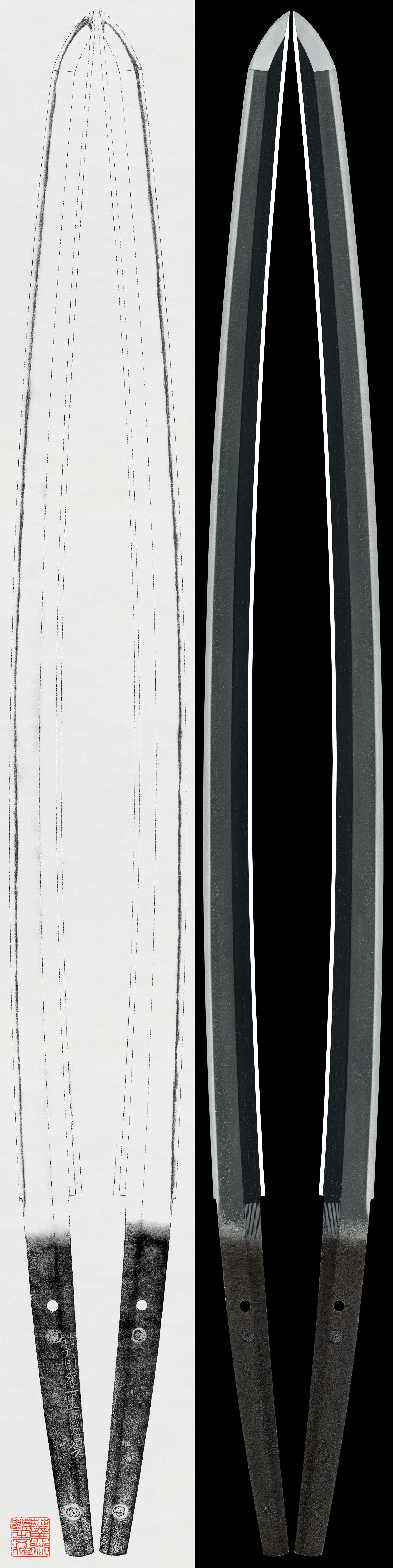
Signature: Oite Nanki Shigekuni Kore wo Tsukuru (Made by Shigekuni in Nanki).
於南紀重国造之
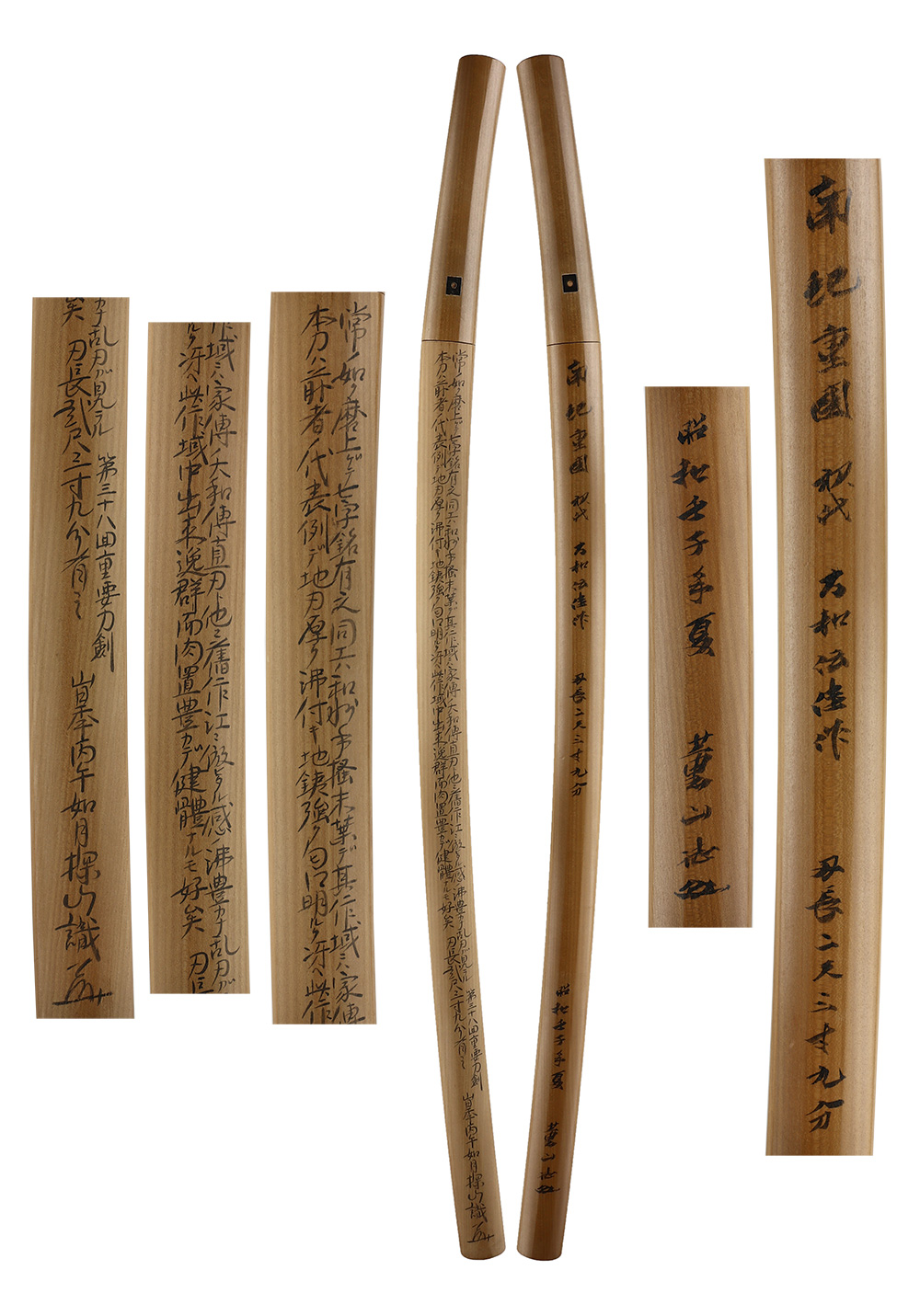
Sayagaki: Nanki Shigekuni, 1st Generation.
An excellent work in the Yamato-den tradition.
Blade Length: 2 shaku 3 sun 9 bu (approximately 72.42 cm / 28.51 in).
Written by Kunzan in the summer of 1972.
Sayagaki by Tanobe Sensei:
As is commonly seen, the blade has been shortened (suriage) and bears a 7-character signature.
This swordsmith belonged to a later branch of the Tegai School of Yamato Province.
His workmanship includes the traditional Yamato-den suguha inherited through his family, as well as nie-rich midareba that appears to have been influenced by the style of old works by Go Yoshihiro.
This particular blade is a representative example of the former style, displaying abundant nie in both the jigane and hamon.
The jigane is exceptionally strong and well forged, while the nie and nioiguchi are bright and clear.
Its workmanship is outstanding even among blades of this style.
Furthermore, the blade retains substantial niku (meat) and is in remarkably healthy condition, which is particularly desirable.
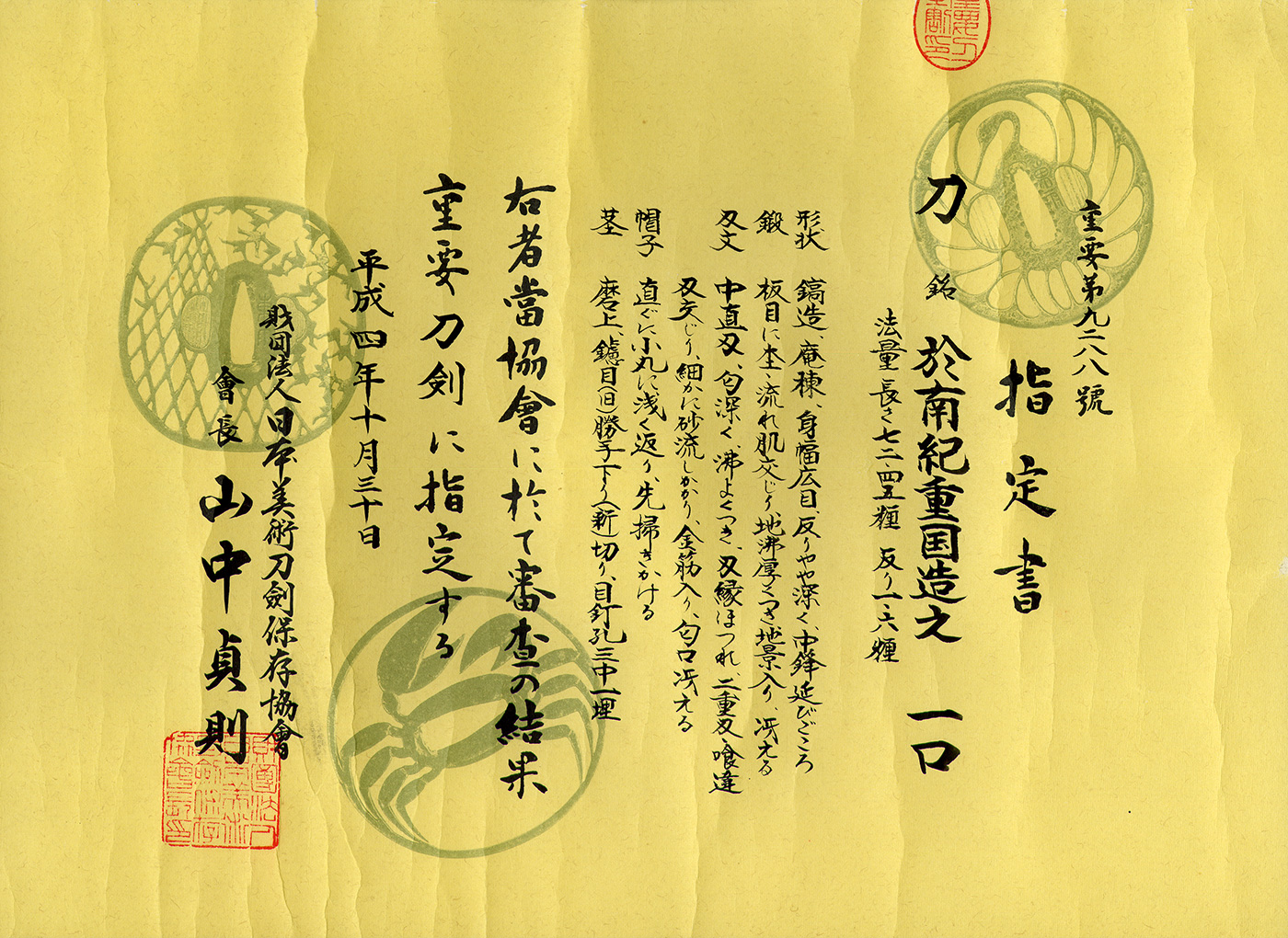
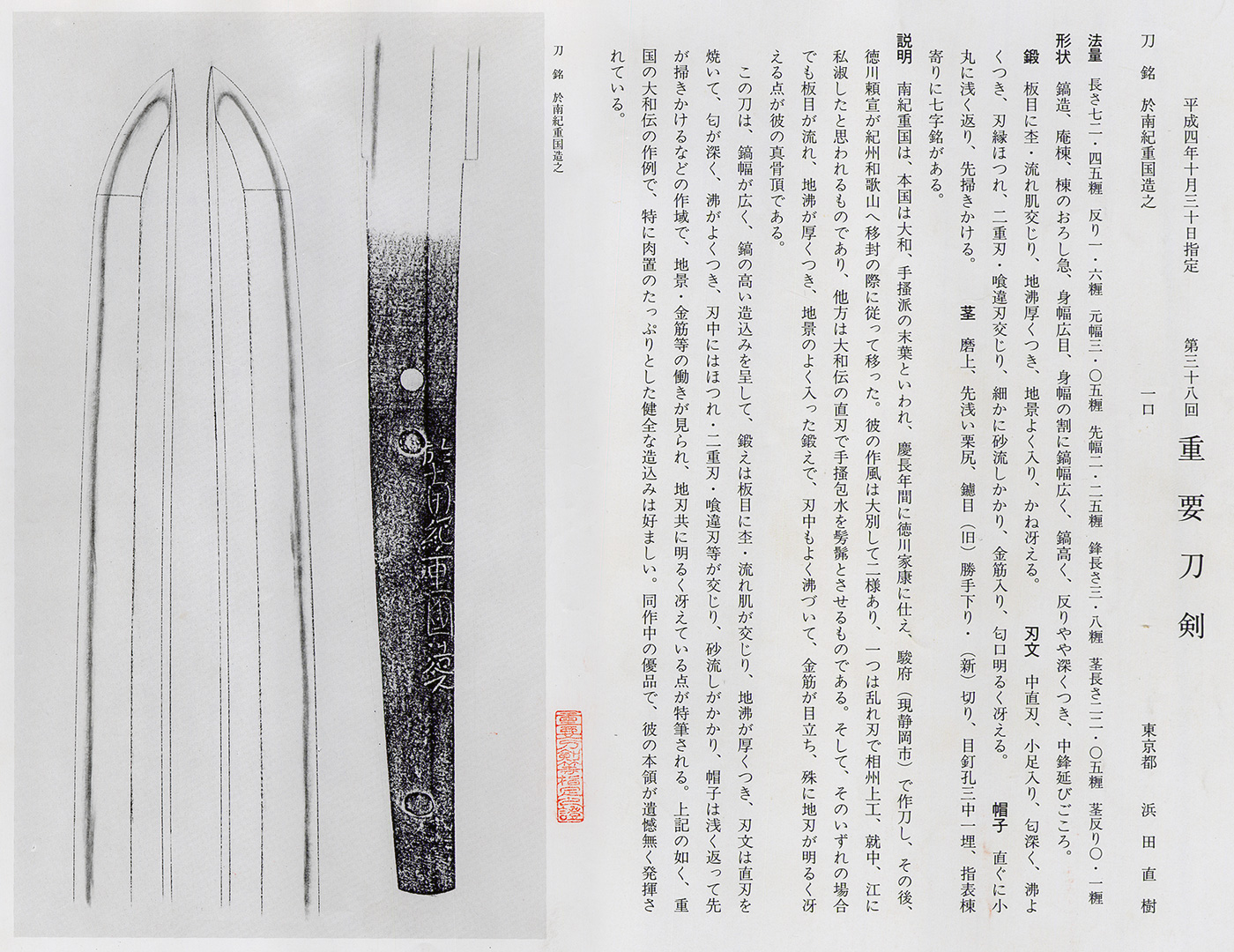
38th NBTHK Juyo Token.
Blade Length: 2 shaku 3 sun 9 bu (approximately 72.42 cm / 28.51 in).
Written by Tanzan (Kao).
Shinto: Ryo-Wazamono: Saijyo Saku: Kii Province
(We divide 4 sections for each sword as Saijyo Saku, Jyojyo Saku, Jyo Saku and Regular Saku).
This blade is ranked as Saijyo Saku among the works of Nanki Shigekuni.
Habaki: Double gold-fouled silver base habaki.
Gold weight: 50 g × 1,968 = ¥684,050 (including shipping), as stated in the original description.
Blade Length: 72.73 cm (28.63 in).
Curvature: 1.52 cm (0.60 in).
Mekugi Hole: 2.
Width at Base (Motohaba): 3.25 cm (1.28 in).
Width at Yokote: 2.25 cm (0.89 in).
Thickness of rim (Kasane): 0.79 cm (0.31 in).
Sword Weight: 923 g.
Era: Edo period, around the Kan'ei era (1624–1644).
Shape: Although the blade has been shortened once, it retains a substantial length and appropriate curvature, giving it an excellent overall shape.
Jigane: Exceptionally well-refined and tightly forged ko-itame hada, displaying remarkably fine-quality steel.
Hamon: Suguha with ko-ashi activity.
The nioiguchi is soft, bright, and exceptionally clear.
The boshi turns back in a ko-maru pattern.
Features: Nanki Shigekuni was originally from Yamato Province and was commonly known as Kuro and Saburo.
He produced swords in Suruga Province together with his father.
At the beginning of the Keicho era (1596–1615), he entered the service of Tokugawa Ieyasu.
In 1615, he accompanied Tokugawa Yorinobu to Kishu Province and settled east of Kajibashi in the eastern part of Marunouchi, Wakayama.
Shigekuni was highly regarded by Tokugawa Yorinobu and enjoyed an excellent reputation.
Because he was able to use first-class steel, he produced swords of exceptional quality.
As Nanki Shigekuni originally came from Yamato Province, many of his works feature suguha hamon in the Yamato tradition.
He also produced numerous swords in the Soshu-den style.
His suguha works, in particular, strongly reflect the characteristics of the Yamato tradition.
Above all, the beauty of his jigane is truly outstanding.
Historical Background: The Kan'ei era (1624–1644) was an important period in Japanese history, particularly during the reign of the 3rd Tokugawa Shogun, Tokugawa Iemitsu.
During this time, the Tokugawa shogunate consolidated the bakuhan system, established its national isolation policies, and witnessed the flourishing of Kan'ei culture.
Mandatory Sankin-Kotai System (1635): A major revision of the Buke Shohatto (Laws for the Military Houses) required daimyo throughout Japan to reside in Edo in alternate years.
This system reduced the financial resources available to the daimyo and helped prevent rebellion against the shogunate.
Complete Prohibition of Overseas Travel and Return by Japanese Nationals (1635): The shogunate prohibited Japanese people from traveling abroad and returning from overseas
Prohibition of Portuguese Ships (1639): Portuguese ships were prohibited from entering Japan.
As a result, Japan's officially permitted European and Chinese trade became concentrated in Nagasaki, with the Dutch trading through Dejima and Chinese merchants also maintaining commercial relations.
These restrictions helped establish the system commonly known as Sakoku (national isolation).
The Shimabara Rebellion (1637–1638): The Shimabara Rebellion was the largest uprising of the Edo period, involving inhabitants of Shimabara and Amakusa, many of whom were Christians.
After suppressing the rebellion, the Tokugawa shogunate further strengthened its restrictions on Christianity through religious registration systems (Shumon Aratame) and the use of Fumie, religious images that suspected Christians were required to step on to demonstrate that they had renounced their faith.
38th NBTHK Juyo Token.
AoiArt estimation paper: Whole Oshigata.
Auction Starting Price: 8,000,000 JPY



Related Items:
 Katana: Mumei (Unsigned)(Yamato-Shizu) (16th NBTHK Juyo Token)
 Katana: Hirofusa Saku (Gimeisai)(NBTHK Hozon Token)
 Katana:Mino Koku Okachiyama Sanroku Junin Fujiwara Nagasada. August, 1866. Made at Aoyama in Edo. (NBTHK Tokubetsu Hozon Token)
 Tachi: Suketsugu (Province Unknown, Late Kamakura Period)(NBTHK Tokubetsu Hozon Token) (Koshirae: NBTHK Hozon Tosogu)
 Katana: (Kimo mon) Ise Kami Fujiwara Kiyokata Dated February, Hōreki 4 (1754), residing in Satsuma Province. (NBTHK Tokubetsu Hozon Token)
 Katana: Yamato Kami Hidekuni (February 1870)(NBTHK Tokubetsu Hozon Token)