
Ordering Number: AS26534
Katana in Shirasaya with Koshirae (NBTHK Tokubetsu Hozon Token)
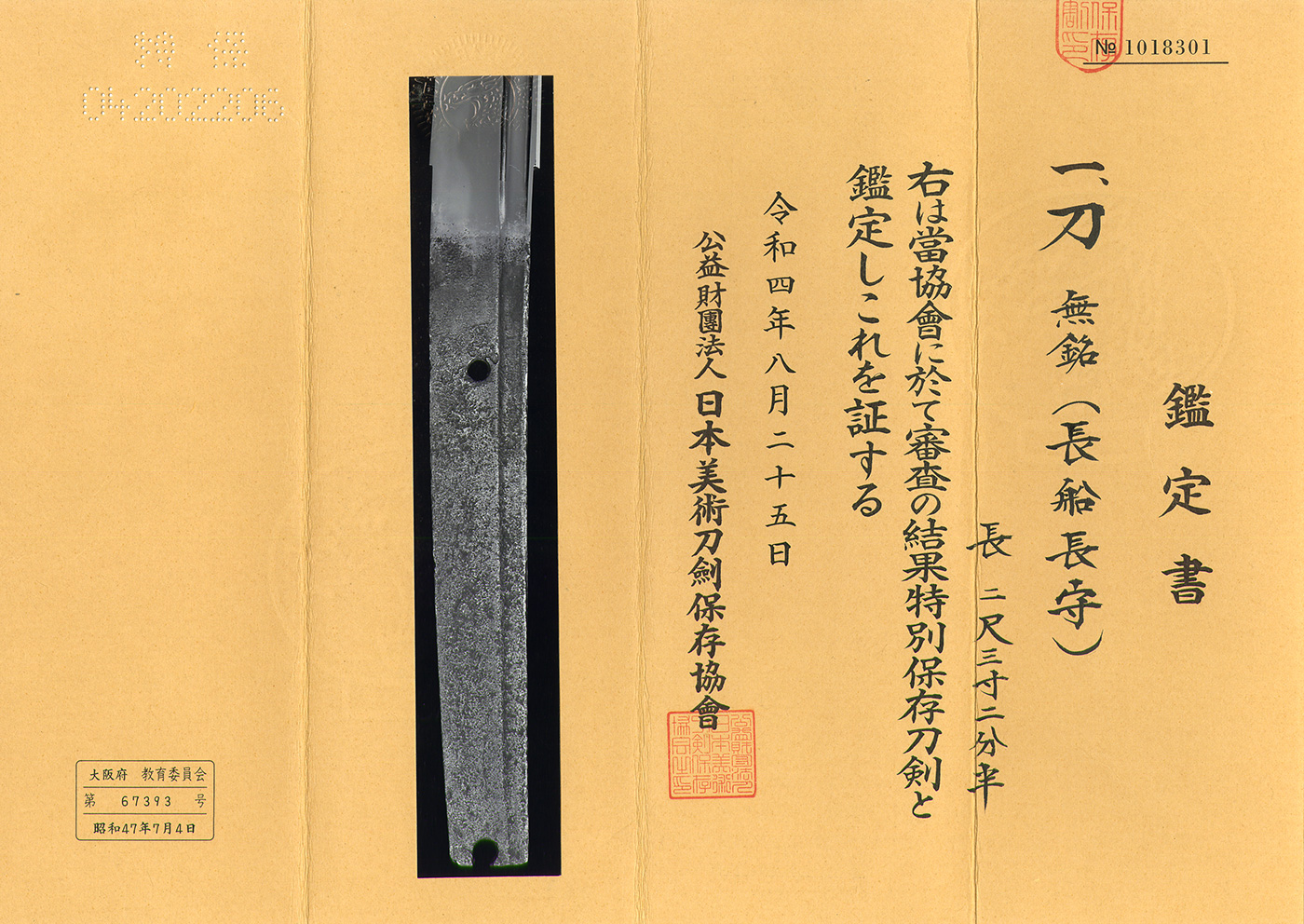
Signature: Mumei (Attributed to Osafune Nagamori)
無銘(長船長守)
Chukoto: Jyo Saku: Enbun Era: Nanbokucho Period: Osafune
(We divide 4 sections for each sword as Saijyo Saku, Jyojyo Saku, Jyo Saku and Regular Saku).
This blade is ranked as Jyojyo Saku among works attributed to Osafune Nagamori.
Habaki: Double gold-foiled habaki.
Blade Length: 71.0 cm (27.95 in).
Curvature: 2.2 cm (0.87 in).
Mekugi Hole: 2 (1 filled).
Width at Base (Motohaba): 2.85 cm (1.12 in).
Width at Yokote: 1.94 cm (0.76 in).
Thickness of rim (Kasane): 0.63 cm (0.25 in).
Sword Weight: 625 g.
Era: Nanbokucho period, around the Enbun era (1356–1361).
Shape: A katana with standard mihaba and kasane, featuring deep curvature.
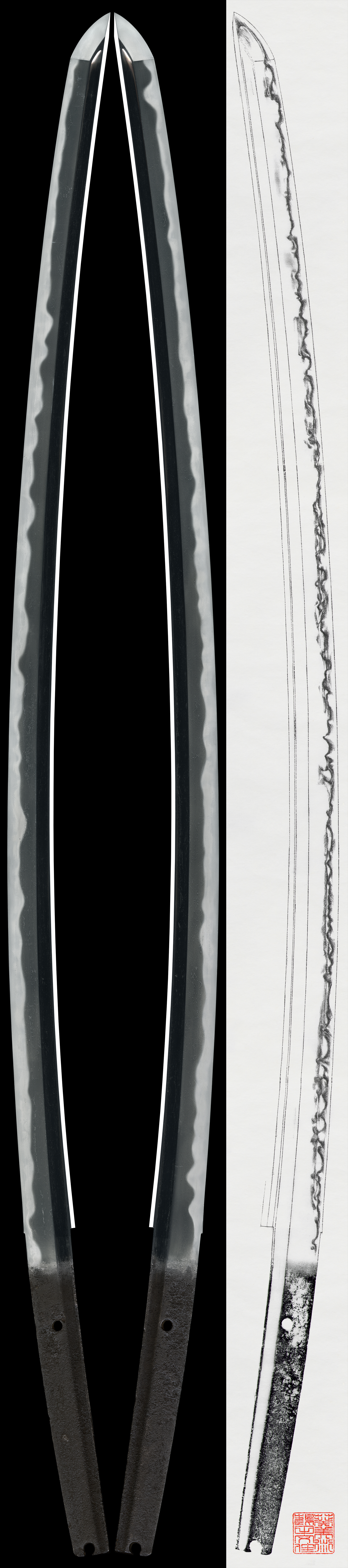
Jigane: Beautifully refined and tightly forged jigane with clearly visible utsuri.
Hamon: Gunome-midare mixed with pointed togari-gunome.
The boshi also displays a midare pattern, ending in a ko-maru (small rounded tip) with a turnback.
The overall workmanship closely resembles that of Nagayoshi.
Features: Osafune Nagamori is said to have been the son of Nagashige and the elder brother of Nagayoshi.
Nagamori is known for producing many naginata-naoshi blades and tanto, while conventional katana by him are said to be relatively rare.
This particular blade displays a richly varied hamon with abundant sunagashi and kinsuji activity.
Koshirae:
Tsuba: A copper tsuba decorated with diagonally engraved lines.
The rim is fitted with a shakudo fukurin.
Fuchikashira and Kojiri: Shakudo fittings carved with wave motifs.
Saya (Scabbard): Dark brown saya with an ishime-ji-style (stone-textured) finish.
Menuki: Carved with lotus motifs and decorated with gold iroe.
Historical Background: During the Nanbokucho period, the Northern Court in Kyoto changed the era name from Bunna to Enbun on April 29, 1356 (March 28, 1356, according to the Japanese lunar calendar).
At that time, the Southern Court in Yoshino continued to use its own era name, Shohei, and the year corresponded to Shohei 11.
In the Kyushu region, the Isshiki forces allied with the Ashikaga shogunate returned from Nagato Province to Kyushu and attempted to regain their position against the Southern Court forces led by Prince Kaneyoshi and the Kikuchi clan.
These military developments marked the beginning of a significant shift in the balance of power in Kyushu, eventually leading to the Battle of Chikugogawa in 1359.
NBTHK Tokubetsu Hozon Token.
AoiArt estimation paper: Whole Oshigata.
*If you want re-wrapping the Tsuka, it will cost 35,000 JPY.
Please note: the price does not include the shipping fees.
Auction Starting Price:1.950,000JPY
Place Bid





Related Items:
 Katana: (Gold inlaid)Nagamori (47th NBTHK Juyo Token)
 Katana:Mumei(Unsigned) (Sa Yoshisada 左吉貞) (65th NBTHK Juyo Token)
 Katana: Mumei (Unsigned)(Yamato-Shizu) (16th NBTHK Juyo Token)
 Katana: Higo no Kuni Ju Akamatsu Tarou Kaneteru Saku(1988)
 Katana: Naniwa ju Gassan Unryushi Sadakazu Kitae (Kokuin) (NBTHK Tokubetsu Hozon Token) (NBTHK Tokubetsu Kicho Token)
 Katana:Mumei attributed as Hokke school. (NBTHK Hozon Token)