
Ordering Number: AS26160.
Katana in Shirasaya with Koshirae.
Signature: Hoshu Ju Harima no Kami Kunitoshi (guaranteed authentic).
Dated February 1863.
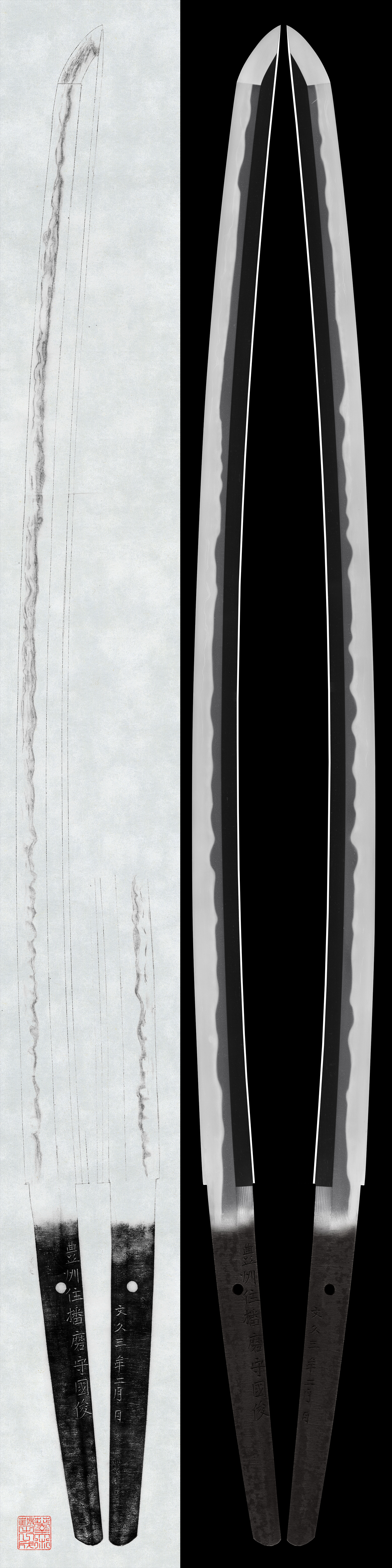
豊州住播磨守国俊(正真保証)
文久三年二月日
(We divide 4 sections for each sword as Saijyo Saku, Jyojyo Saku, Jyo Saku and Regular Saku).
This blade is ranked as a Jyojyo Saku work among the works of Hoshu Ju Harima no Kami Kunitoshi.
Habaki: Double gold-foiled Habaki.
Blade Length: 70.07 cm (27.59 in).
Curvature: 1.66 cm (0.65 in).
Mekugi Hole: 1.
Width at Base (Motohaba): 3.21 cm (1.26 in).
Width at Yokote (Sakihaba): 2.32 cm (0.91 in).
Thickness of rim (Kasane): 0.74 cm (0.29 in).
Sword Weight: 895 grams.
Era: Edo Period, 1863.
Shape: A blade with wide width, thick kasane, and deep curvature.
Jigane: Well-forged ko-itame hada.
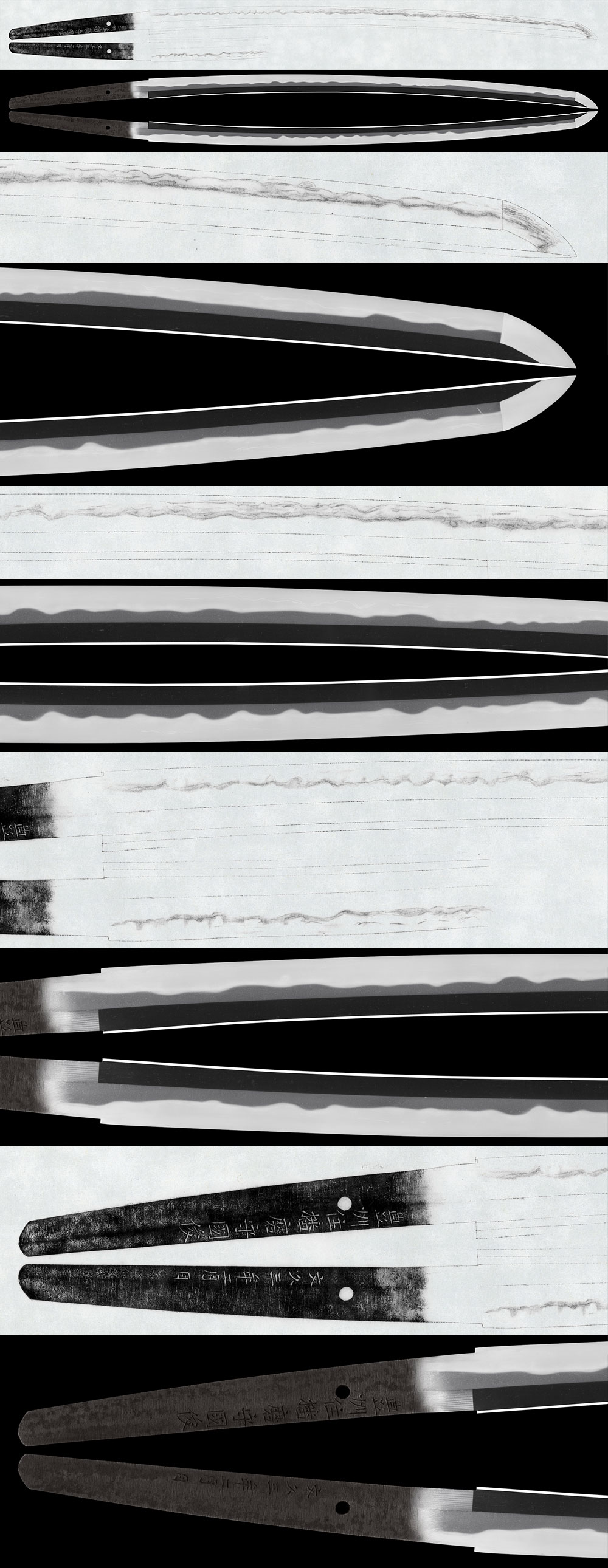
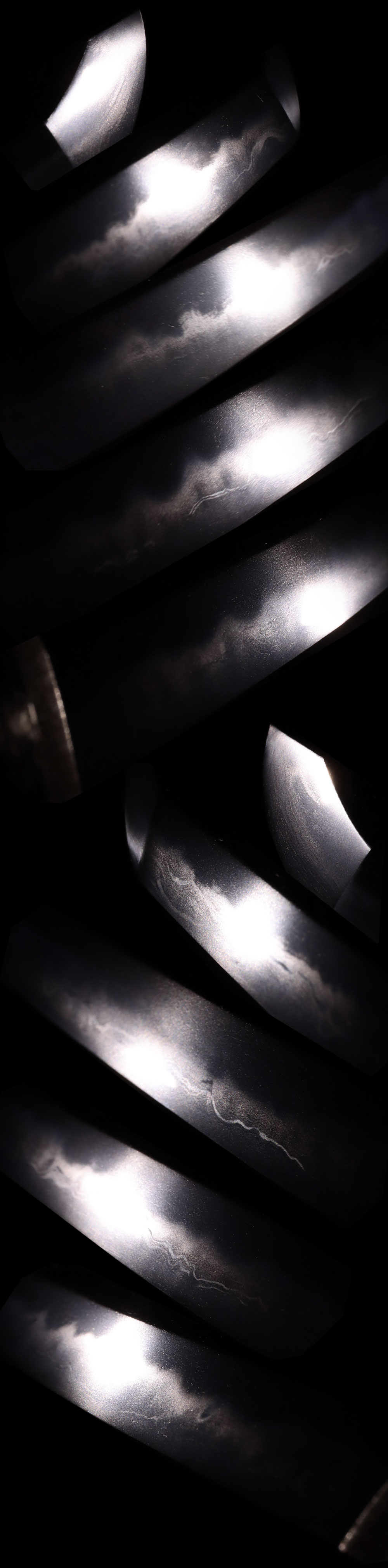
Hamon: Nie-deki straight hamon with active kinsuji throughout.
The boshi becomes irregular and turns back in a rounded form.
Features: Hoshu Ju Harima no Kami Kunitoshi is known for abundant shirake-suji and kinsuji activities, a rich and deep nioiguchi, and a soft hamon with great variation.
This is an excellent blade full of activity and variation.
Bearing the signature Hoshu Ju Harima no Kami Kunitoshi, it can be regarded as a work made with great confidence.
Koshirae:
Tsuba: Round iron tsuba with openwork carving of paulownia motifs.
Fuchikashira: Shakudo nanako ground carved with lion motifs.
Saya (Scabbard): Black roiro lacquered saya.
Menuki: High-relief carving of a kenmaki-ryu (dragon entwined around a sword).
Historical Background: The date February 1863 falls within the turbulent Bakumatsu period, a time when many outstanding swords were forged.
Prominent swordsmiths active during this era included Chojusai Tsunatoshi, Unju Kanetomo, Kishinmaro Minamoto Masatoshi, and Taira Nobuhide (Kurihara Nobuhide).
In Kyoto that year, Tokugawa Iemochi had an audience with Emperor Komei, and the movement advocating reverence for the Emperor and expulsion of foreigners was reaching a peak.
The year 1863 was a turning point in which the political situation at the end of the Edo period changed dramatically, and ideas began to transform into direct action.
Until then, the sonnō jōi movement had largely remained at the stage of discussion and advocacy, but during this year it developed into actual armed actions across the country.
The Choshu Domain fired upon foreign vessels, the Satsuma Domain entered into conflict with Britain, and political upheavals occurred in Kyoto, placing the entire nation under increasing tension.
In other words, 1863 can be described as the year when ideological conflict transformed into armed confrontation.
Aoi Art’s Comment: This is an extremely rare sword from Bungo.
The workmanship is exceptionally fine.
The blade displays abundant shirake-suji and kinsuji, giving it the appearance and atmosphere of an old Koto masterpiece.
It is a magnificent sword that we highly recommend.
AoiArt estimation paper: Whole Oshigata.
Please note: the price does not include the shipping fees.
Auction Starting Price:800,000JPY
Place Bid



Related Items:
 Katana: Bakufushi Kawai Hisayuki Nanajuhassai Saku Kore(1863)(NBTHK Tokubetsu Hozon Token)
 Katana: Chōjusai Tsunatoshi (1863)(NBTHK Tokubetsu Hozon Token)
 Katana: Yamato Kami Hidekuni (February 1870)(NBTHK Tokubetsu Hozon Token)
 Katana: Ho-ki Kami Taira Ason Masayuki
 Katana: Echizen Ju Harima Daijo Fujiwara Shigetaka(2nd generation)
 Katana:Chounsai Tsunatoshi