
Ordering Number: AS09330
Katana in Koshirae
Signature: Chōunsai Emura saku 長運斉江村作 (Guaranteed genuine)
(We divide 4 sections for each sword as Saijyo Saku, Jyojyo Saku, Jyo Saku and Regular Saku).
The workmanship of this piece is ranked as Jyo Saku for Chōunsaï Emura.
Habaki: Single-layer silver habaki.
Blade Length: 66.6 cm (26.22 in).
Curvature: 1.8 cm (0.71 in).
Mekugi Hole: 1.
Width at Base (Motohaba): 2.3 cm (0.91 in).
Width at Yokote: 2.15 cm (0.85 in).
Thickness of rim (Kasane): 1.8 cm (0.71 in).
Sword Weight: 670 grams.
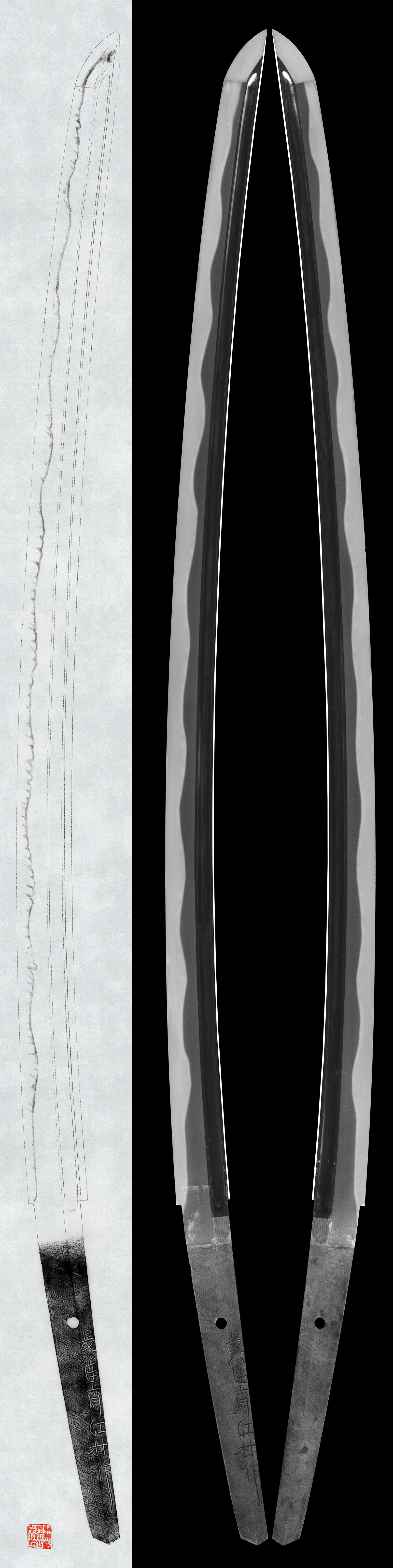
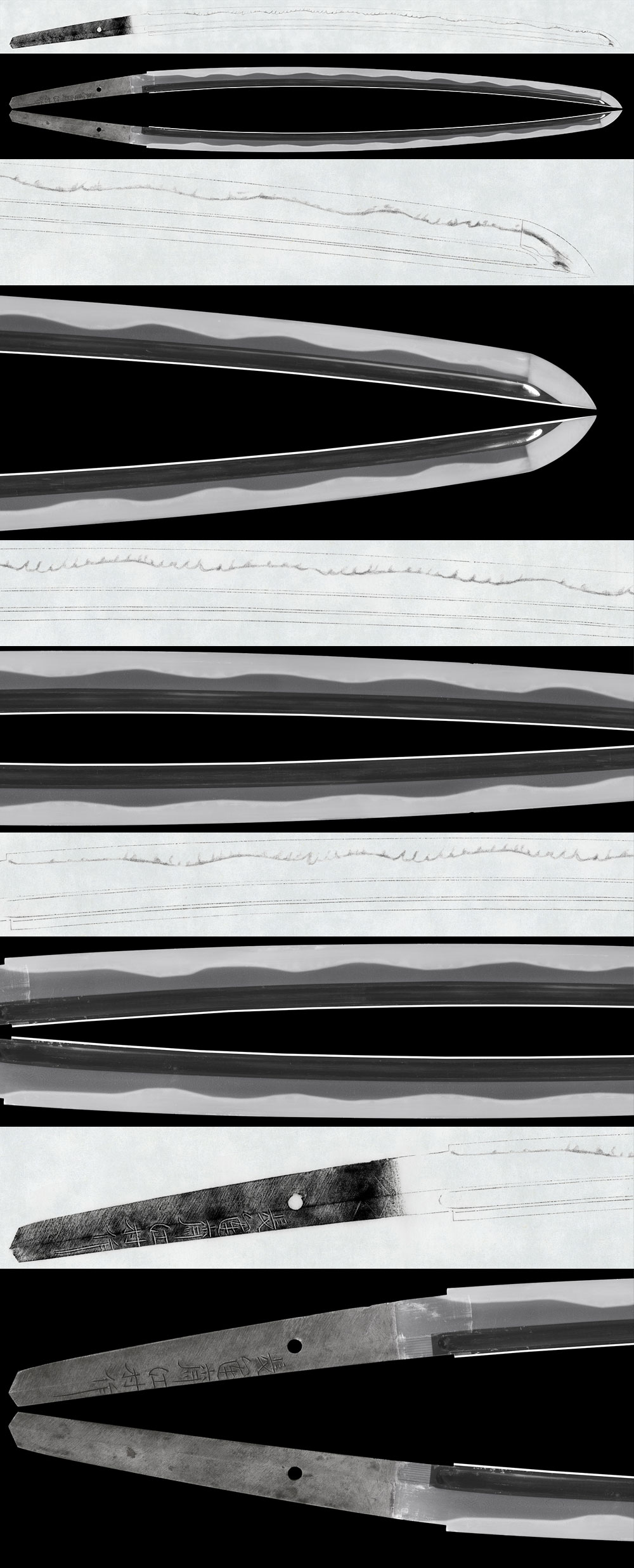
Shape: Wide blade with slightly thick kasane, grooves carved on both sides.
Deep curvature with a slightly long kissaki.
Jigane: Well-forged ko-itame hada forming a plain surface appearance.
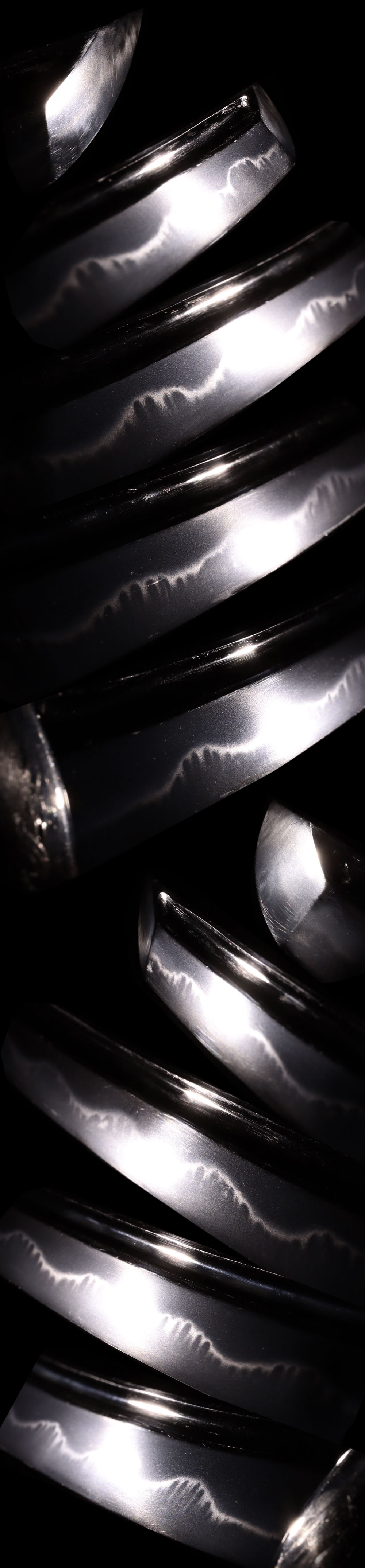
Hamon: Nie-deki, notare mixed with gunome-midare, the boshi turns back in a round shape.
Features: This work is an excellent piece by Chōunsaï Emura.
Usually he signed simply “Emura” or “Emura saku,” but particularly carefully made works bear the long signature “Chōunsaï Emura saku.”
Emura served as the director of Okayama Prison during the war, and it is said that there was a large-scale Japanese sword production workshop inside the prison.
The makers were selected from among well-behaved prisoners serving long sentences, and under the director’s supervision they devoted themselves to sword production.
Polishing was also carried out in the same workshop, resulting in well-polished blades.
In the past, Nagamitsu and Emura were often confused.
He was born in Tokushima Prefecture and died in 1960.
His workmanship differs from that of Nagamitsu and appears to be of even higher quality.
I have long paid attention to his works, and while Nagamitsu produced many swords with some variation in quality, nearly all of Emura’s works are above standard, and some surpass even Yasukuni swords in quality.
These works will attract increasing attention in the future.
It is said that the quenching and signature engraving were always performed by Director Emura himself, and the signatures include “Emura,” “Emura saku,” and “Chōunsaïtō Emura saku.”
Koshirae:
Tsuba: Suaka plate tsuba carved with birds by the waterside.
Fuchikashira: Shakudo nanako ground carved with waterside birds and finished with gold iroe.
Saya (Scabbard): Black roiro lacquered saya.
Menuki: Shakudo ground with high-relief chrysanthemums, finished with gold iroe.
Aoi Art’s Comment: After a long time, a long-signature Emura blade has appeared.
Mr. Emura, the director of Okayama Prison, was as described above.
Therefore, because polishing was also performed there, many of his works are of high quality and in good condition.
This piece can be regarded as one of Emura’s masterpieces, solidly made, with a particularly gorgeous hamon of deep nioiguchi gunome-midare mixed with choji-midare.
The ashi are gently formed, creating an atmosphere as if drifting in mist.
It is an outstanding work that could easily be mistaken for a high-quality Shinshinto Jyo Saku blade, and if submitted for appraisal, it would astonish the judges.
Historical Background: Made during wartime, and bearing a long signature, it is an especially carefully crafted sword.
AoiArt estimation paper: Whole Oshigata.
Auction Starting Price:400,000JPY
Place Bid



Related Items:
 Katana:Chounsai Tsunatoshi
 Katana: Oite Koufu Chojyusai Tsunatoshi Chounsai Koretoshi
 Katana:Mumei (Unsigned), attributed to Chikakage.(The 41st NBTHK Juyo Token)
 Katana:Minamoto Moriyoshi & Yoshitsugu collaboration (Mukansa Swordsmith) Showa 51 Nen 5 Gatsu (May, 1976)(NBTHK Tokubetsu Hozon Token)
 Tachi:Unshū-jū Tadayoshi Zo Kore (2nd)(Mukansa Swordsmith)(NBTHK Hozon Token)
 Tachi:Bishū Osafune Tomosada (Ko-zori)(48th NBTHK Juyo Token)