
Ordering Number: AS25724
Katana in Shirasaya (NBTHK Tokubetsu Hozon Token)
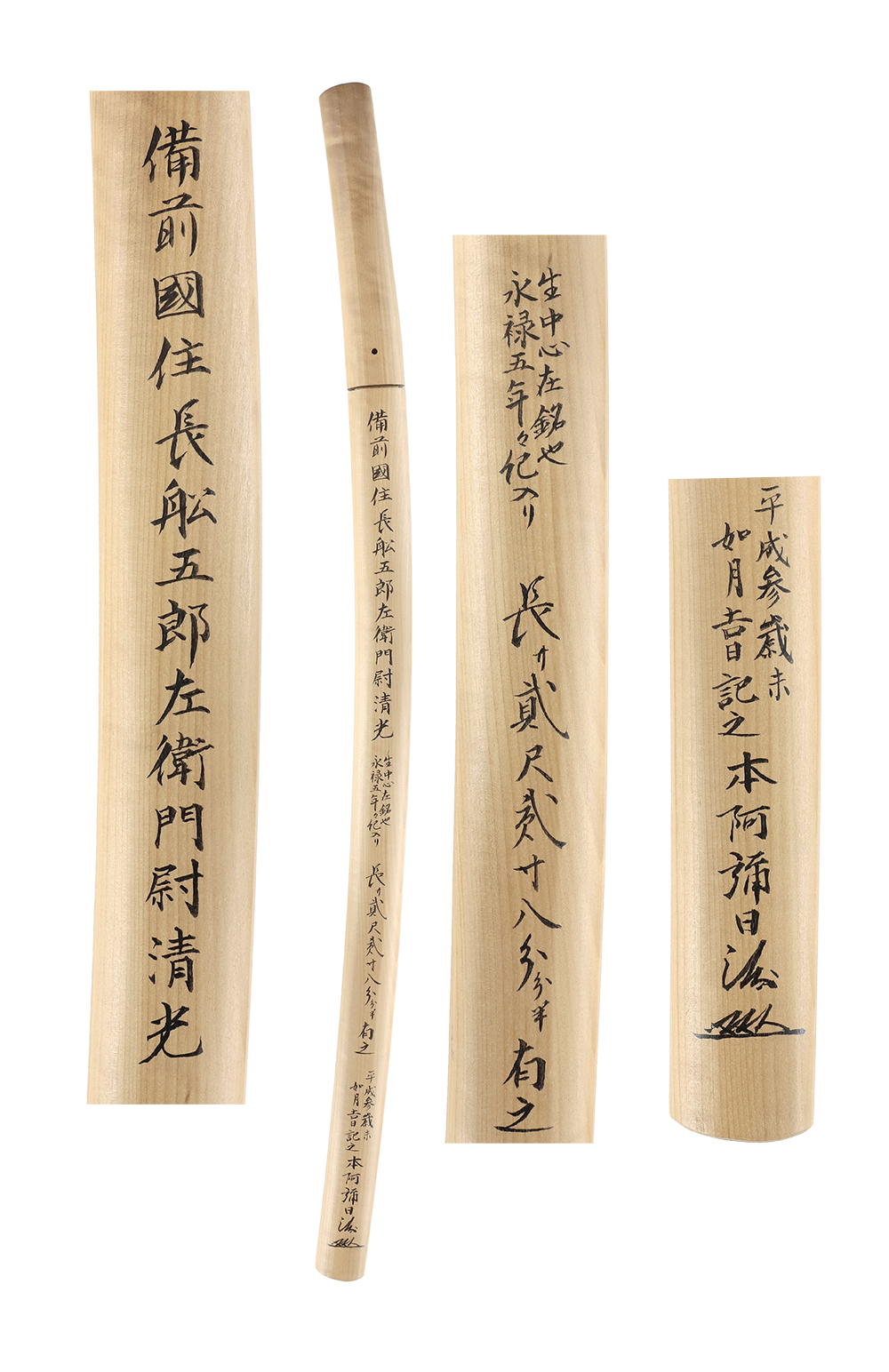
Signature: Bizen Kuni Ju Osafune Kiyomitsu Saku Kore
Dated: August, 1562 (Eiroku 5)
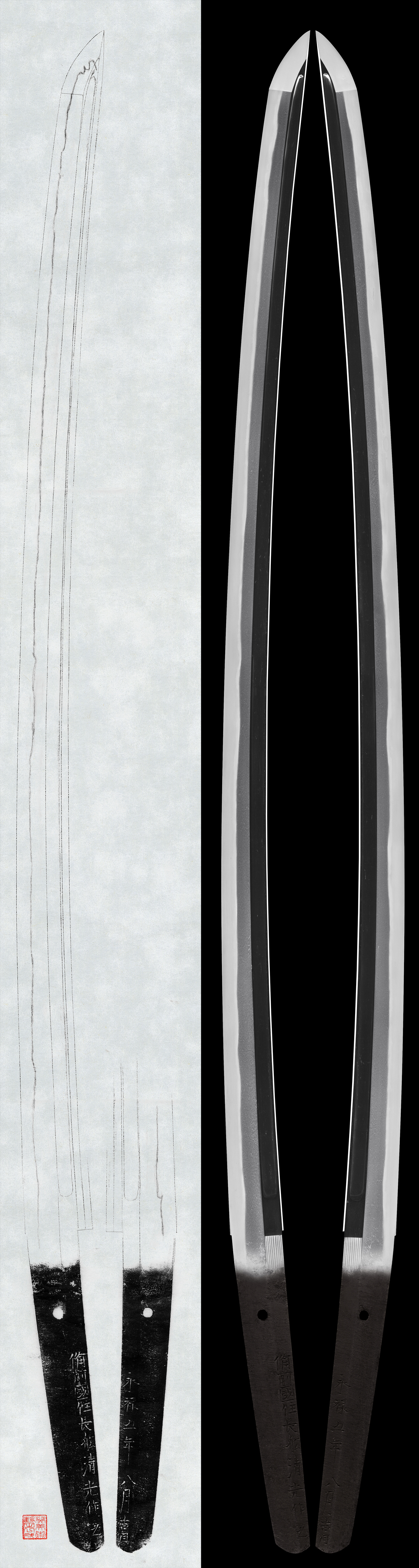
Oshigata:
Bizen Kuni Ju Osafune Gorosaemon no Jo Kiyomitsu.
Dated inscription on the tang: Eiroku 5 (1562).
Blade length noted as 2 shaku 2 sun 8 bu han (approx. 69.2 cm).
Written by Hon’ami Nisshu on a lucky day in February, 1991 (Heisei 3).
We divide 4 sections for each sword as Saijyo Saku, Jyojyo Saku, Jyo Saku and Regular Saku.
This piece is ranked as Jyo Saku (Above Average Work).
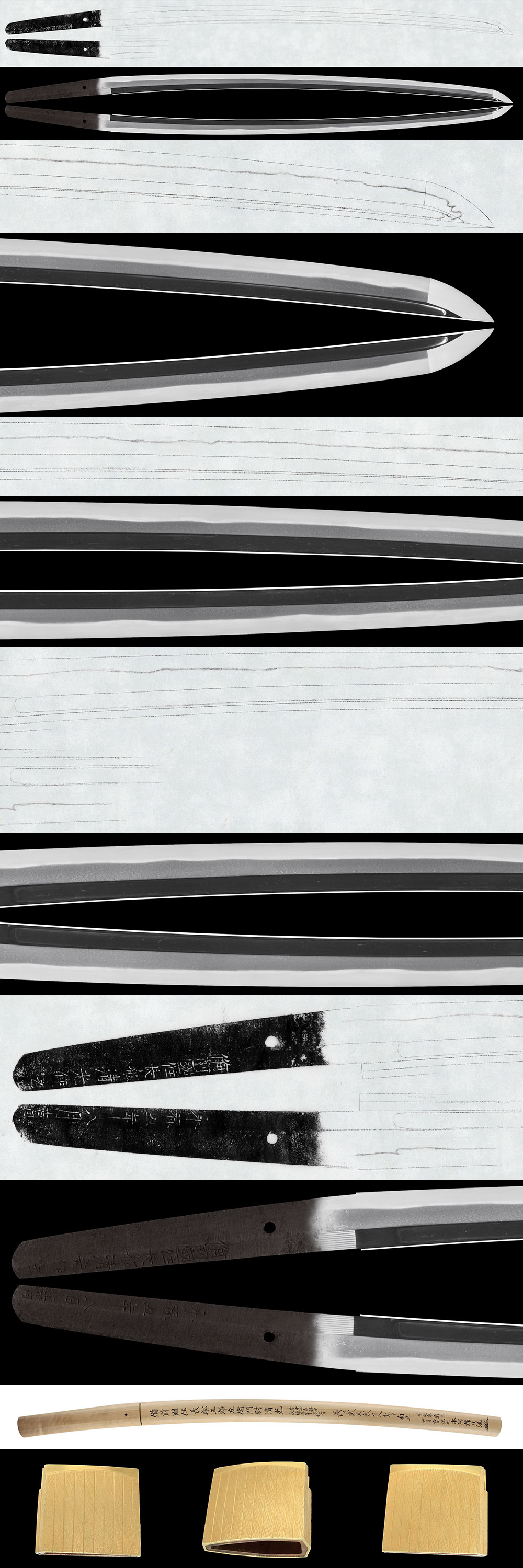
Habaki: Gold-plated single Habaki.
Blade Length: 69.2 cm (27.24 in)
Curvature: 1.7 cm (0.67 in)
Mekugi Hole: 1
Width at Base (Motohaba): 3.14 cm (1.24 in)
Width at Tip (Sakihaba): 2.00 cm (0.79 in)
Thickness of Rim (Kasane): 0.74 cm (0.29 in)
Sword Weight: 780 g
Shape:This sword has a robust width, with a bo-hi (groove) carved on both sides.The kissaki (tip) is slightly extended, presenting a solid and well-balanced appearance.
Jigane (Steel Surface):Well-forged ko-itame hada, showing a faint utsuri (shadow-like pattern).The signature resembles that of Gorosaemon no Jo Kiyomitsu.
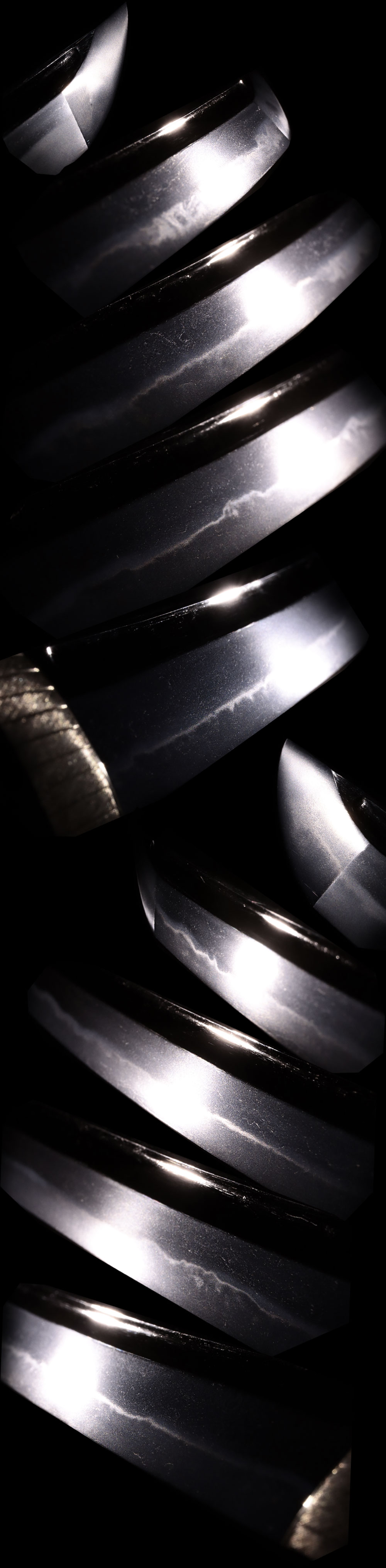
Hamon (Temper Pattern):Confirmed by Hon’ami Nisshu.
The jigane is beautiful, and the hamon complements it elegantly.
It begins with a straight temper line (suguha) transitioning into a mild notare, then a gentle gunome-midare with small ashi included—rich in variety.
Aoi Art’s Comment:
In the late Muromachi period, high-quality swords were rare.
However, some daimyos and warriors commissioned superior works.
This piece by Bizen Kuni Ju Osafune Gorosaemon no Jo Kiyomitsu is one such fine example.
Era: Muromachi Period
Historical Background:
The Muromachi period was an era of warfare.
The Eiroku era (1558–1570) included key events such as the Battle of Okehazama (where Nobunaga defeated Imagawa Yoshimoto), and the "Eiroku Incident" in 1565, when the 13th shogun Ashikaga Yoshiteru was assassinated.
These events marked a turning point in weakening the Muromachi shogunate and intensifying the Sengoku period's power struggles.
In 1565 (Eiroku 8):
The Eiroku Incident occurred—Miyoshi Nagayasu, Miyoshi Soun, Ise Sadanari (Miyoshi Sanninshu) and Matsunaga Hisahide attacked and killed Shogun Ashikaga Yoshiteru at Nijo Palace in Kyoto.
This unprecedented event—where a shogun was assassinated by his own retainers—led to the collapse of the shogunate’s authority.
Following the assassination, Yoshiteru's younger brother, Ashikaga Yoshiaki, was captured by Matsunaga Hisahide and placed under house arrest.
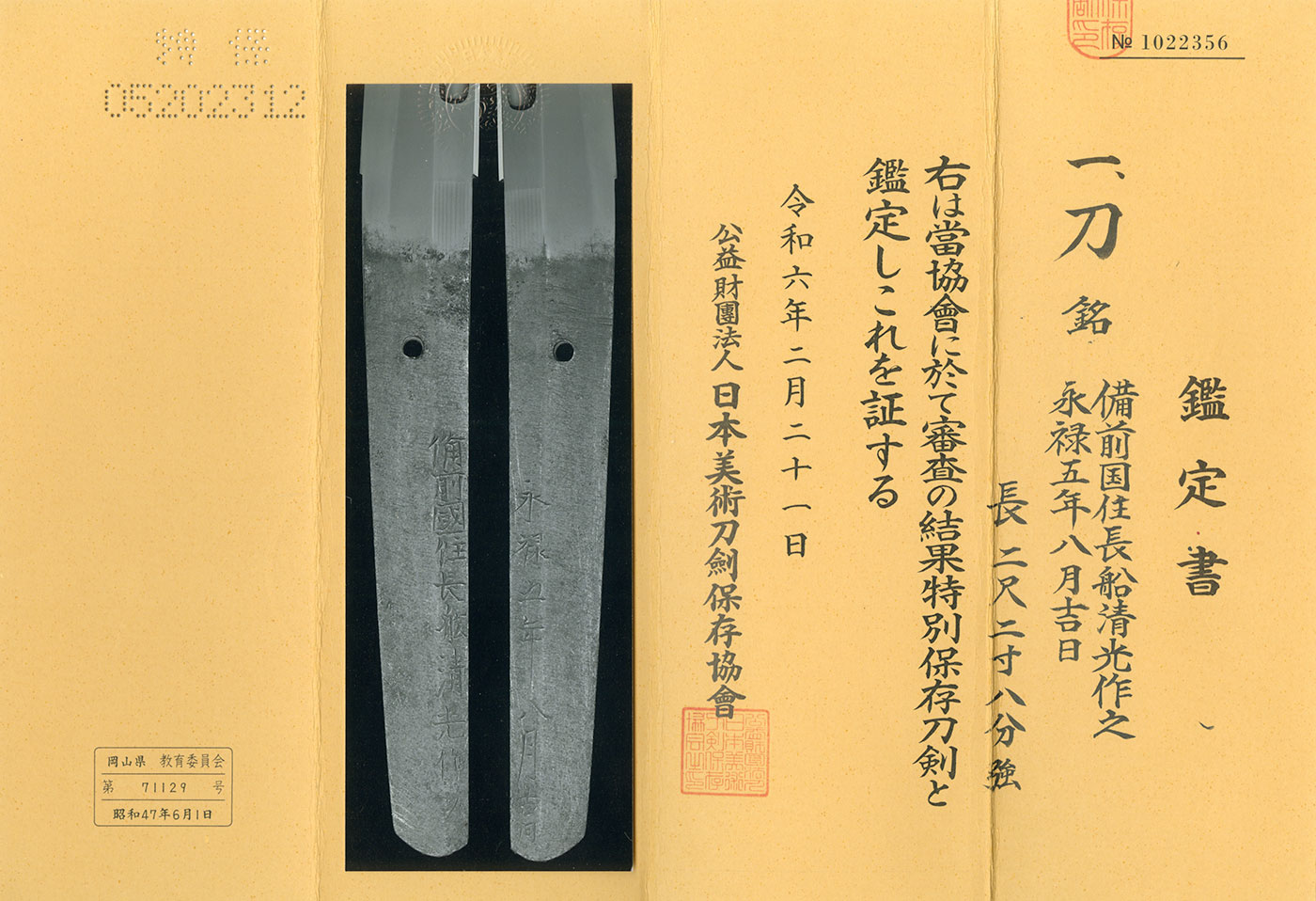
NBTHK Tokubetsu Hozon Token
Aoi Art Estimation Paper
Whole Oshigata
Shipping fee not included.
Auction Starting Price:1,400,000JPY
Place Bid


Related Items:
 Katana: Bizen Koku Ju Osafune Magouemon Jo Kiyomitsu(NBTHK Tokubetsu Hozon Token)
 Katana: Bizen Kuni ju Osafune Harumitsu(NBTHK Hozon Token)
 Tachi:Morihiro(22nd NBTHK Juyo Token)
 Wakizashi:Kaneyoshi (Seki) (NBTHK Hozon Token)
 Katana: Echizen Yasutsugu (2nd generation)(NBTHK Tokubetsu Hozon Token)
 Tachi:Bishū Osafune Tomosada (Ko-zori)(48th NBTHK Juyo Token)