
Ordering Number: AS26015
Katana in Shirasaya (NBTHK Tokubetsu Hozon Token)
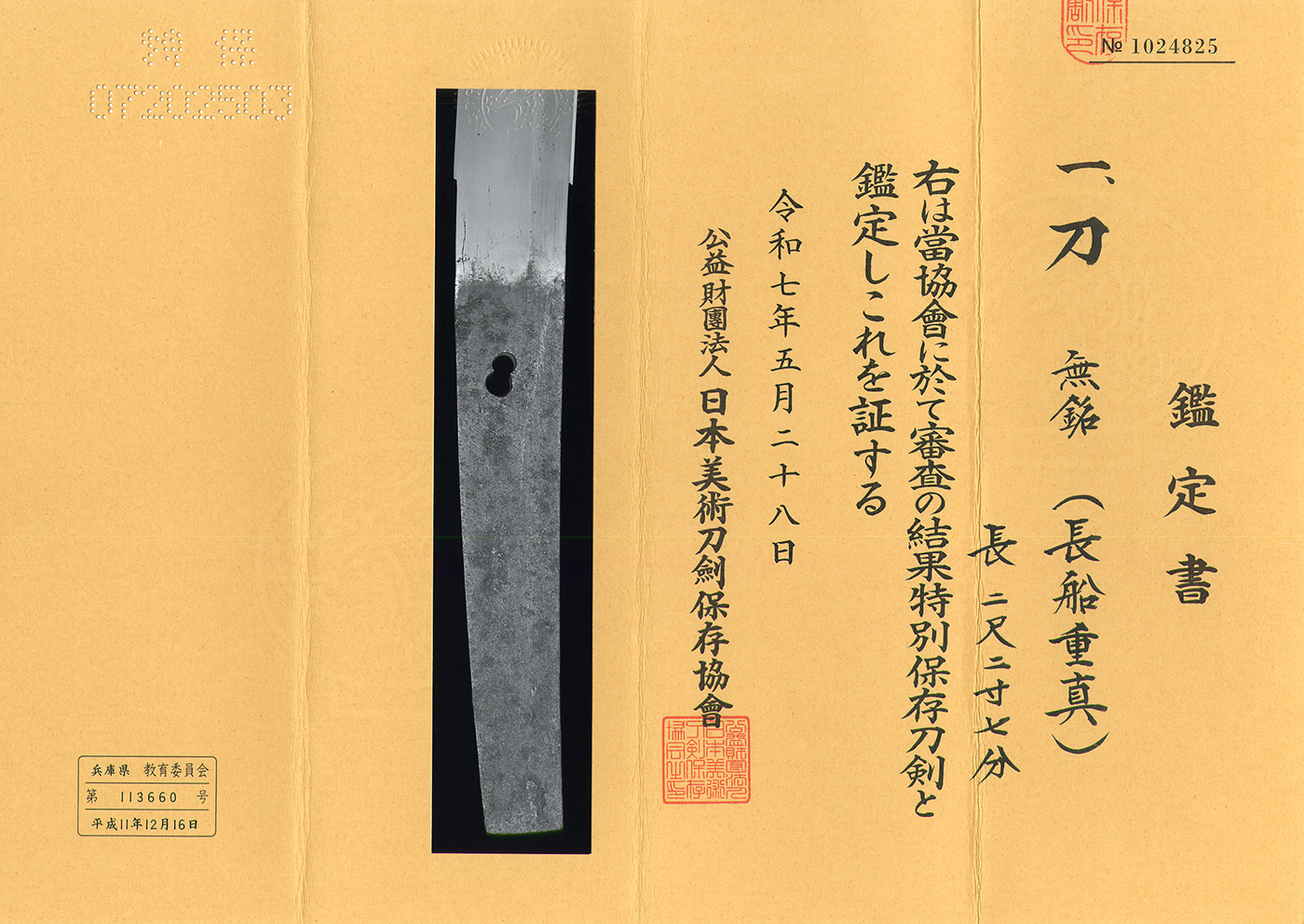
Signature: Mumei(Unsigned) (Osafune Shigezane)
無銘(長船重真)
Old Sword: Ryo Wazamono: Jyo Saku; Bizen.
(We divide 4 sections for each sword as Saijyo Saku, Jyojyo Saku, Jyo Saku and Regular Saku).
This work is ranked as Jyojyo Saku for Mumei (Osafune Shigezane).
Habaki: Single-layer silver habaki.
Blade Length: 68.8 cm (27.09 in).
Curvature: 1.4 cm (0.55 in).
Mekugi Hole: 1.
Width at Base (Motohaba): 3.13 cm (1.23 in).
Width at Tip: 2.1 cm (0.83 in).
Thickness of rim (Kasane): 0.68 cm (0.27 in).
Sword Weight: 750 g.
Era: Late Kamakura period, around 1334.
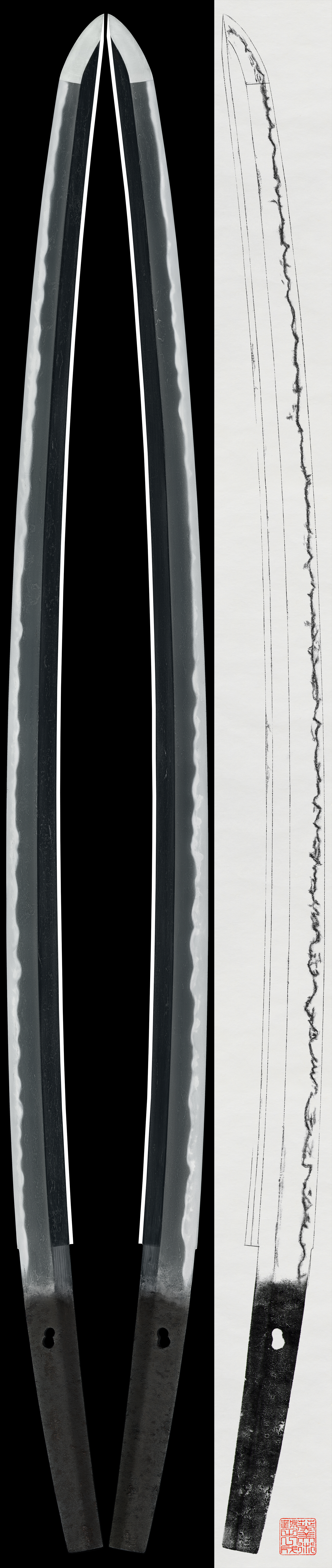
Shape: Wide blade with thick kasane and an extended kissaki, showing a well-proportioned and powerful shape.
Jigane: Well-forged ko-itame hada with well-refined shinogi-ji.
Hamon: Gunome-midare with sunagashi and kinsuji appearing in the temper.
Features: Osafune Shigezane was a swordsmith active from the late Kamakura period to the early Nanbokucho period, said to have been a younger brother or disciple of Motoshige, and his workmanship is similar. This blade has a wide mihaba and an excellent overall shape. The period of this work is considered to be around the late Kamakura period.
Historical Background: The year 1334 (Kenmu 1) was the year following the fall of the Kamakura shogunate in 1333, when Emperor Go-Daigo initiated direct imperial rule known as the Kenmu Restoration. Due to policies favoring court nobles and confusion over rewards, dissatisfaction among the samurai increased, forming the basis for the later Nanbokucho conflicts. This innovative political system, which collapsed in just over two years, marked its beginning in this period. Emperor Go-Daigo, after two failed attempts to overthrow the shogunate (the Shochu Incident and the Genko Incident), was exiled to Oki. During the Genko Incident, Prince Moriyoshi escaped the pursuit of the Kamakura forces and went to Yoshino in Yamato (present-day Nara Prefecture), calling upon anti-Hojo retainers, outlaws, warrior-merchants, and temples and shrines to rise in rebellion. Responding to this call, Kusunoki Masashige, Nitta Yoshisada, and Ashikaga Takauji advanced toward Kyoto on the emperor’s side. With officials expelled from institutions such as the Rokuhara Tandai (an agency established by the Kamakura shogunate to monitor the imperial court), the Kamakura shogunate, which had lasted approximately 150 years, came to an end.
NBTHK Tokubetsu Hozon Token.
AoiArt estimation paper: Whole Oshigata.
Please note: The price does not include the international shipping fees.
Auction Starting Price:1,100,000JPY
Place Bid




Related Items:
 Katana: Mumei (Den Osafune Shigezane)(NBTHK Tokubetsu Hozon Token)
 Katana:: Mumei (Ichimonji) (NBTHK Tokubetsu Hozon Token) (Consignment Sale)
 Katana:Mumei (Ichimonji) (NBTHK Tokubetsu Hozon Token)
 Katana:Chikuzen Kami Nobuhide(NBTHK Tokubetsu Hozon Token)
 Katana: Mumei(Rai Kunitoshi) with golden inscription by Hon'ami Mitsutada (25th NBTHK Tokubetsu Juyo Token)
 Katana:Mumei (attributed to Omura Kaboku) (Kiri-tsuke Mei): Ken Tanren Gokusei Den Tame Kaho Fujii Noriaki Bunki Chichi Kore wo Haku(NBTHK Hozon Token)