
Ordering Number: AS25792
Katana in Shirasaya (NBTHK Tokubetsu Hozon Token)
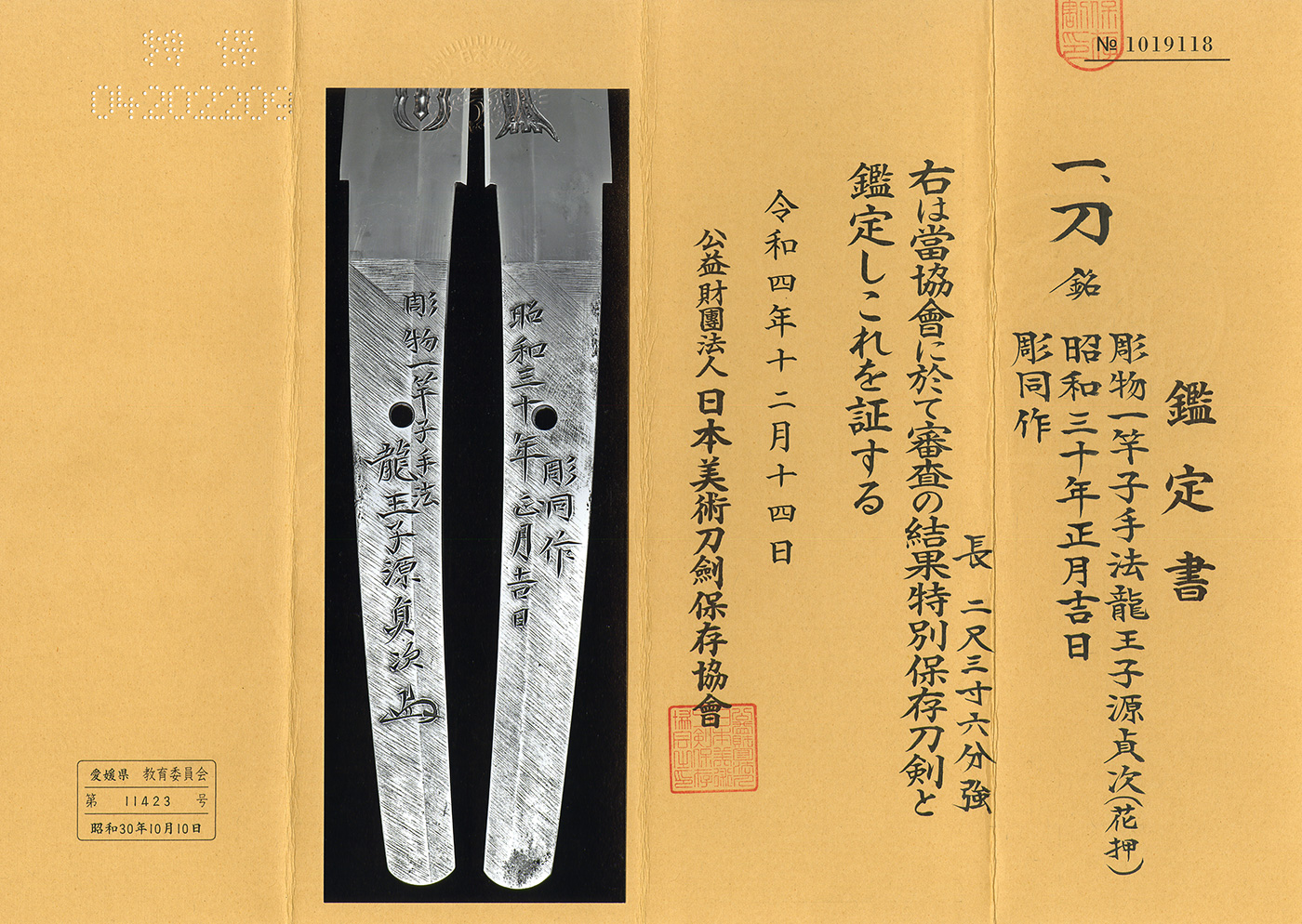
Signature: Horimono Ikkanshi technique
Ryuouji Minamoto Sadatsugu (kao)
A lucky day in January, 1955
Carving by the same artist
彫物一竿子手法
龍王子源貞次(花押)
昭和三十年正月吉日
彫同作
Living National Treasure 1st designation
(We divide 4 sections for each sword as Saijyo Saku, Jyojyo Saku, Jyo Saku and Regular Saku).
This work is ranked as Jyojyo Saku for Ryuouji Minamoto Sadatsugu.
Habaki:
Blade Length: 71.82 cm (28.28 in).
Curvature: 2.58 cm (1.02 in).
Mekugi Hole: 1.
Width at Base (Motohaba): 3.41 cm (1.34 in).
Width at Tip: 2.42 cm (0.95 in).
Thickness: 0.81 cm (0.32 in).
Sword Weight: gram.
Era: Carved on a lucky day in January, 1955.
Shape: Wide mihaba, thick kasane, with deep curvature and a standard kissaki.
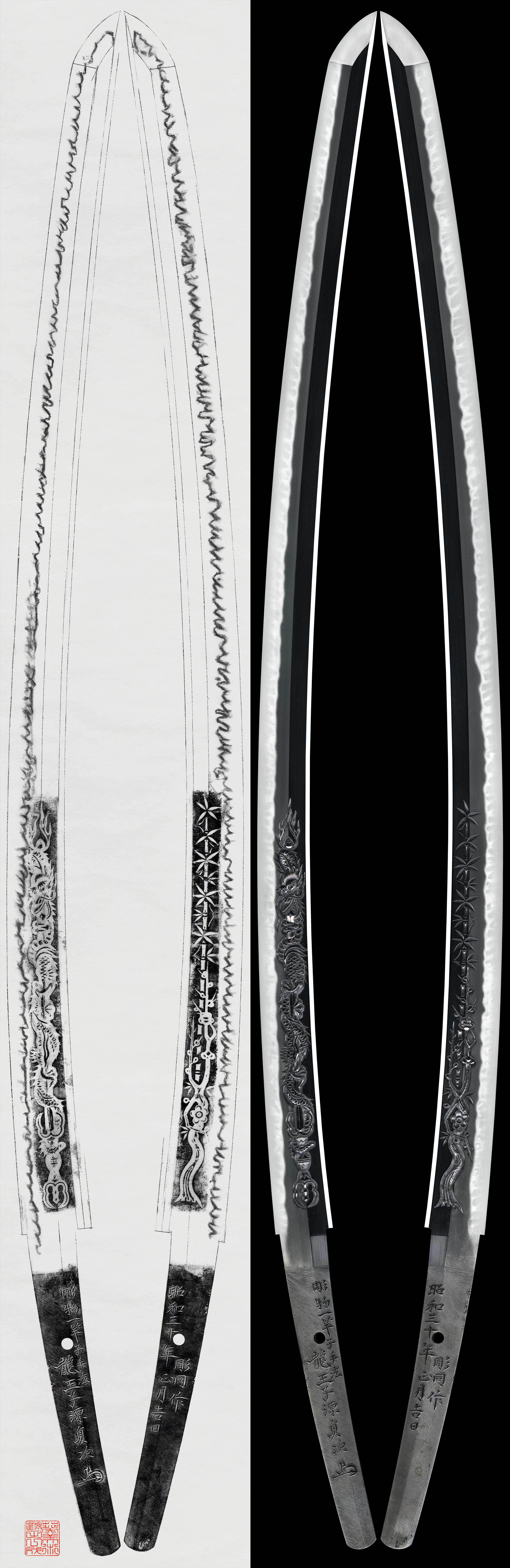
On the omote, the inscription “Ikkanshi technique” is carved along with a dragon by the artist himself, and on the ura, plum blossoms and bamboo are carved.
The carvings are truly magnificent and उत्कृष्ट.
Jigane: Fine ko-itame hada is tightly forged, resulting in excellent steel.
Hamon: A well-executed choji-midare with active irregular pattern.
Takahashi Kinichi Sadatsugu was a swordsmith from Ehime Prefecture recognized as an Important Intangible Cultural Property, that is, a Living National Treasure.
He produced many swords dedicated to shrines and presented to the Imperial Household, and in 1938 he received the Prime Minister’s Award at the 1st Sword Exhibition.
In the past, I purchased a tanto in the American market.
That tanto was very similar to one with carvings that the Japanese government presented to Lieutenant General Uokawa around 1949 after Japan’s defeat in the war.
The tanto of Lt. Gen. Uokawa had a large dragon carving and on the reverse side beautifully carved plum and bamboo motifs, all executed by the same carver.
I later purchased a piece with similarly magnificent carvings.
This work, carved by the same artist, is among the finest modern examples.
In the future, it will likely become quite famous, and recently the prices of Japanese swords have risen considerably.
In the past, wakizashi could be purchased at relatively low prices, but it has become increasingly difficult.
Well-known works today are expected to rise significantly in value.
Please carefully apply machine oil, maintain the tang, and prevent rust.
Features: As one of the first designated Living National Treasures, Sadatsugu was highly regarded as a leading master of sword carvings.
I once purchased a tanto in the United States, believed to have been sent from Japan in the early postwar period, probably around 1948.
The name of Lt. Gen. Uokawa was clearly engraved on the tang.
I later sold that tanto in Japan, but after telling this story to the buyer, he decided not to sell it and took it back.
It is likely still carefully preserved today.
I have now acquired this large sword with impressive carvings, perhaps by some fate.
Lt. Gen. Uokawa died in a car accident during the Korean War.
This sword was made in imitation of the Edo-period master Ikkanshi Tadatsuna, as indicated by the carving.
It is a superbly carved work.
Historical Background: The New Year of 1955 was a time when Japan, having achieved postwar recovery, embraced the dawn of high economic growth known as the “Jinmu boom.”
Bustling districts such as Asakusa regained vitality, and family traditions like mochi pounding, formal greetings in festive attire, and gatherings in tatami rooms were central, reflecting a transition from monochrome to color era.
Social Conditions: Ten years after the war, Japan stood at the threshold of rapid economic growth.
NBTHK Tokubetsu Hozon Token
Aoi Art estimation paper
Whole Oshigata:
*International shipping not included separately.
Please note: The price does not include the international shipping fees.
Auction Starting Price:6,500,000JPY
Place Bid




Related Items:
 Katana: Seitan Ryuoji Minamoto Sadatsugu (NBTHK Tokubetsu Hozon Token)
 Tachi: Sanryūtei Ryōsanshi Masamine Saku Kore (Living National Treasure) Dated: August, Year of the Wood Rabbit (1975) (NBTHK Tokubetsu Hozon Token)
 Katana:Amata Akitsugu Saku Kore (Living National Treasure) A fortunate day in January, 1977 Made on request by Mr. Takeshi Muraki (NBTHK Tokubetsu Hozon Token)
 Tachi:Unshū-jū Tadayoshi Zo Kore (2nd)(Mukansa Swordsmith)(NBTHK Hozon Token)
 Katana: Naniwa ju Gassan Unryushi Sadakazu Kitae (Kokuin) (NBTHK Tokubetsu Hozon Token) (NBTHK Tokubetsu Kicho Token)
 Katana:Osaka Ju Gassan Sadakatsu (Kao) (NBTHK Tokubetsu Hozon Token)