
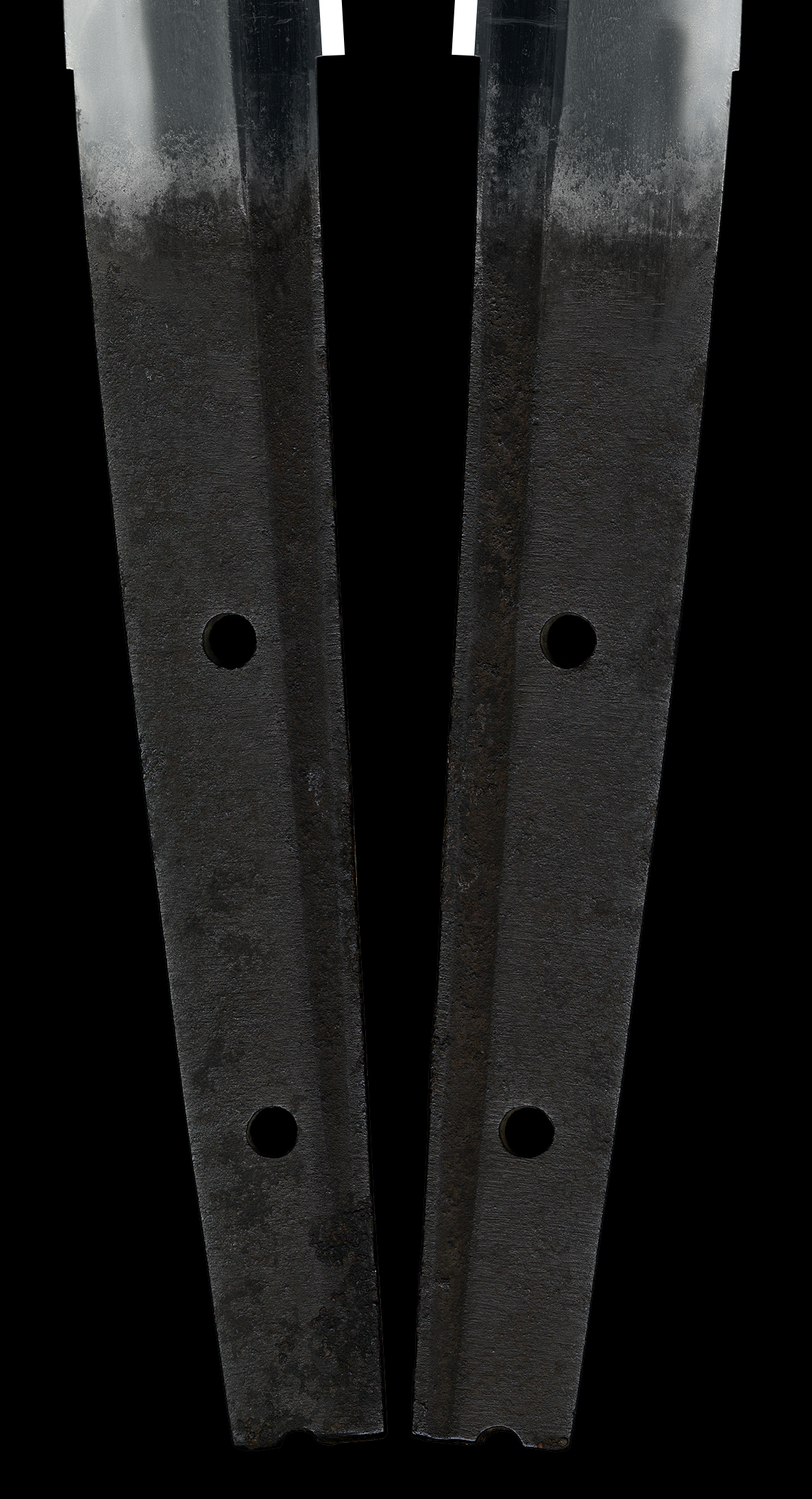
Previous answer is
Mumei(Unsigned) (Aoe).
無銘(青江)
Features: This Aoe work is solidly built, heavy in weight, and a healthy sword.
It has recently been designated as Juyo Token.
From the extended kissaki, it is likely judged as a work of the Nanbokucho period.
Aoe is a school that continued from the Kamakura period (1185–1333) into the Nanbokucho period (1336–1392).
The sayagaki bears the inscription “Aoe Tsunetsugu” and appears to date from the early Showa period (1926–1989).
We have rarely seen such a solidly constructed piece, and the workmanship is excellent.
=====================================
Appraisal Quiz #885 (February 4th, 2026)
Who made this sword do you think ?
=====================================
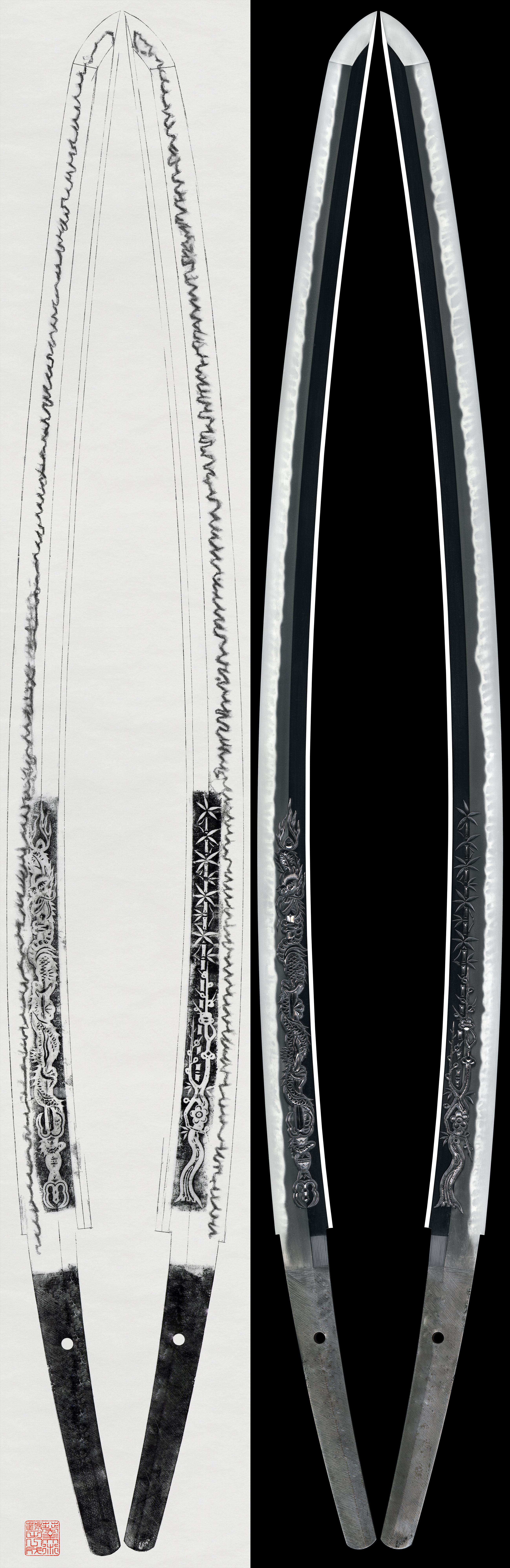

Blade Length: 2 shaku 3 sun 7 bu 71.82 cm (28.29 in).
Curvature: 8 bu 5 rin 2.58 cm (1.01 in).
Mekugi Hole: 1.
Width at Base (Motohaba): 3.41 cm (1.34 in).
Width at Yokote (Sakihaba): 2.42 cm (0.95 in).
Thickness (Kasane): 0.81 cm (0.32 in).
Shape: Wide mihaba, thick kasane, and deep curvature with a standard kissaki.
On the omote, the smith carved a dragon by himself, and on the ura he carved plum blossoms and bamboo.
The carvings are magnificent and superbly executed.
Jigane: The ko-itame hada is well forged and tightly packed, forming an excellent jigane.
Hamon: A well-executed choji-midare with an active and beautiful irregular pattern
=====================================
Answer will be posted at next Appraisal Quiz.
=====================================
(Please acknowledge not replying to mail about Appraisal Quiz by our convenience.)