
Ordering Number: 26566
Katana in Shirasaya with Koshirae (NBTHK Hozon Token)
Signature: Hirofusa Saku 廣房作 (Gimeisai 義明斎)
(We divide 4 sections for each sword as Saijyo Saku, Jyojyo Saku, Jyo Saku and Regular Saku).
This blade is ranked as Jyo Saku among the works of Hirofusa.
Habaki: Single copper habaki
Blade Length: 76.5cm (30.12in)
Curvature: 1.4cm (0.55in)
Mekugi-ana: 1
Motohaba: 3.47cm (1.37in)
Sakihaba: 2.45cm (0.96in)
Kasane: 0.68cm (0.27in)
Weight: 915g
Period: Late Edo period
Shape: A powerful and imposing katana with a wide mihaba, relatively shallow curvature, and an elongated kissaki.
The blade has a robust and magnificent appearance.
Jigane: Ko-itame hada with a slightly pronounced grain pattern.
Areas of hardened steel are visible in places along the shinogi-ji.
Hamon: Nie-deki ko-gunome-midare.
The boshi displays a midare-komi pattern.
Features: Hirofusa, who used the art name Gimeisai, was a swordsmith active in Kuwana, Ise Province.
He was a disciple of Daido.
Koshirae: Han-tachi Koshirae
Tsuba: A mokko-shaped iron tsuba featuring openwork decoration and a raised rim.
Fuchikashira and Kojiri: Iron fittings.
Saya (Scabbard): Black ishime-ji (stone-textured) lacquer saya.
Menuki: Carved with lion and peony motifs, decorated with gold iroe.
Historical Background: The Bakumatsu period (approximately 1853–1869) was a turbulent time in Japanese history, beginning with the arrival of the American Black Ships and culminating in the collapse of the Edo shogunate and the establishment of the new Meiji government.
The following were some of the major events of this period.
1853 – Arrival of the Black Ships: Commodore Matthew Perry's American fleet arrived at Uraga and demanded that Japan open its ports to foreign nations.
1854 – Convention of Kanagawa: Japan signed the Treaty of Peace and Amity with the United States, marking a significant step toward ending its policy of national seclusion.
The ports of Shimoda and Hakodate were opened to American ships.
1858 – Treaty of Amity and Commerce: Ii Naosuke, the Tairo (Great Elder) of the shogunate, signed a commercial treaty with the United States without obtaining imperial approval.
The treaty expanded foreign trade but contained unequal provisions that disadvantaged Japan.
1860 – Sakuradamon Incident: Ii Naosuke was assassinated outside the Sakuradamon Gate of Edo Castle by a group that included former samurai from the Mito Domain.
1867 – Restoration of Imperial Rule (Taisei Hokan): Tokugawa Yoshinobu, the 15th and final Tokugawa shogun, formally returned political authority to the Imperial Court, bringing the Tokugawa shogunate to an end.
1868 – Bloodless Surrender of Edo Castle: Through negotiations involving Katsu Kaishu and Saigo Takamori, Edo Castle was surrendered without a major battle, helping prevent widespread destruction in the city.
NBTHK Tokubetsu Hozon Token.
AoiArt estimation paper: Whole Oshigata.
Overseas shipping is charged separately.
Please note: the price does not include the shipping fees.
Price:500,000JPY
Order Form


Related Items:
 Katana:Sakai Ikkansai Shigemasa (Mukansa Swordsmith) (NBTHK Hozon Token)
 Katana:Mino Koku Okachiyama Sanroku Junin Fujiwara Nagasada. August, 1866. Made at Aoyama in Edo. (NBTHK Tokubetsu Hozon Token)
 Katana:Joshu Mito Ju Katsumura Tokukatsu Kore wo Tsukuru 常州水戸住勝村徳勝造之 Meiji San nen Hachi gatsu hi (NBTHK Tokubetsu Hozon Token) (NBTHK Tokubetsu Kicho Token)(Shibata estimation paper)
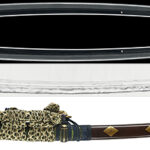 Tachi: Suketsugu (Province Unknown, Late Kamakura Period)(NBTHK Tokubetsu Hozon Token) (Koshirae: NBTHK Hozon Tosogu)
 Katana: Seitan Ryuoji Minamoto Sadatsugu (NBTHK Tokubetsu Hozon Token)
 Katana: Yamato Kami Hidekuni (February 1870)(NBTHK Tokubetsu Hozon Token)