
Ordering Number: AS26511
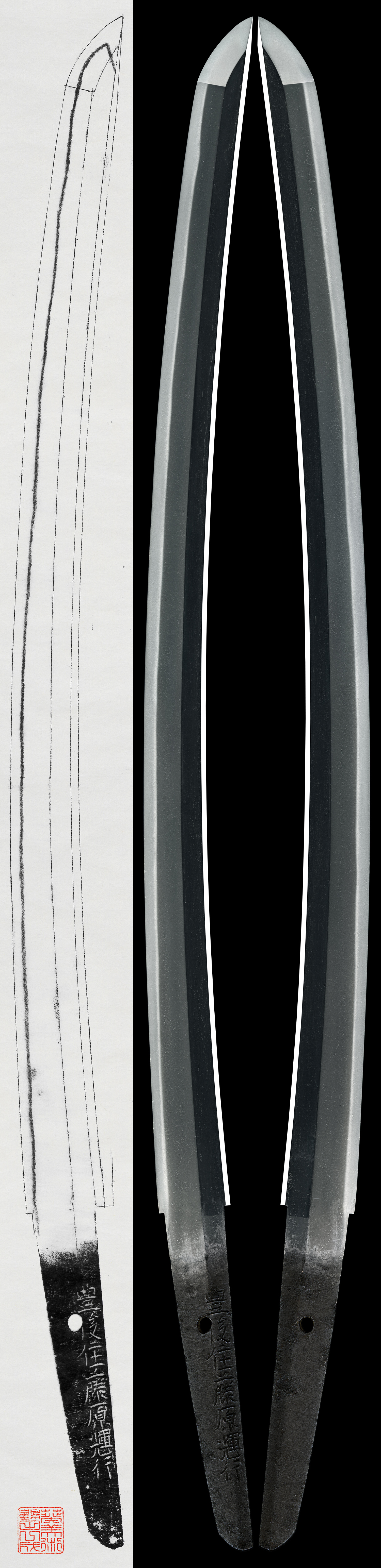
Wakizashi in Shirasaya with Koshirae (NBTHK Hozon Token)
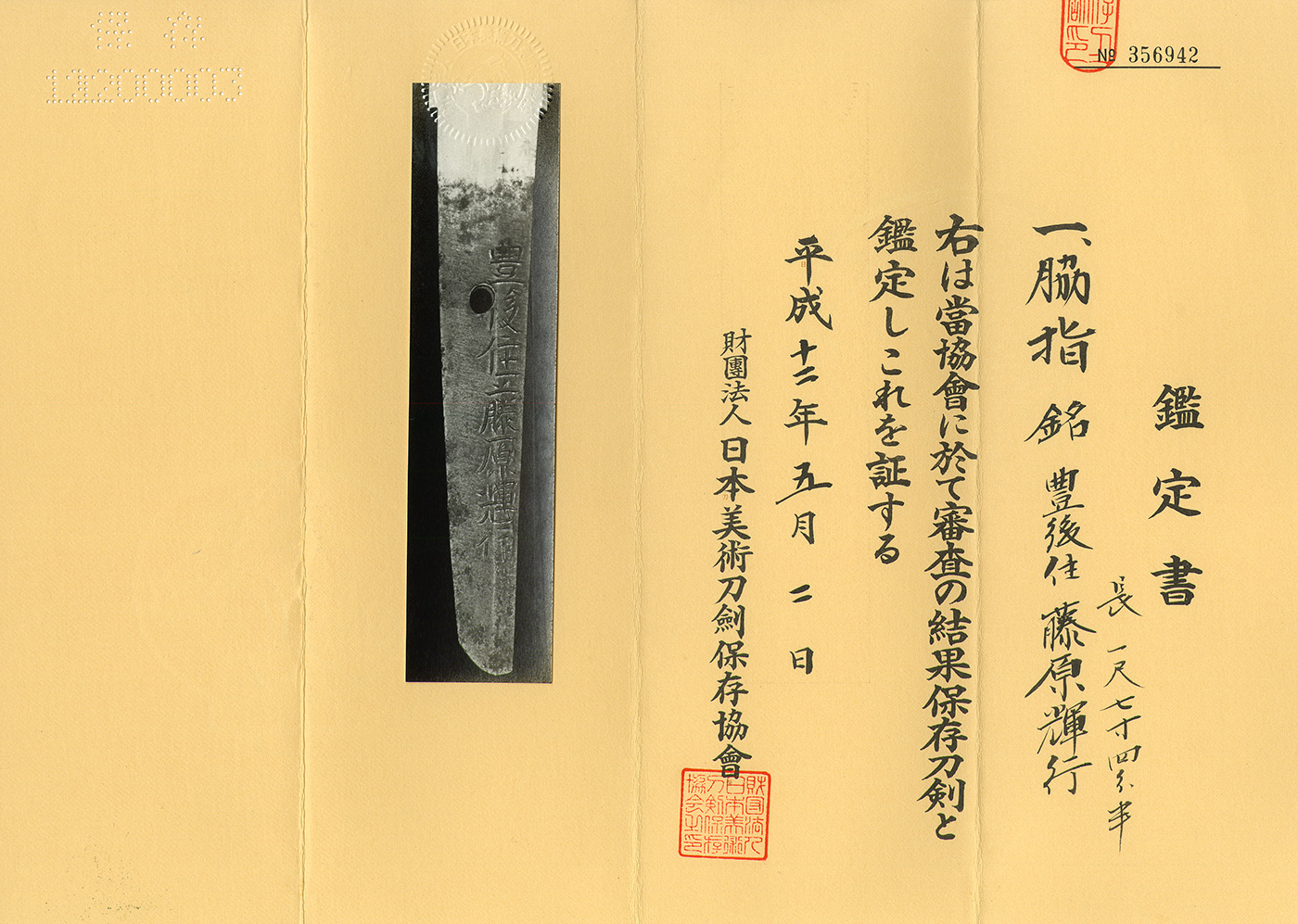
Signature: Bungo Ju Fujiwara Teruyuki
豊後住藤原輝行
Shinto: Chu Saku: Enpo Era: Bungo Province
(We divide 4 sections for each sword as Saijyo Saku, Jyojyo Saku, Jyo Saku and Regular Saku).
This blade is ranked as Jyo Saku among the works of Bungo Ju Fujiwara Teruyuki.
Habaki: Copper habaki decorated with gold iroe.
Blade Length: 53.0 cm (20.87 in).
Curvature: 1.7 cm (0.67 in).
Mekugi Hole: 1.
Width at Base (Motohaba): 3.19 cm (1.26 in).
Width at Yokote: 2.14 cm (0.84 in).
Thickness of rim (Kasane): 0.70 cm (0.28 in).
Sword Weight: 565 g.
Era: Around the Enpo era (1673–1681), Edo period.
Shape: A well-proportioned wakizashi with a wide mihaba, substantial kasane, deep curvature, and an elongated kissaki, giving it an impressive overall appearance.
Jigane: Finely forged ko-mokume hada mixed with ko-itame hada, displaying a well-organized and refined grain structure.
Hamon: Nie-deki suguha.
The boshi turns back in a rounded form.
Features: Although many swords of the Takada school may appear rather ordinary at first glance, numerous examples produced during the early Edo period and earlier display surprisingly exceptional craftsmanship.
Some are so finely made that they could almost be mistaken for works of the prestigious Ichimonji school.
This is a particularly interesting blade worthy of attention.
Koshirae:
Tsuba: Iron tsuba with rounded-square corners, carved with bamboo and a wise scholar, highlighted with gold iroe.
Menuki: Menuki carved with chrysanthemum motifs and decorated with gold iroe.
Fuchikashira: Shakudo fuchikashira carved with Daruma (Bodhidharma) and plant motifs, decorated with gold iroe.
Kurikata: Shakudo kurikata carved with plant motifs and decorated with gold iroe.
Saya (Scabbard): Black polished lacquer saya.
Historical Background:
Arrival of the British Ship Return (Request to Resume Trade):
The British ship Return arrived at Dejima in Nagasaki and requested the resumption of trade with Japan, an event known as the Return Incident.
However, the Tokugawa shogunate rejected the request, citing reasons including the British king's marriage to a Catholic princess.
Construction of Kintai Bridge:
Kintai Bridge, located in present-day Iwakuni City, Yamaguchi Prefecture, and regarded as one of Japan's 3 most famous bridges, was constructed in 1673.
Kikkawa Hiroyoshi, the lord of Iwakuni Domain, commissioned the bridge with the aim of creating a structure that could withstand repeated flooding.
The year 1688, marking the transition from the Jokyo era to the Genroku era, was also the beginning of a period in which Genroku culture flourished and the vibrant culture of the merchant class developed significantly.
NBTHK Hozon Token.
AoiArt estimation paper: Whole Oshigata.
Please note: The price does not include the international shipping fees.
Auction Starting Price:0,000JPY
Place Bid





Related Items:
 Wakizashi:Bungo no Kami Minamoto Masayasu(NBTHK Tokubetsu Hozon Token)
 Wakizashi:Bungo no Kami Minamoto Masayasu (also read as Masatomo) (NBTHK Hozon Token)
 Wakizashi:Bishu Osafune Norimitsu (4th generation) Dated: February, Eikyo 5 (1433) (NBTHK Tokubetsu Hozon Token)
 Wakizashi: Higashiyama ju Yoshihira (NBTHK Tokubetsu Hozon Token)
 Wakizashi: Hizen Dewa no Kami Fujiwara Yukihiro (First Generation)(NBTHK Hozon Token)
 Wakizashi:Omi Daijo Fujiwara Tadahiro (NBTHK Tokubetsu Hozon Token)