
Ordering Number: AS25617
Katana in Shirasaya (NBTHK Tokubetsu Hozon Token)
Inscription: Mumei(Unsigned)(Komihara 古三原)
We divide works in to Saijo Saku, Jyojyo Saku, Jyo Saku,and Regular Saku.
This piece is ranked as Jyojyo Saku for Mumei(Komihara).
Habaki: Single Silver
Blade Length: 67.2cm (26.46in)
Curvature: 1.8cm (0.71in)
Mekugi-ana: 4 (2 filled)
Motohaba: 3.09cm (1.22in)
Sakihaba: 2.24cm (0.88in)
Kasane: 0.71cm (0.28in)
Weight: 415g
Era: Nanbokucho period, circa early 14th century
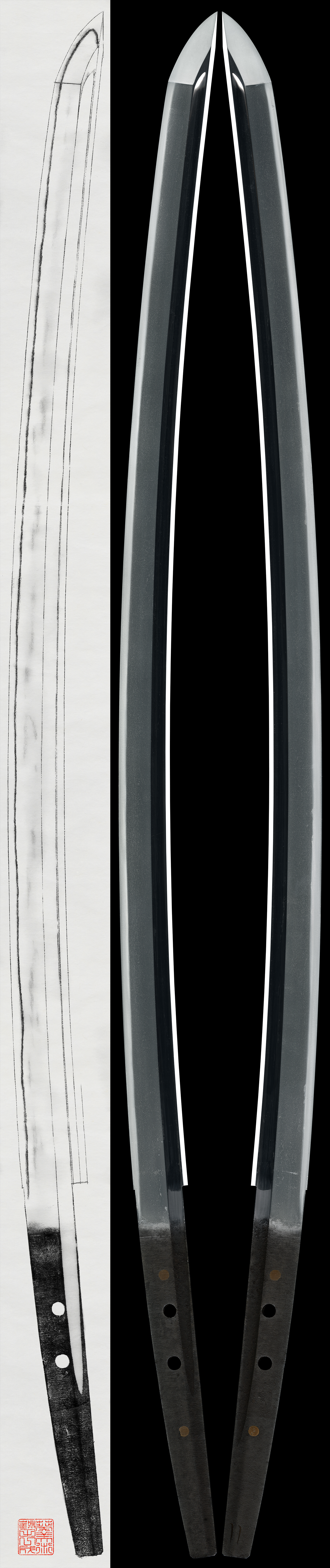
Shape: slightly wide, thick and slightly carved blade with big kissaki. Bohi is carved on the both sids.
Jigane: Koitame hada covered with fine chikei and jinie.
Hamon: Suguha with tight nioikuchi.
Features: The Mihara school was a group of swordsmiths who flourished in Mihara, Bingo Province, tracing their origins to Masaiye in the late Kamakura period. Among their works, those produced from the late Kamakura through the Nanbokucho period are classified as Ko-Mihara (Old Mihara). As this region contained many estates belonging to temples and shrines in Nara, the workmanship of the Mihara school shows the influence of the Yamato tradition. Compared with swords made in Yamato proper, however, the nie in the ji and ha tends to be more subdued, shirake-utsuri appears in the forging, the nioiguchi is relatively tight, and the boshi is generally gentle in character.
This sword has the imposing and dignified shape characteristic of the Nanbokucho period. The nie in the jigane sparkles beautifully, and the sword displays excellent workmanship.
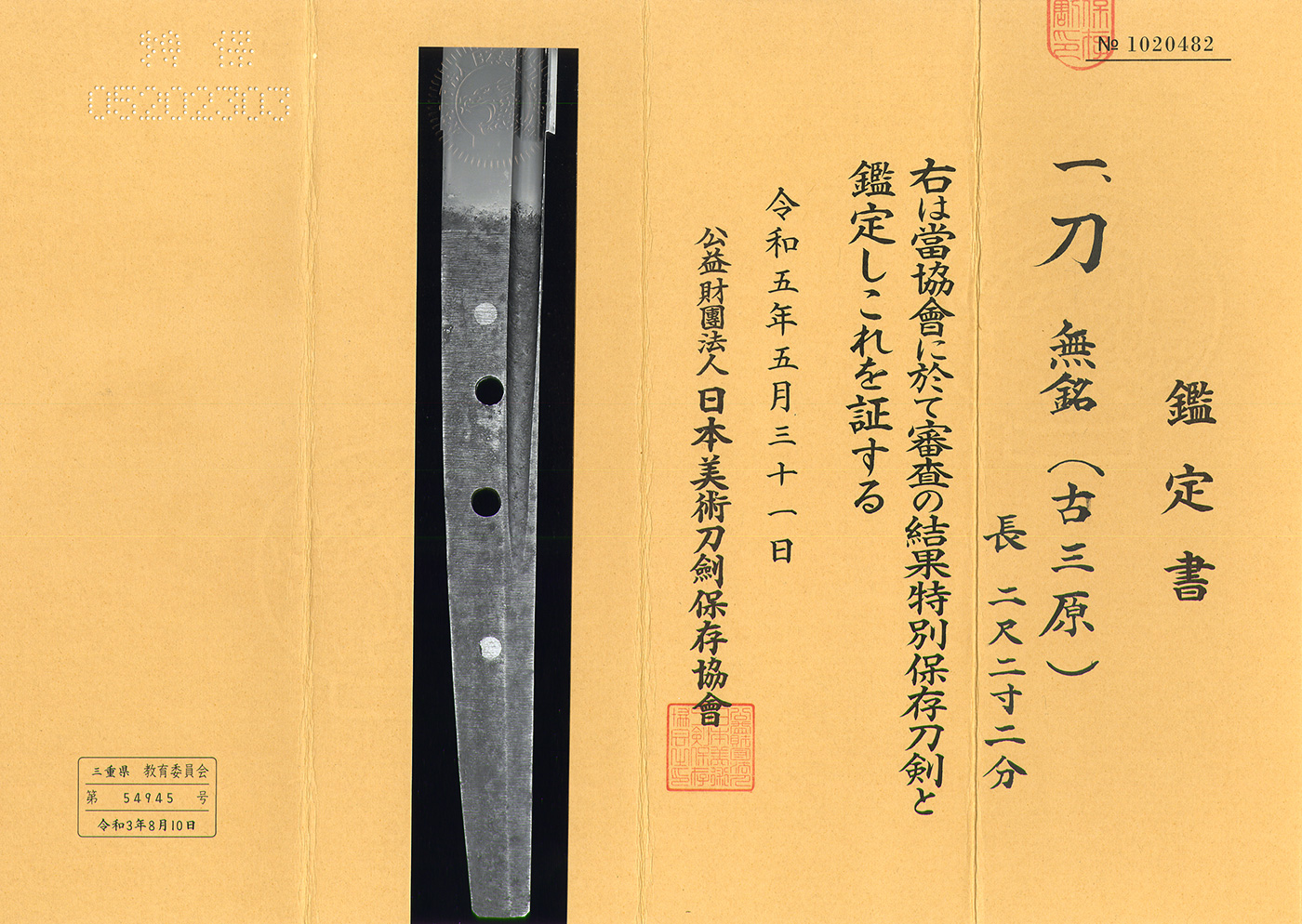
NBTHK Tokubetsu Hozon Certificate
Aoi-Art estimation Paper
whole Oshigata
Please note: the price does not include the shipping fees.
Auction Starting Price:950,000JPY
Place Bid


Related Items:
 Katana:Mumei (Unsigned) (Hokke School, Nanbokucho Period) (NBTHK Tokubetsu Hozon Token)
 Katana: Mumei(Unsigned)(judged as Enju)(the 26th NBTHK Juyo Token)
 Katana: Mumei (Aoe school)(the 25th Juyo Token)
 Katana: Mumei(Unsigned)(Hokke Ichijo) (NBTHK Tokubetsu Hozon Token)
 Tachi:Sueyuki (Den Bungo, Late Kamakura period)(NBTHK Tokubetsu Hozon Token)
 Katana: Mumei (Unsigned)(Yamato-Shizu) (16th NBTHK Juyo Token)