
Ordering Number: AS26451
Katana in Shirasaya with Koshirae (NBTHK Tokubetsu Hozon Token)
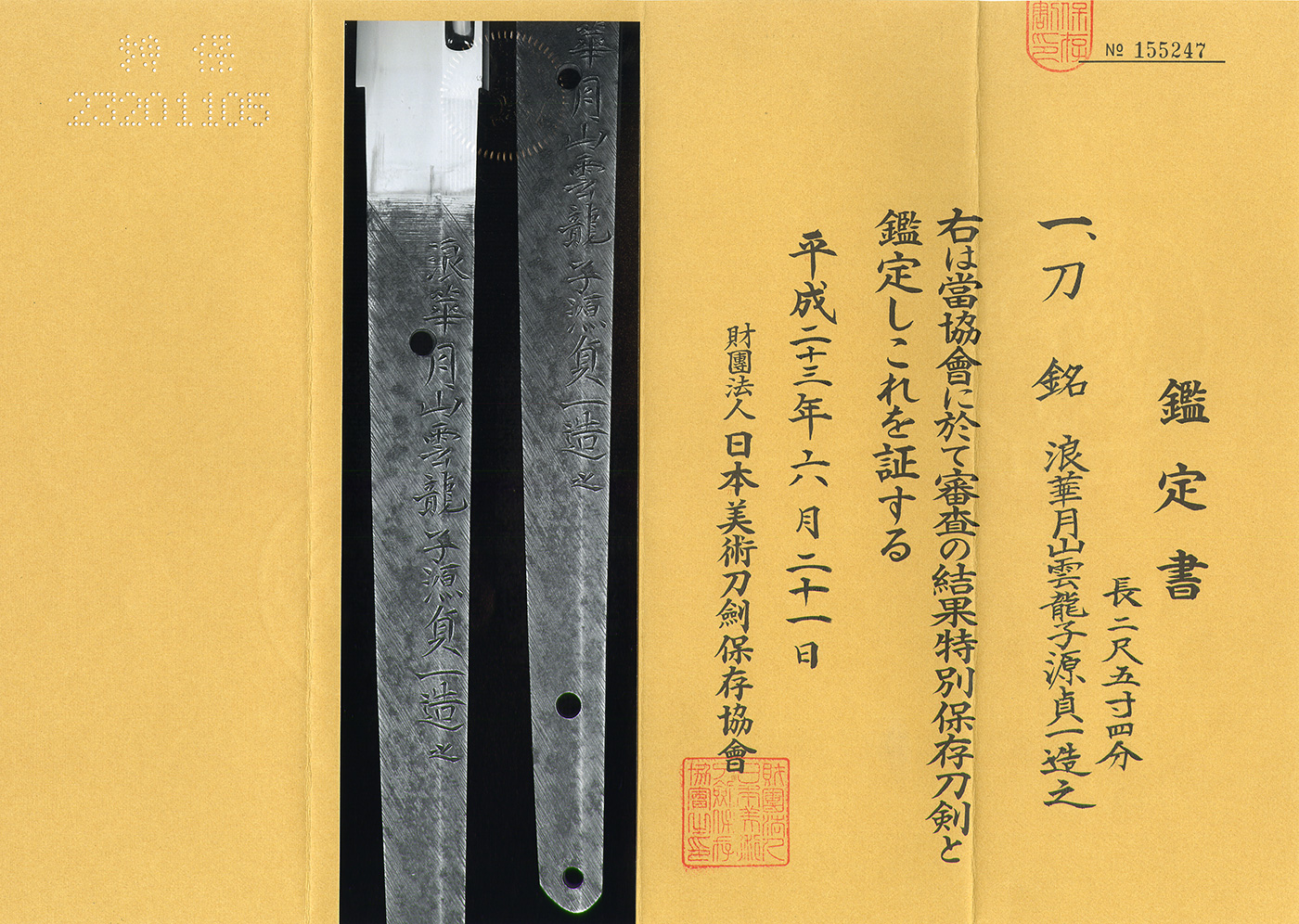
Signature: Naniwa Gassan Unryūshi Minamoto Sadakazu Tsukuru Kore
浪華月山雲龍子源貞一造之
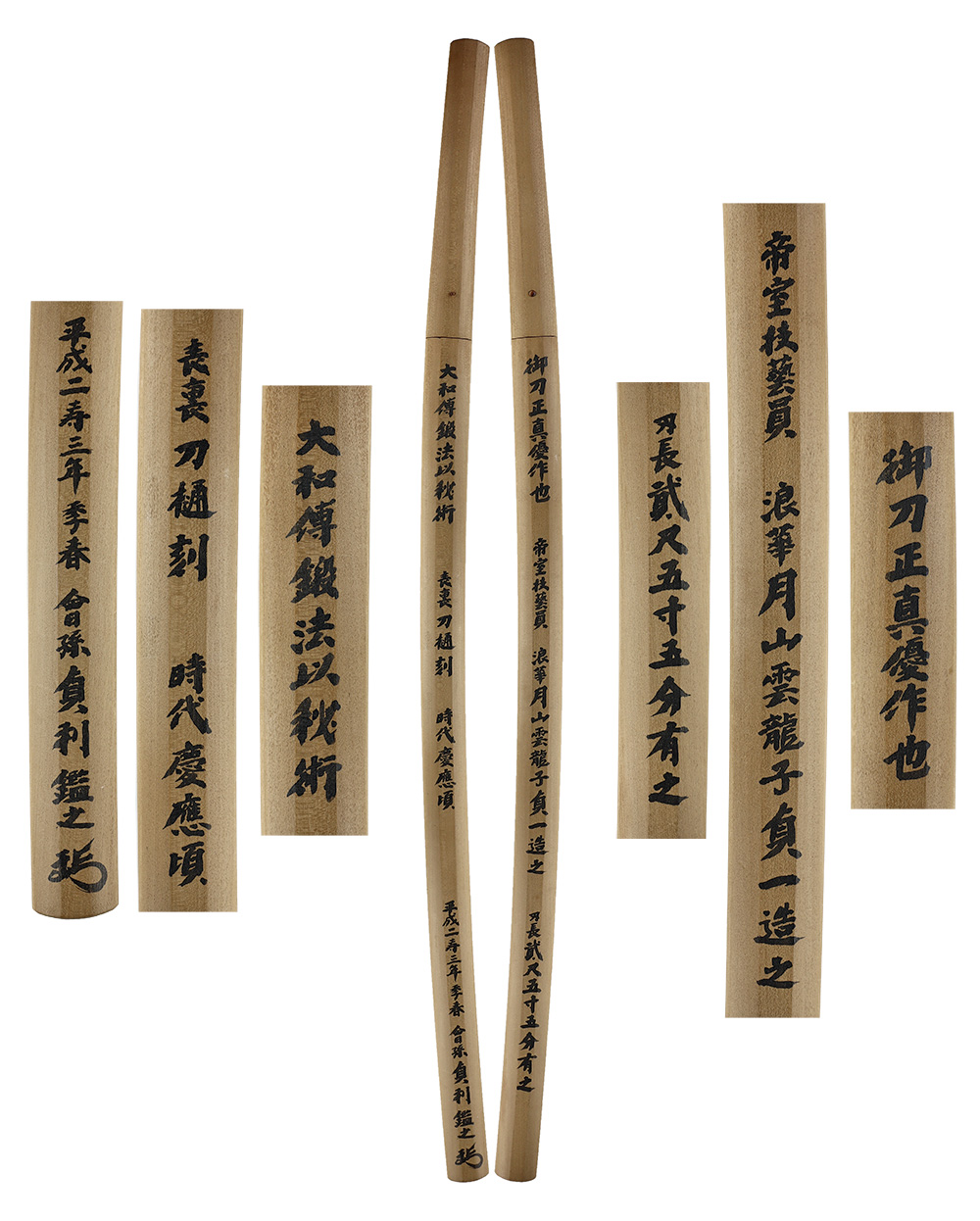
Sayagaki: This sword is genuine and an excellent work by Imperial Household Artist Naniwa Gassan Unryūshi Sadakazu. Blade length: 2 shaku 5 sun 5 bu. Forged in the Yamato tradition using secret techniques, with bohi carved on both sides. Made around the Keio era (1865–1868). Appraised by his great-grandson, Sadatoshi, in the third month of Heisei 23 (2011). (Kaō)
(We divide 4 sections for each sword as Saijyo Saku, Jyojyo Saku, Jyo Saku and Regular Saku).
This blade is ranked as Jyojyo Saku among the works of Naniwa Gassan Unryūshi Minamoto Sadakazu.
Habaki: Double gold-foiled habaki.
Blade Length: 77.0 cm (30.31 in).
Curvature: 1.0 cm (0.39 in).
Mekugi Hole: 3.
Width at Base (Motohaba): 3.54 cm (1.39 in).
Width at Yokote: 2.58 cm (1.02 in).
Thickness of rim (Kasane): 0.79 cm (0.31 in).
Sword Weight: 950 g.
Era: Late Edo period.
Shape: A magnificent, long blade with a wide mihaba, ubu nakago, shallow curvature, and an elongated kissaki. Bohi are carved on both sides.
Jigane: Tightly forged masame hada with vivid, flowing grain that displays exceptional vitality.
Hamon: Suguha with fine ko-ashi. The boshi is finished in hakikake.
Features: Gassan Sadakazu was a master swordsmith of Settsu Province. His personal name was Gassan Yagorō. He was born in 1836 in Sukoshi Village, Ōmi Province, and was adopted by Gassan Sadayoshi at the age of seven. He began his training around the age of eleven and is said to have mastered the distinctive ayasugi-hada by the age of twenty. Even after the Haitōrei (Sword Abolishment Edict) of 1876, he devoted himself entirely to swordmaking. In 1893, he exhibited a sword at the World's Columbian Exposition in Chicago, where it received an award, and the following year one of his works was purchased by Emperor Meiji. In 1906, he was appointed an Imperial Household Artist (Teishitsu Gigei-in). He was also renowned as an outstanding engraver. Sadakazu passed away on July 11, 1918, at the age of eighty-four. His surviving works span from 1850, when he was fifteen years old, until the year of his death in 1918.
The accompanying koshirae is believed to have been made during the same period as the blade and retains the atmosphere and character of its original era.
Koshirae:
Tsuba: Mokko-shaped iron tsuba carved with a dragon motif.
Fuchikashira / Kojiri: Iron.
Menuki: None.
Saya (Scabbard): Vermilion lacquered saya.
NBTHK Tokubetsu Hozon Token.
AoiArt estimation paper: Whole Oshigata.
Please note: the price does not include the shipping fees.
Auction Starting Price:1,650,000JPY
Place Bid






Related Items:
 Katana: Naniwa ju Gassan Unryushi Sadakazu Kitae (Kokuin) (NBTHK Tokubetsu Hozon Token) (NBTHK Tokubetsu Kicho Token)
 Katana:Osaka Gassan Sadakazu Saku(stamped) Meiji 30 Nen 8 Gatsu Hi Motte Soushu Kamakura Masamune Den(NBTHK Tokubetsu Hozon Token)
 Tachi: Naniwa Ju Gassan Sadakatsu Kinsaku (1937) (NBTHK Tokubetsu Hozon Token)
 Katana: Gassan Sadakatsu(1933) Commemorating the Birth of the Crown Prince (NBTHK Tokubetsu Hozon Token)
 Katana:Minamoto Moriyoshi (Mukansa Swordsmith)(1990)(NBTHK Tokubetsu Hozon Token)
 Katana:Forged at the residence of Toyama Mitsuru by Kasama Ikkansai Shigetsugu June, Showa 12 (1937) Made upon the request of Hirooka Kenji (NBTHK Tokubetsu Hozon Token)