
Ordering Number: AS26167
Wakizashi in Shirasaya (NBTHK Tokubetsu Hozon Token)
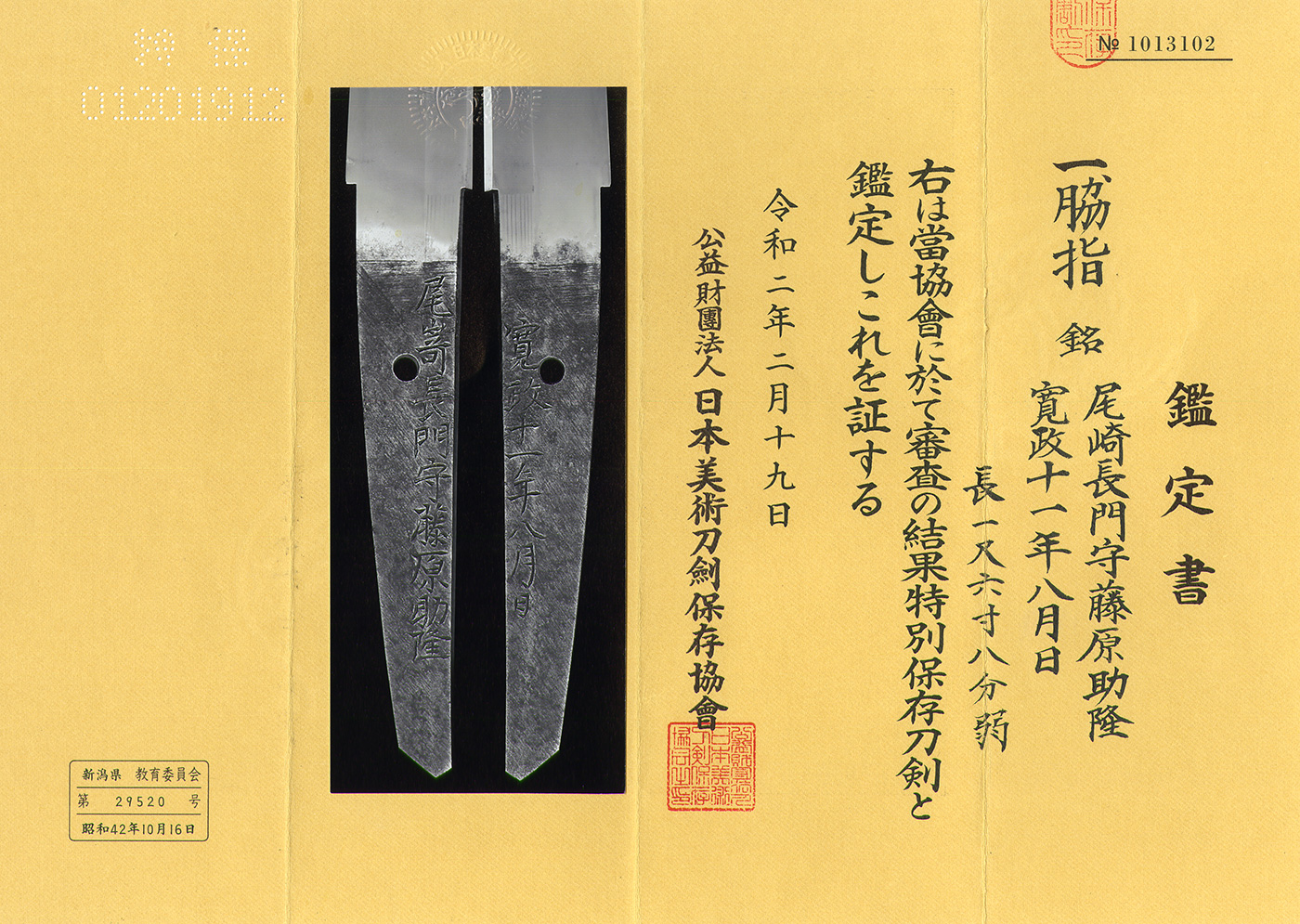
Signature: Ozaki Nagato no Kami Fujiwara Suketaka
A day in the eighth month of Kansei 11 (1799).
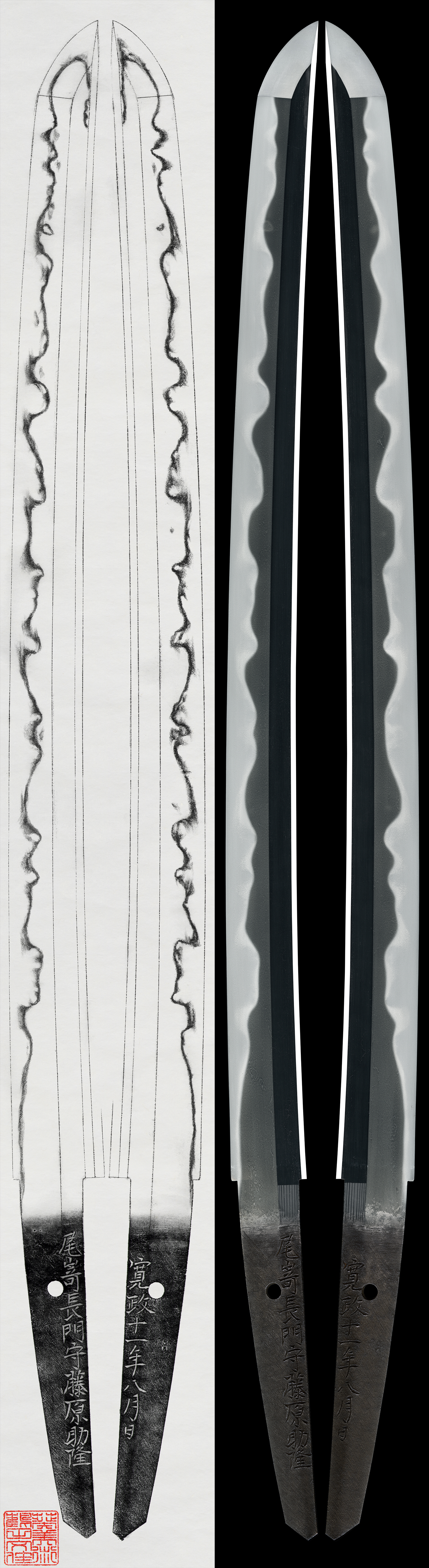
尾崎長門守藤原助隆
寛政十一年八月日
Shinshinto: Jyo Saku: Settsu
(We divide 4 sections for each sword as Saijyo Saku, Jyojyo Saku, Jyo Saku and Regular Saku).
This blade is ranked as Jyojyo Saku among the works of Ozaki Nagato no Kami Fujiwara Suketaka.
Habaki: Single silver-foiled habaki.
Blade Length: 50.8 cm (20.00 in).
Curvature: 0.7 cm (0.28 in).
Mekugi Hole: 1.
Width at Base (Motohaba): 3.37 cm (1.33 in).
Width at Yokote: 2.31 cm (0.91 in).
Thickness of rim (Kasane): 0.70 cm (0.28 in).
Sword Weight: 595 g.
Era: Edo period, August 1799.
Shape: A robust wakizashi with a wide mihaba and substantial kasane.
Jigane: Beautiful, well-forged ko-itame hada.
Hamon: Nie-deki tōran-ba with a deep nioiguchi, featuring prominent rounded "tama" elements. The boshi turns back deeply in a rounded form.
Features: Ozaki Suketaka was originally from Harima Province and studied under the swordsmith Kuroda. He received the title Nagato no Kami in December 1798 and passed away in 1805 at the age of fifty-three. During the early Shinshinto period, the flamboyant tōran-ba style made famous by Tsuda Sukehiro of the Kanbun era enjoyed tremendous popularity. Many swordsmiths sought to master and reproduce this spectacular hamon, and Ozaki Suketaka was among the foremost of them. Although his tōran-ba possesses a somewhat firmer character than that of Sukehiro, it is nevertheless an impressive interpretation of the style. This blade has a broad mihaba, thick kasane, and an imposing overall appearance.
Aoi Art’s Comment: During both the early and late Edo period, appreciation swords were highly sought after, and blades with flamboyant hamon such as tōran-ba were especially admired for their striking beauty and became exceptionally popular among collectors.
Historical Background: In August 1799 (Kansei 11), the castle town of Ōzu in present-day Ehime Prefecture suffered the Great Fire of Kansei 11. The fire broke out on August 21, 1799 (July 21 on the lunar calendar) in the Yunoki district and, driven by strong winds, destroyed nearly the entire castle town, making it one of the largest urban fires of the Edo period. This was also the era of the Kansei Reforms, introduced by Matsudaira Sadanobu. Unlike the preceding policies of the Tanuma administration, which emphasized increasing revenue through commerce, the Kansei Reforms focused on reducing government expenditures through strict frugality, reflecting the same principles Sadanobu had successfully implemented in the Shirakawa Domain.
NBTHK Tokubetsu Hozon Token.
AoiArt estimation paper: Whole Oshigata.
Overseas shipping is charged separately.
Please note: The price does not include the international shipping fees.
Auction Starting Price:950,000JPY
Place Bid




Related Items:
 Wakizashi:: Oku Yamato no Kami Taira Ason Motohira (First Generation) Autumn of Kansei 7, Year of the Hare (1795) (NBTHK Tokubetsu Hozon Token)
 Wakizashi : Shirakawa Kashin Masashige(NBTHK Tokubetsu Hozon Token)
 Wakizashi(Sunnobi Tanto):Tsunahide(NBTHK Tokubetsu Hozon Token)
 Wakizashi: Sasshu Ju Fujiwara Masayoshi (NBTHK Tokubetsu Hozon Token)
 Wakizashi:Bungo no Kami Minamoto Masayasu(NBTHK Tokubetsu Hozon Token)
 Wakizashi:Banshu Tegarayama Roku Fujiwara Ujishige Seitan Saku A day in the 2nd month of An'ei 5 (1776) Made for Koizumi Sadayoshi (NBTHK Tokubetsu Hozon Token)