
Previous answer is
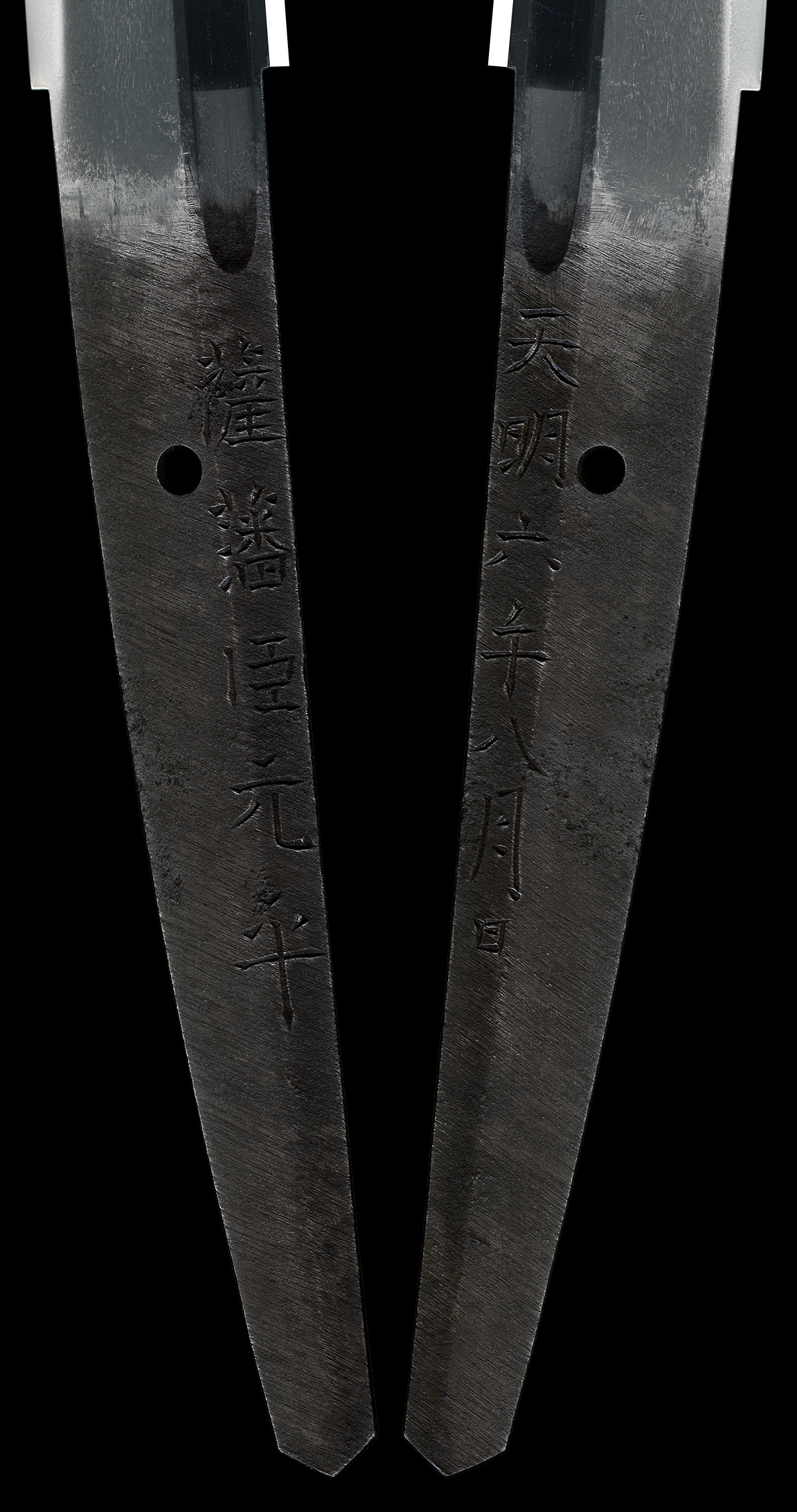
Signature: Satsuhan-shin Motohira
Dated: A day in the eighth month of Tenmei 6 (1786).
薩藩臣元平
天明六年八月日
Features: This Motohira was formerly in the collection of the Matsudaira family of Unshu (Izumo Domain). It is also illustrated in the Token Zufu, where it is described as: "During the Edo period, this blade was one of those handed down within the Matsudaira family of Unshu."
Oku Motohira was a swordsmith of the Satsuma Domain and the eldest son of Oku Motonao. His common name was Saemon. He was born in 1744 and passed away in 1826 at the age of eighty-three. Together with Hoki no Kami Masayuki, he was regarded as one of the foremost masters of the Satsuma Shinshinto tradition. In 1789, both he and Masayuki were granted the title Yamato no Kami.
His earliest works date from the Meiwa era (1764–1772), when he signed inscriptions such as "Satsuyōshi Motohira" or "Satsuhan-shin Oku Motohira." After receiving the title of Yamato no Kami in 1789, he most commonly signed "Oku Yamato no Kami Taira no Ason Motohira."
His workmanship is distinguished by gunome-midare mixed with ko-notare and pointed elements, a deep nioiguchi, abundant and coarse nie, and vigorous activities such as kinsuji and sunagashi, clearly reflecting the Soshu tradition.
This blade is an excellent example of that style. The hamon consists of rounded gunome mixed with smaller gunome and pointed elements. Thick ashi are abundant, the nioiguchi is deep, and the blade is richly covered in strong, coarse nie, with prominent kinsuji and sunagashi. Particularly striking are the long, conspicuous nie streaks. As this is believed to be an early work by Motohira, it possesses exceptional vigor and a powerful presence.
The blade is broad, with a thick kasane and ample hiraniku, giving it the robust form characteristic of Satsuma swords. The boshi finishes in a hakikake style resembling a blazing flame, and the conspicuous nie streaks—popularly known as "Satsuma no Imozuru" (Satsuma potato vines)—are a distinctive hallmark of Satsuma workmanship.
=====================================
Appraisal Quiz #913 (September 5th, 2026)
Who made this sword do you think ?
=====================================
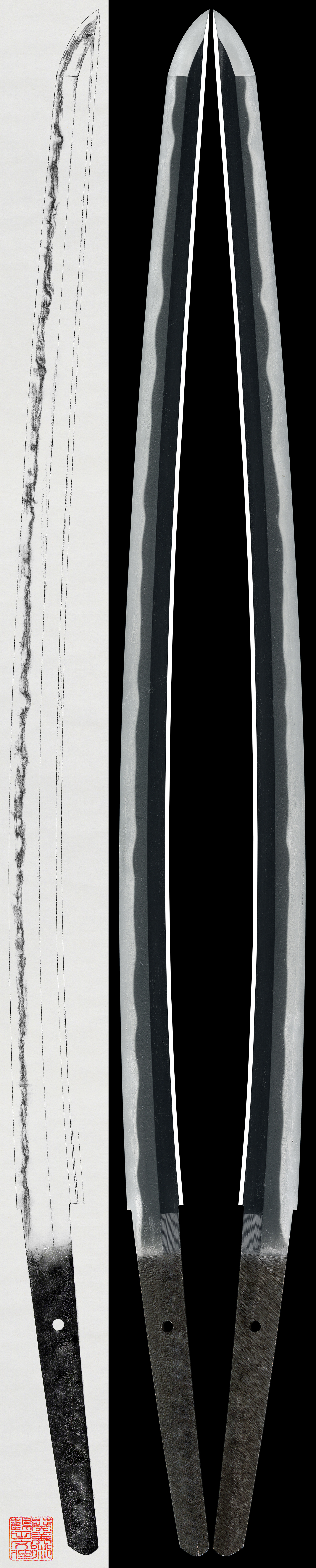

Blade Length: 65.6 cm (25.83 in).
Curvature: 1.3 cm (0.51 in).
Mekugi Hole: 1.
Width at Base (Motohaba): 3.14 cm (1.24 in).
Width at Yokote: 2.05 cm (0.81 in).
Thickness of rim (Kasane): 0.63 cm (0.25 in).
Sword Weight: 640 g.
Shape: A well-proportioned blade with a substantial mihaba, retaining its original cutting edge. It has pronounced curvature and a long boshi.
Jigane: Well-forged ko-itame hada producing a refined and beautiful jigane.
Hamon: Nie-deki gunome-midare with abundant sunagashi and kinsuji. The boshi enters midare.
=====================================
Answer will be posted at next Appraisal Quiz.
=====================================
(Please acknowledge not replying to mail about Appraisal Quiz by our convenience.)