
Ordering Number: AS25721
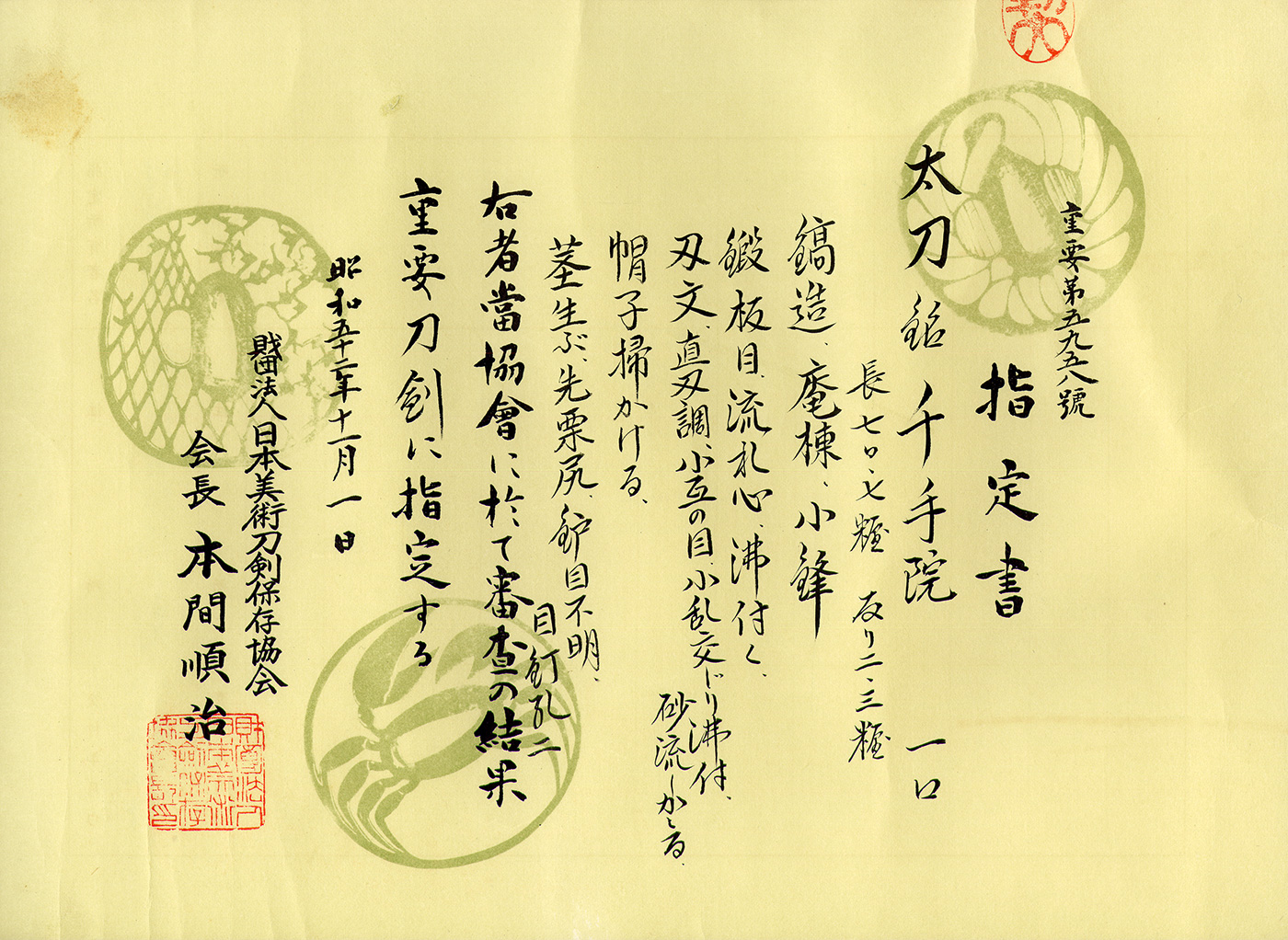
Tachi: in Shirasaya with Koshirae (25th NBTHK Juyo Token)
Signature: Senjuin
千手院
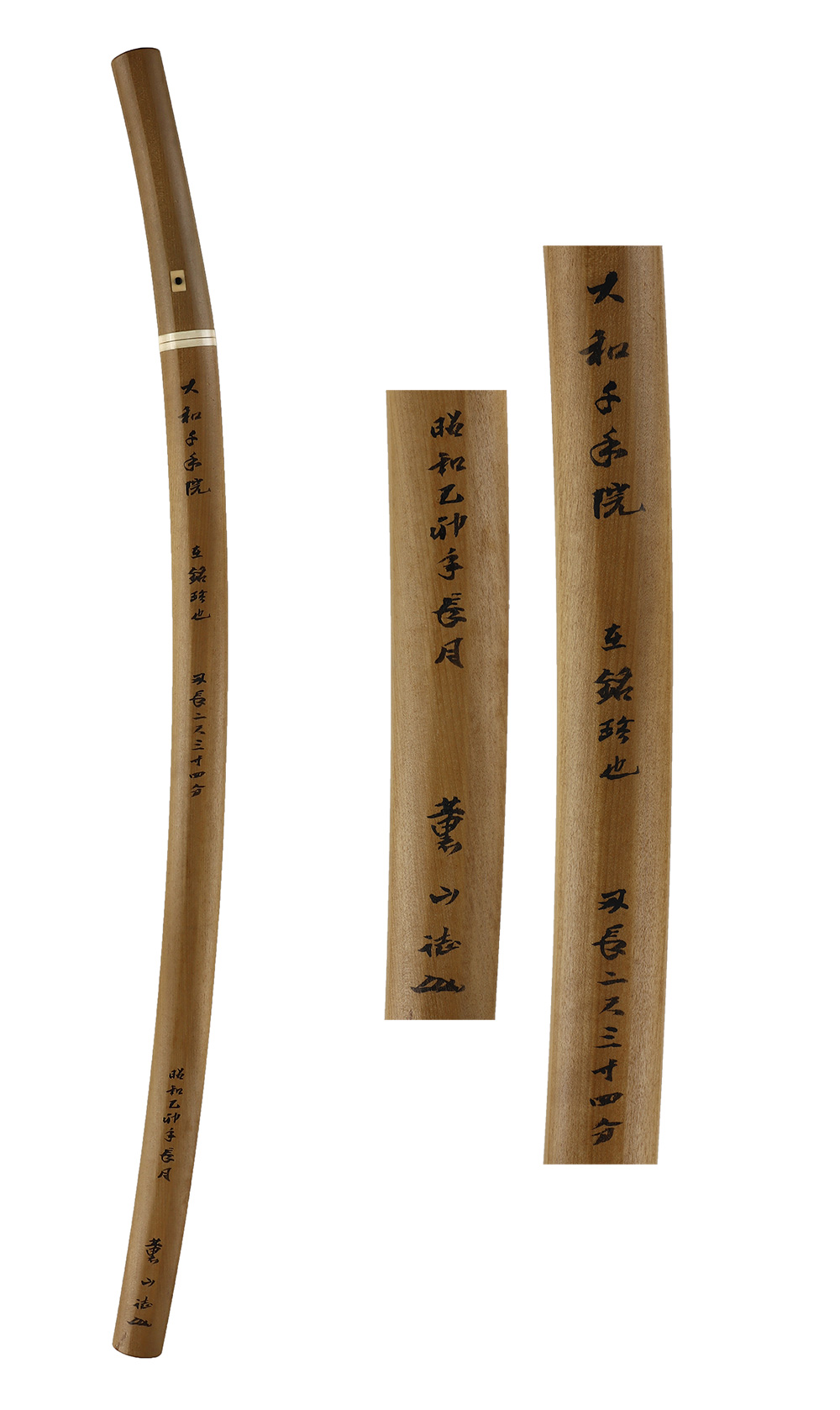
Sayagaki: Yamato Senjuin. A rare signed work.
Blade length: 2 shaku 3 sun 4 bu. Written by Kunzan in the month of Chogetsu, the year of Kinoto-U, Showa (1975) Kunzan (Kao).
Koto: Jyo Saku: Yamato
We classify swords into Saijyo Saku, Jyojyo Saku, Jyo Saku, and Regular Saku based on the swordsmith's skill.
Among Senjuin works, this piece is ranked as Saijyo Saku.
Habaki: Gold-covered single-layer.
Blade length: 70.8 cm (27.87 in)
Curvature (Sori): 1.5 cm (0.59 in)
Mekugi-ana (peg hole): 2
Width at Base (Motohaba): 2.78 cm (1.09 in)
Width at Tip (Sakihaba): 1.59 cm (0.63 in)
Kasane (thickness): 0.80 cm (0.31 in)
Blade weight: 625 grams
Era: Early Kamakura period, around the Ken'ei era.
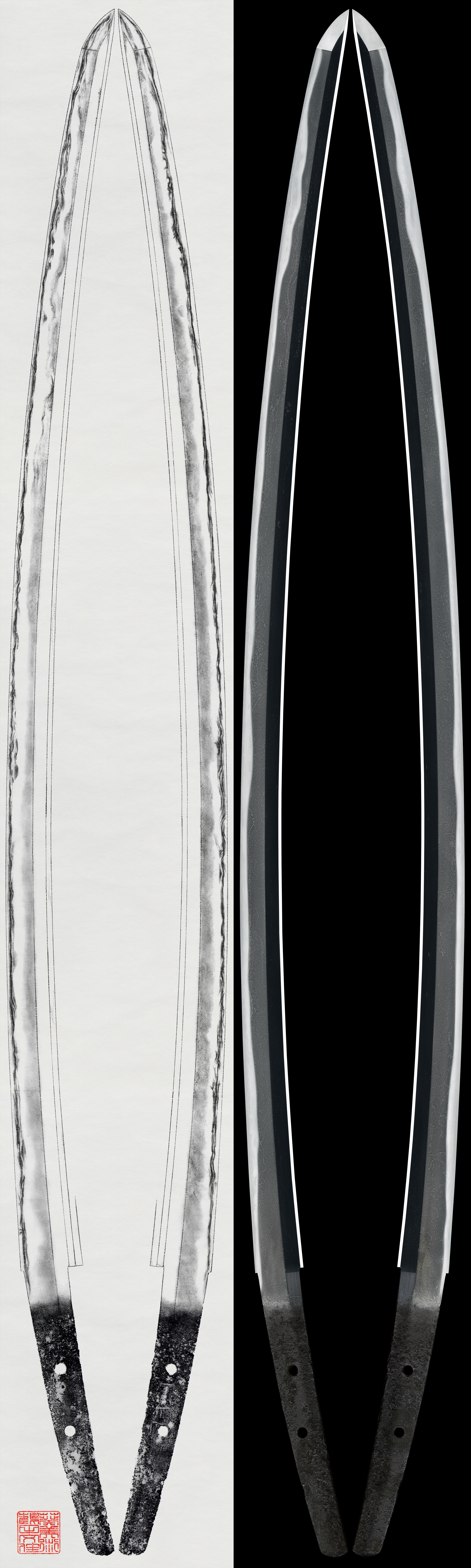
Shape: The blade is somewhat wide, with deep curvature and a slightly extended kissaki.
Judging from the curvature, the blade is considered to retain almost its original ubu form.
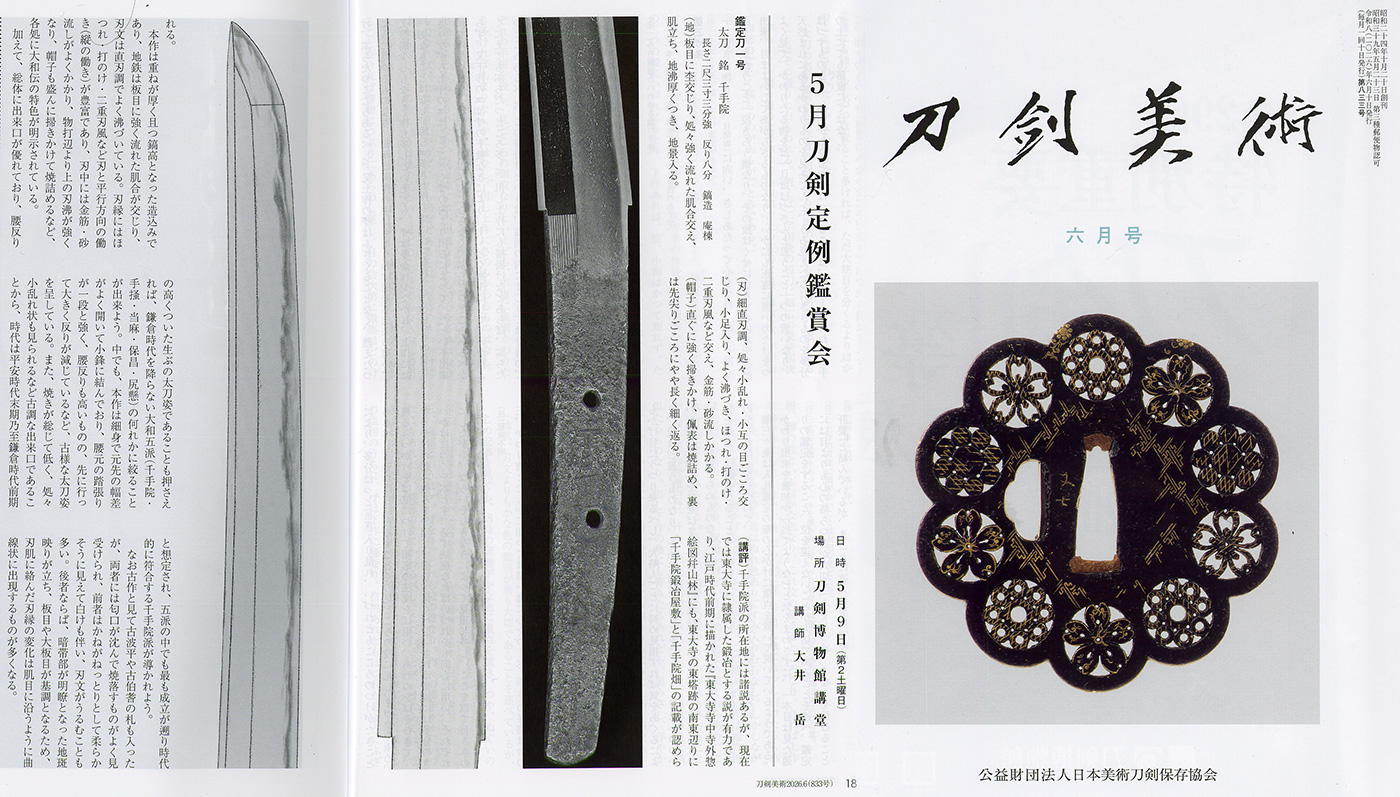
Jigane: Chikei appears, the grain stands out, and utsuri manifests.
The shinogi-ji shows a mixture of itame hada, masame hada, and mokume hada, conveying a sense of great age.
Hamon: The hamon is suguha.
The nioiguchi is deep, with fine sunagashi and kinsuji working actively throughout.
Features:
The Senjuin Washu school was not a single swordsmith but is believed to have consisted of several smiths.
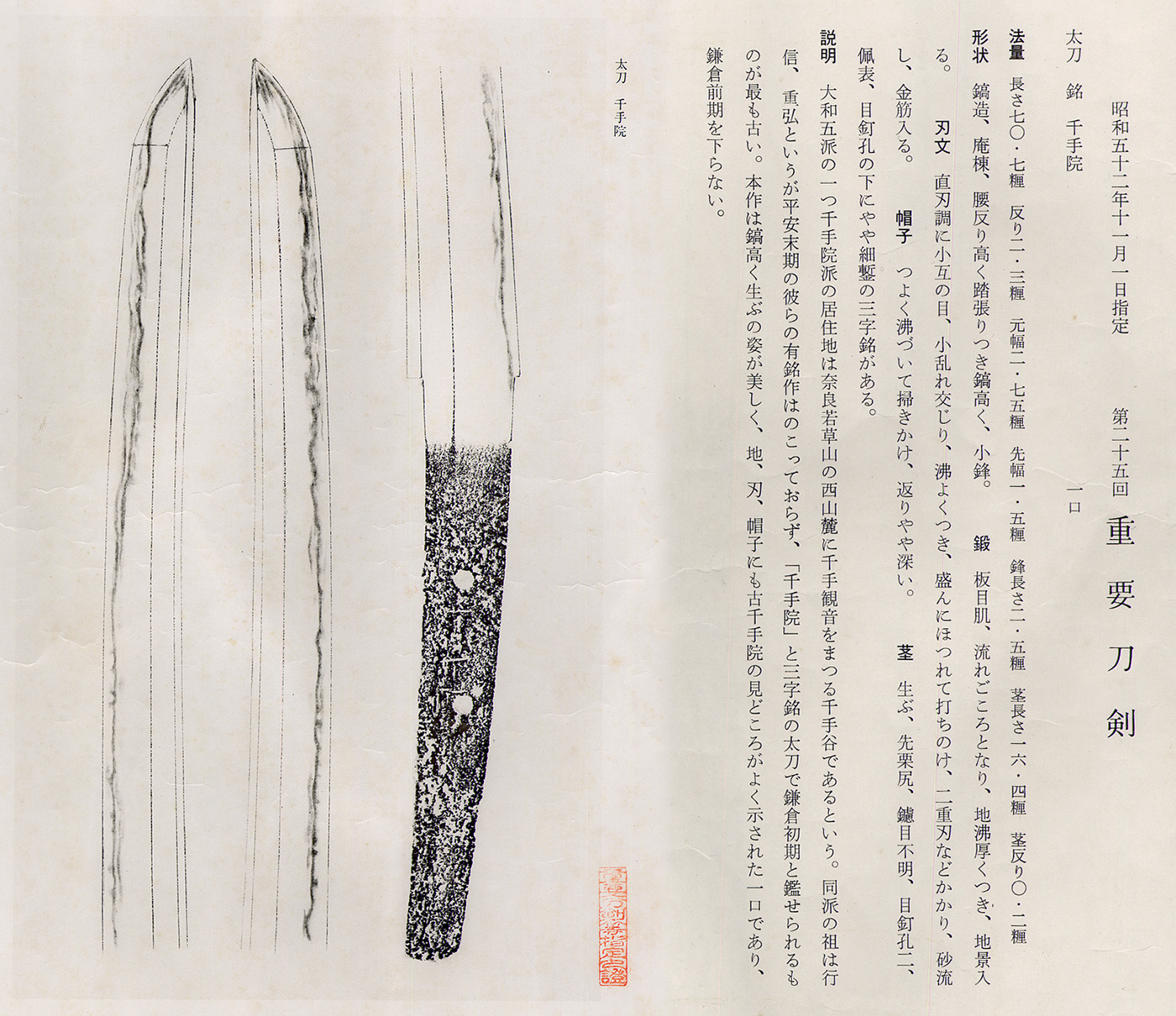
While many mumei attributions to Senjuin are recorded in the Kanto Hibisho, only one signed work is known to exist. That very sword is the piece introduced here.
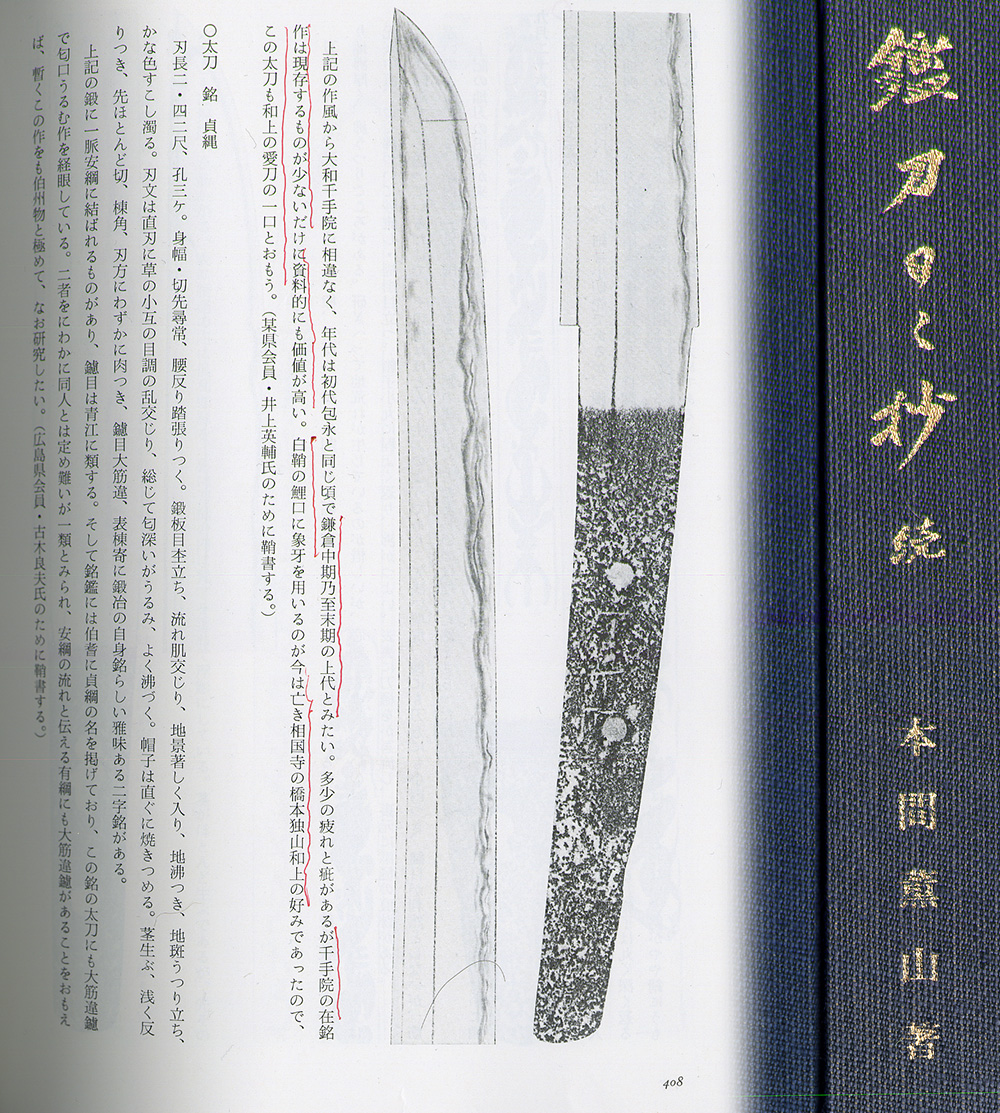
It appears on pages 407 and 408 of the Kanto Hibisho, Zoku (Sequel).
According to the book:
"The blade is slender with a ko-kissaki, but the koshi-zori is high, with good tapering (funbari), and a high shinogi.
The forging is itame nagare, with masame and chikei mixed in.
The hamon is nie-deki, a chu-suguha with ko-gunome-midare and hotsure mixed in, with sunagashi and kinsuji.
The boshi returns deeply and roundly, with strong nie, somewhat crumbling in character, but with strong hakikake.
The nakago is ubu, with a broken-up upper edge (saki-yabure) and a kurijiri, the ha-side gently rounded, and the yasurime indistinct.
The signature is somewhat buried in rust but is read as 'Senjuin,' and as is customary, the chisel strokes are rather thick.
From the above workmanship, there is no doubt that this is Yamato Senjuin, and the period should be regarded as around the same time as Kanenaga, roughly the mid-Kamakura period.
Although there is some fatigue, signed Senjuin works are extremely rare, giving this piece high documentary value."
This was a favorite of the late Reverend Hashimoto Dokuzan of Shokoku-ji, and we believe it was one of the reverend's cherished swords.
It is a truly precious signed work.
It is a piece from before the mid-Kamakura period, with a character quite distinct from that of the Bizen smiths.
We highly recommend it.
Koshirae:
Tsuba: Mokko-shaped shakudo nanako-ground tsuba carved with clouds and a dragon, highlighted with gold iroe.
Fuchikashira: Shakudo ground with a dragon in high relief, decorated with gold iroe.
Kurikata: Shakudo ground.
Saya (Scabbard): An exceptionally well-crafted aogai-chirashi saya.
Menuki: Dragon in high relief.
Aoi Art's Comment:
As you may know, almost all Senjuin works are mumei attributions.
While many mumei Senjuin attributions are recorded in the Kanto Hibisho, only one signed work exists, and that very sword is the piece introduced here.
Consequently, any works evaluated hereafter will have no choice but to refer to and be judged against the mumei attributions.
By using this elegantly shaped, ubu, signed work as a reference for the hamon—particularly by carefully studying its many distinctive features such as the boshi hotsure, the descending hakikake and the character of the hamon, and the niju-ha—we believe everyone can gain a full understanding of what a Senjuin work is.
Among Juyo Token, this can be said to be the oldest and most clearly demonstrated example of a three-character Senjuin signature.
Both the sword and the koshirae have been carefully preserved, and it was most likely handed down by a famous daimyo.
25th NBTHK Juyo Token
Aoi Art estimation paper: Whole Oshigata
Published references:
Kanto Hibisho, Zoku (Sequel), pp. 407–408
Token Bijutsu, June 2026 (No. 833), p. 18
Please note: The price does not include the international shipping fees.
Auction Starting Price:8,000,000JPY
Place Bid




Related Items:
 Katana:Mumei(Unsigned)(Tegai school 手掻) (the 22th NBTHK Juyo Token)
 Tachi: Norinari (Ko-Ichimonji)(69th NBTHK Juyo Token)
 Katana:Mumei (attributed to Den Hosho).(NBTHK Tokubetsu Hozon Token)
 Katana: Nagasone Okisato Nyudo Kotetsu with Saidan-mei(45th NBTHK Juyo Token)
 Tachi:Sueyuki (Den Bungo, Late Kamakura period)(NBTHK Tokubetsu Hozon Token)
 Katana: Mumei (Unsigned) (Hatakeda Sanemori) (12th Session Juyo Token)