
Ordering Number: AS26237 (Consignment Sale)
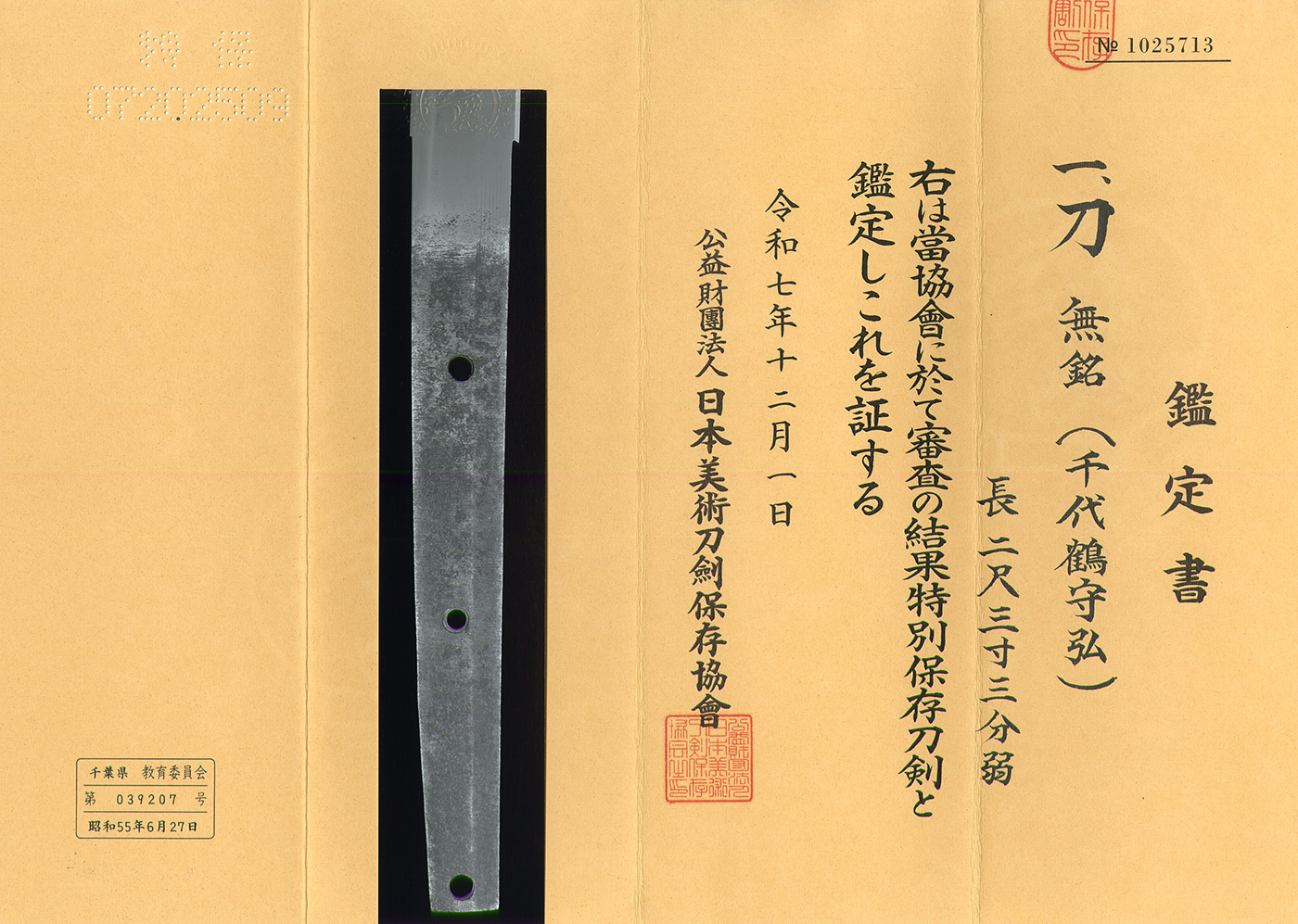
Katana in Shirasaya (NBTHK Tokubetsu Hozon Token)
Signature: Mumei(Unsigned) (Chiyozuru Morihiro)
無銘(千代鶴守弘)
(We divide 4 sections for each sword as Saijyo Saku, Jyojyo Saku, Jyo Saku and Regular Saku).
This work is ranked as Jyojyo Saku among the works attributed to Mumei(Unsigned) (Chiyozuru Morihiro).
Habaki: Single-piece copper habaki with shakudo-style colored finish.
Blade Length: 70.7 cm (27.83 in).
Curvature: 2.3 cm (0.91 in).
Mekugi Hole: 3.
Width at Base (Motohaba): 2.34 cm (0.92 in).
Width at Yokote: 1.95 cm (0.77 in).
Thickness of rim (Kasane): 0.68 cm (0.27 in).
Sword Weight: 690 grams.
Era: Nanbokucho period, around Bunna (1352-1356, approximately 1352).
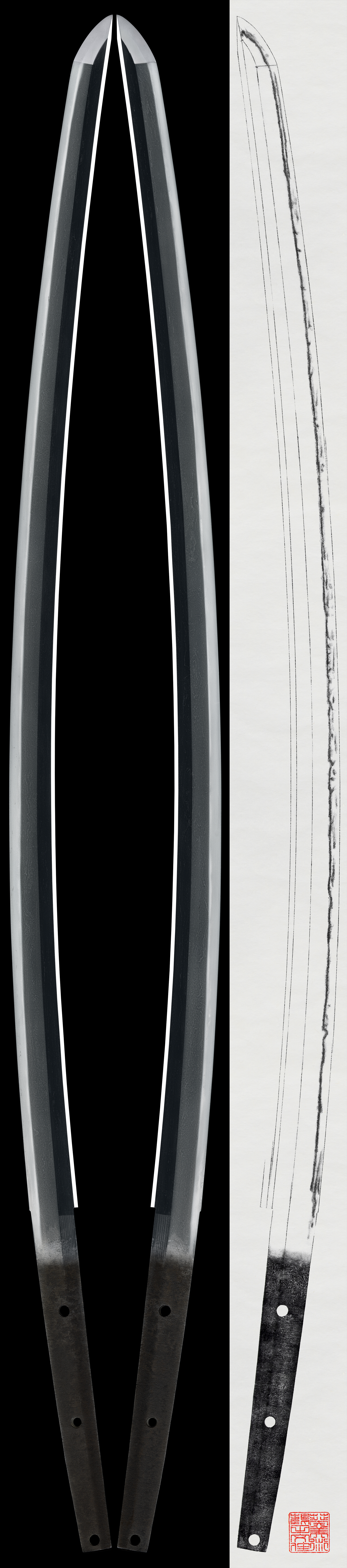
Shape: A well-proportioned katana with a slightly wide width, substantial thickness, and a strongly extended kissaki.
Jigane: Well-forged itame-hada with the grain pattern clearly visible.
Hamon: Nie-deki, with ko-ashi, a somewhat deep nioiguchi, and a boshi that turns round and returns in a small maru form.
Features: Chiyozuru Morihiro was the son of Chiyozuru Kuniyasu, lived in Kaga Province, and was also known as Kamo Saburo.
He was a swordsmith of the Rai school.
This sword has an elegant curvature, displays a faint whitish utsuri, and remains in healthy condition.
It was made around Bunna in the Nanbokucho period (1352).
Historical Background: During the Bunna era (1352-1356) of the Northern Court in the Nanbokucho period, nationwide turmoil occurred, including the conclusion of the Kanno Disturbance, the largest internal conflict of the Muromachi Shogunate, and repeated occupations of Kyoto by the Southern Court forces.
Why were there two imperial courts?
The origin lay in the dissatisfaction of the warrior class with Emperor Go-Daigo's imperial-centered government known as the Kenmu Restoration.
When Ashikaga Takauji installed a new emperor in Kyoto (the Northern Court), Emperor Go-Daigo fled to Yoshino in Nara and established a rival government (the Southern Court), creating the unprecedented situation in which Japan had two emperors simultaneously.
NBTHK Tokubetsu Hozon Token.
AoiArt estimation paper: Whole Oshigata.
Please note: The price does not include the international shipping fees.
Auction Starting Price:650,000JPY
Place Bid




Related Items:
 Katana: Mumei(Unsigned)(Chiyozuru Morihiro)(NBTHK Tokubetsu Hozon Token)
 Katana:Mumei(Unsigned) (Sa Yoshisada 左吉貞) (65th NBTHK Juyo Token)
 Katana: Naniwa ju Gassan Unryushi Sadakazu Kitae (Kokuin) (NBTHK Tokubetsu Hozon Token) (NBTHK Tokubetsu Kicho Token)
 Katana: Mumei(Unsigned) (Aoe school)(the 70th NBTHK Juyo Token)
 Katana: Mumei(Unsigned)(Nariie)(68th NBTHK Juyo Token)
 Katana: Mumei (Aoe school)(the 25th Juyo Token)