
Ordering Number: 25789
Tanto in Shirasaya with Koshirae (NBTHK Hozon Token)
Signature: Kanemachi (Kanemachi).
兼町
(We divide 4 sections for each sword as Saijyo Saku, Jyojyo Saku, Jyo Saku and Regular Saku).
This work ranks as Jyo Saku for Kanemachi.
Habaki: Single-layer silver Habaki.
Blade Length: 29.5 cm (11.61 in).
Curvature: 0.2 cm (0.08 in).
Mekugi Hole: 2.
Width at Base (Motohaba): 2.56 cm (1.01 in).
Thickness of rim (Kasane): 0.51 cm (0.20 in).
Sword Weight: 0.51 g.
Era: Muromachi period, around the Eiroku era (1558-1570).
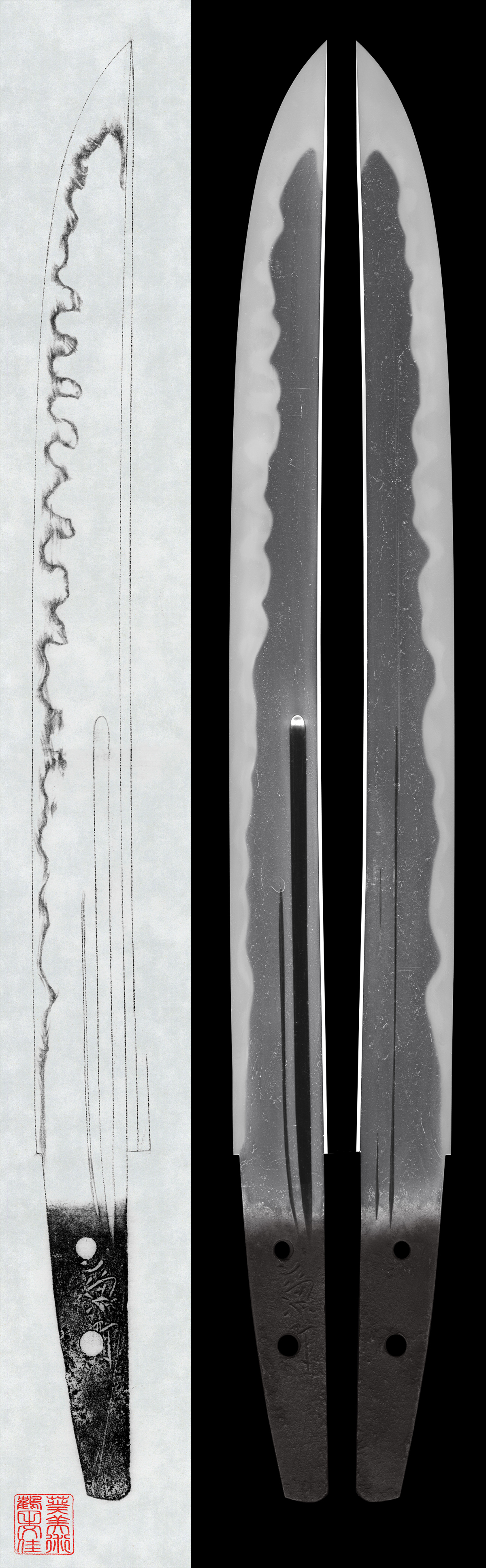
Shape: A stout tanto with solid width and thick kasane.
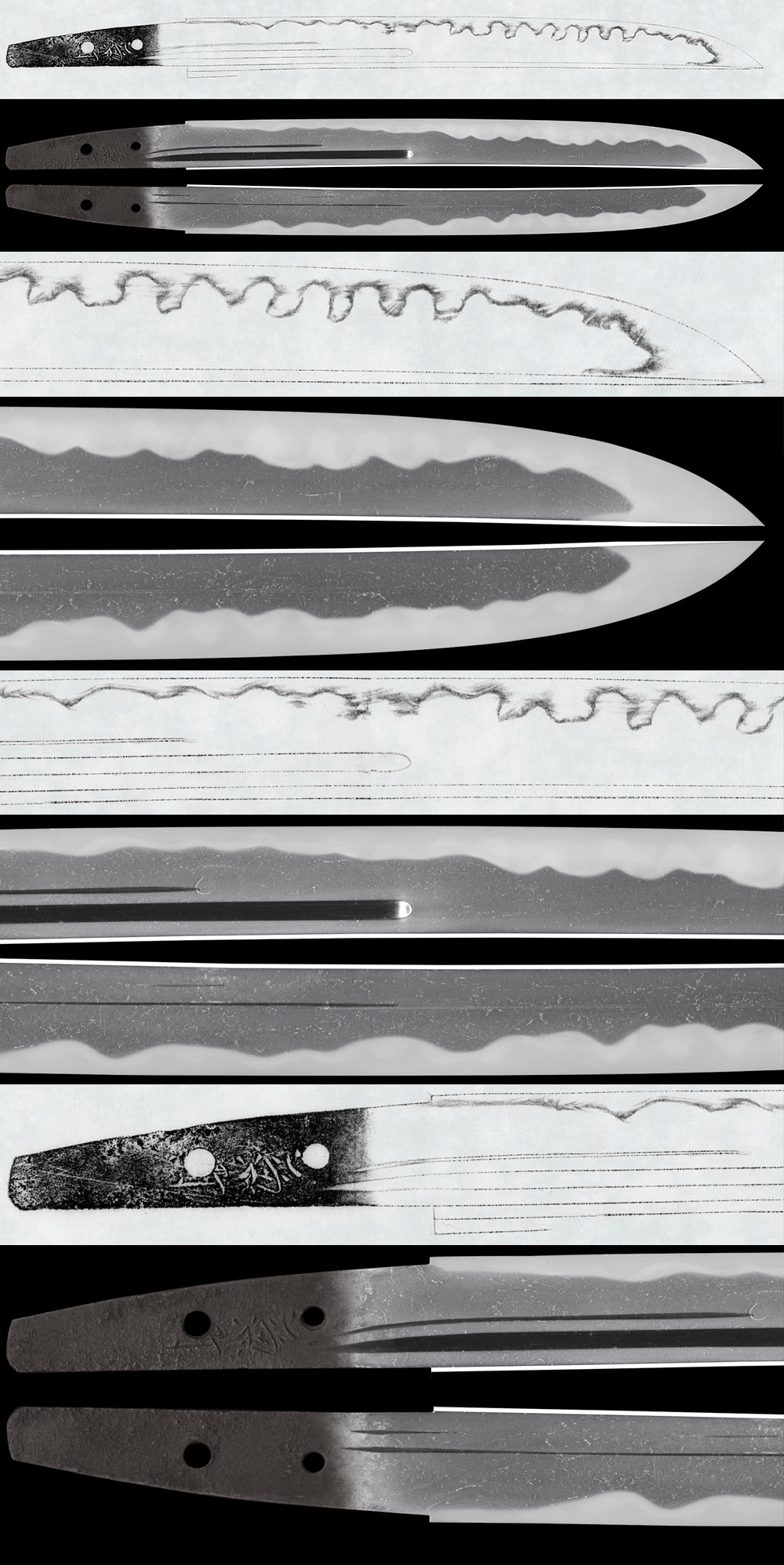
Jigane: A bohi and soehi are carved on the front side, while on the reverse side there is a bohi with a thin groove alongside it.
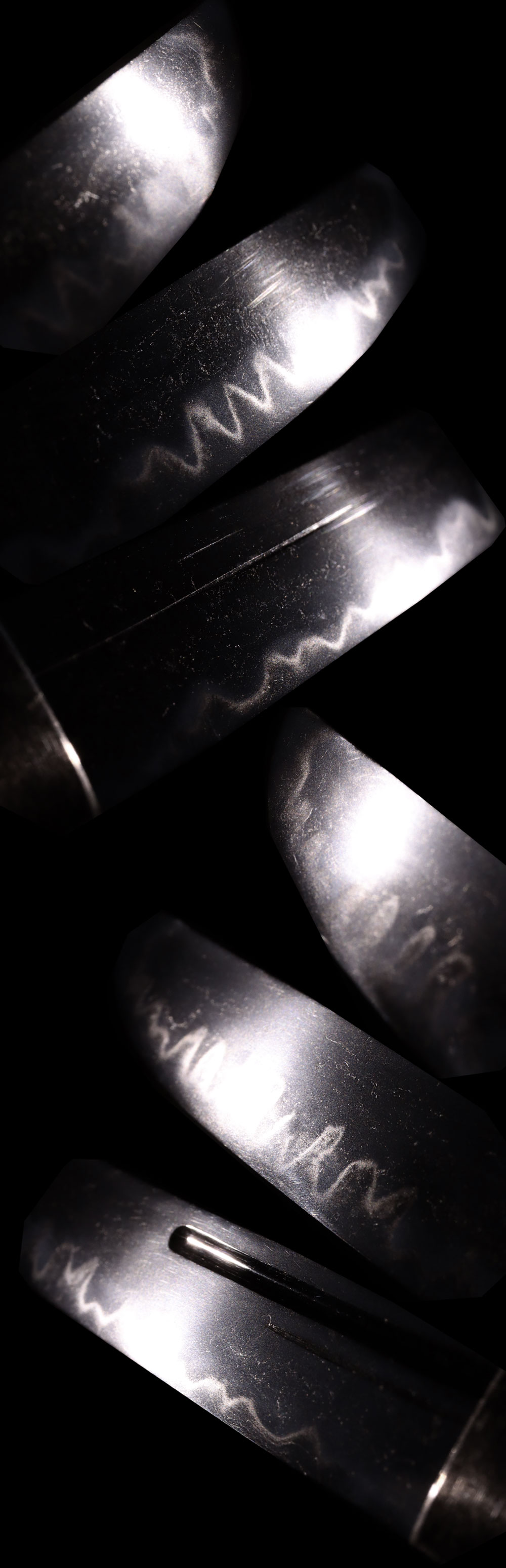
Hamon: Gunome midare mixed with pointed gunome. The boshi is midare-komi.
Features: This tanto was made in the late Muromachi period. The gunome midare hamon is covered in nioi, evoking the old atmosphere of the Eiroku era.
Koshirae:
Tsuba: Iron hamidashi tsuba carved with flowers and plants, decorated with gold and silver iro-e.
Fuchi: Shakudo ground with twisted pattern carving.
Kashira: Horn.
Menuki: Dragonfly design with gold-colored decoration.
Saya (Scabbard): Reddish-brown stone-textured saya.
Umabari: Decorated in red iro-e and bears a signature.
Aoi Art’s Comment: During this period, a great number of tanto were produced in Mino, and it could almost be said that most works were tanto. Perhaps there was a strong division of labor among swordsmiths. Although many tanto were made during times of war, once warfare subsided, the makers of tanto nearly disappeared. It may be said that there was no longer a need to use tanto, as the custom of wearing daisho when appearing at the castle became established, and tanto fell out of use. Occasionally one encounters Shinto-period tanto, but they are precious works, and if you find a Shinto tanto, we highly recommend purchasing it. As trends change, it seems likely that more people will begin seeking tanto.
Historical Background: In 1558 (Eiroku 1), Shogun Ashikaga Yoshiteru reconciled with Miyoshi Nagayoshi and returned to Kyoto. In the same year, Oda Nobunaga assassinated his younger brother Nobukatsu and nearly unified Owari Province, while Tokugawa Ieyasu fought his first battle. It was a turning point in history that set in motion events leading toward the later unification of Japan.
NBTHK Hozon Token.
AoiArt estimation paper: Whole Oshigata.
*Shipping cost overseas is not included.
Please note: the price does not include the shipping fees.
Price:365,000JPY
Order Form



Related Items:
 Tanto: Sakuyou Bakkashi Hosokawa Masayoshi(NBTHK Tokubetsu Hozon Token)
 Tanto:Nobukuni (Chikushi) (NBTHK Hozon Token)
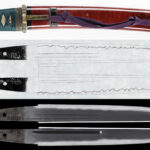 Tanto: Ichi Chounsai Tsunatoshi (2nd Generation)(NBTHK Tokubetsu Hozon Token)
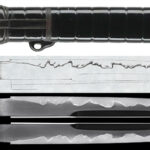 Tanto: Sukenobu(Yokoyama Sukenobu)(NBTHK Hozon Token)
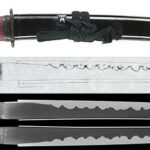 Tanto: Bishu Osafune Ju Yokoyama Sukekane(1870)(NBTHK Tokubetsu Hozon Token)
 Tanto:Minase Jingu Hiromae Magara Ryukichi Saijin Kore, Sadatsugu Tanto Kore(NBTHK Hozon Token)