
Ordering Number: 26103
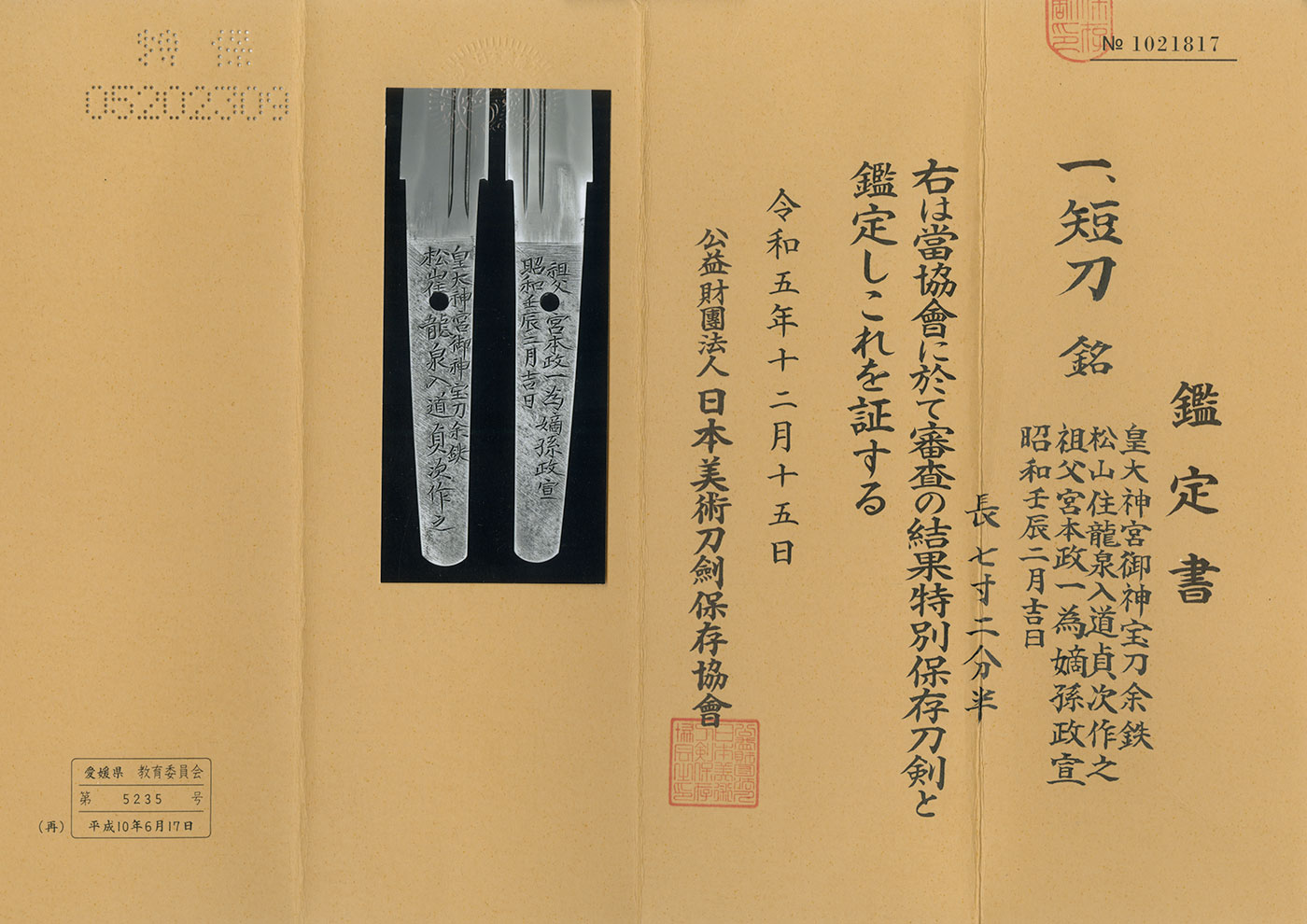
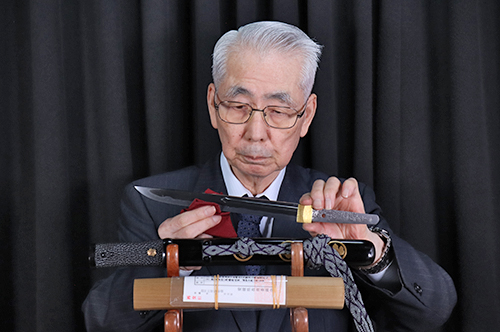
Tanto: Shirasaya with Koshirae (NBTHK Tokubetsu Hozon Token)
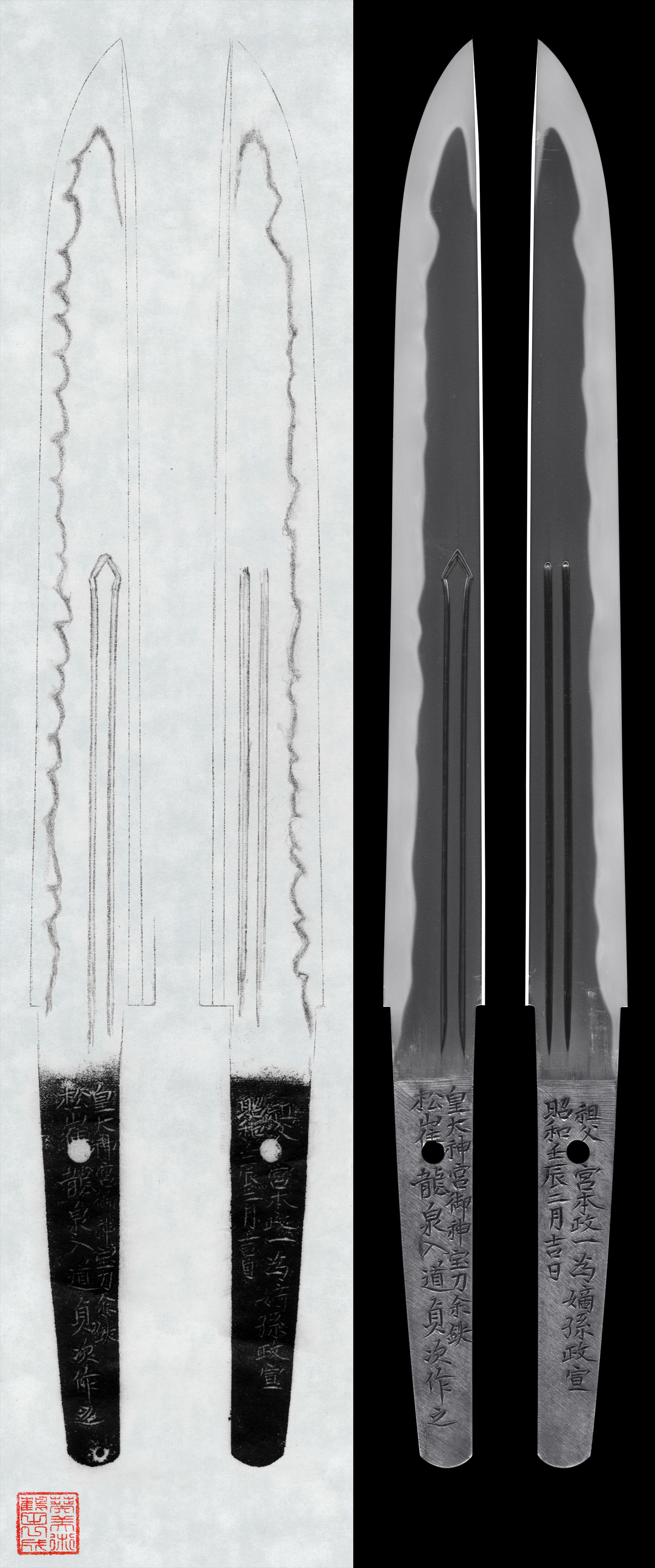
Signature: Remaining steel from the sacred treasure sword of the Imperial Grand Shrine
Made by Matsuyama ju Ryusen Nyudo Sadatsugu (Living National Treasure)
For his grandfather Miyamoto Masaikazu and heir Masanobu
A lucky day in February, 1952
皇大神宮御神宝刀余鉄
松山住龍泉入道貞次作之(重要無形文化財保持者(人間国宝))
祖父宮本政一為嫡孫政宣
昭和壬辰二月吉日
(We divide 4 sections for each sword as Saijyo Saku, Jyojyo Saku, Jyo Saku and Regular Saku).
This work is ranked as Saijyo Saku for Matsuyama ju Ryusen Nyudo Sadatsugu.
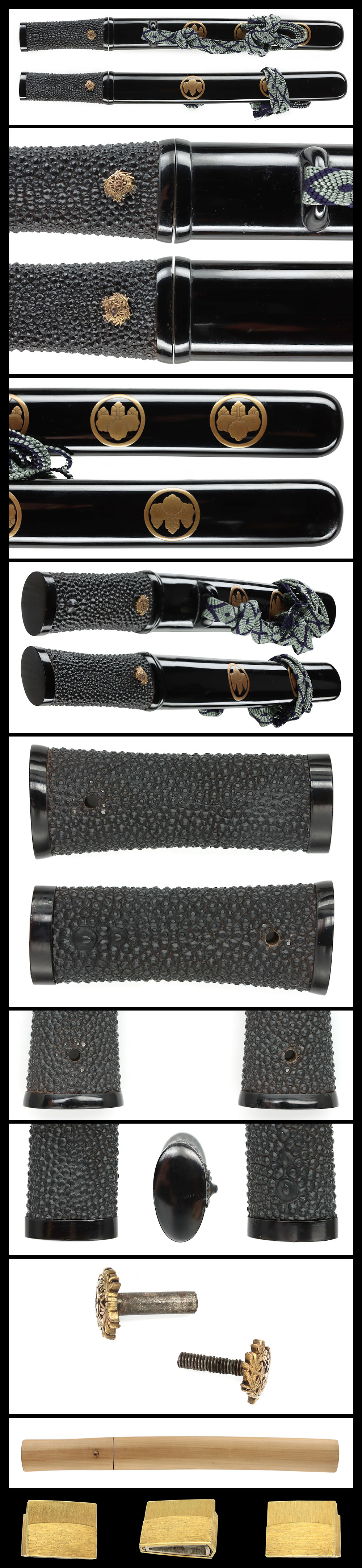
Habaki: Double-layer gold-plated.
Blade Length: 21.9 cm (8.62 in).
Curvature: 0.0 cm (0.00 in).
Mekugi Hole: 1.
Width at Base (Motohaba): 2.35 cm (0.93 in).
Thickness of rim (Kasane): 0.52 cm (0.20 in).
Sword Weight: 135 g.
Era: A lucky day in February, 1952.
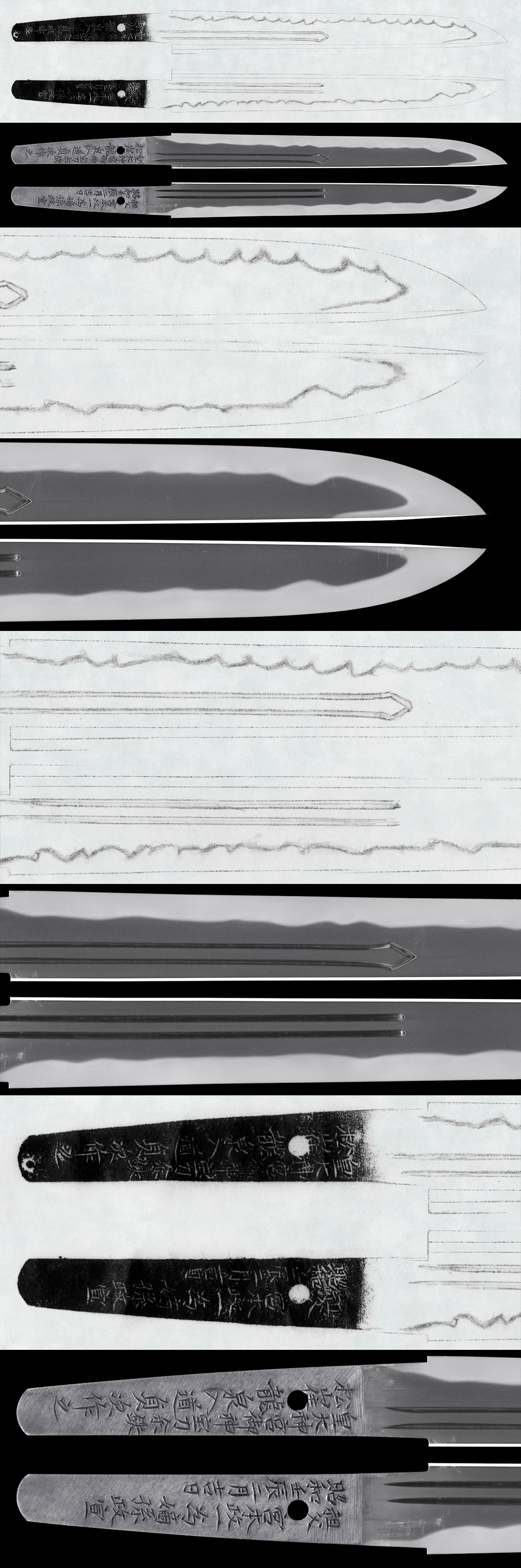
Shape: A suken (straight sword engraving) is carved on the front, and double grooves (futatsuji-hi) are carved on the reverse.
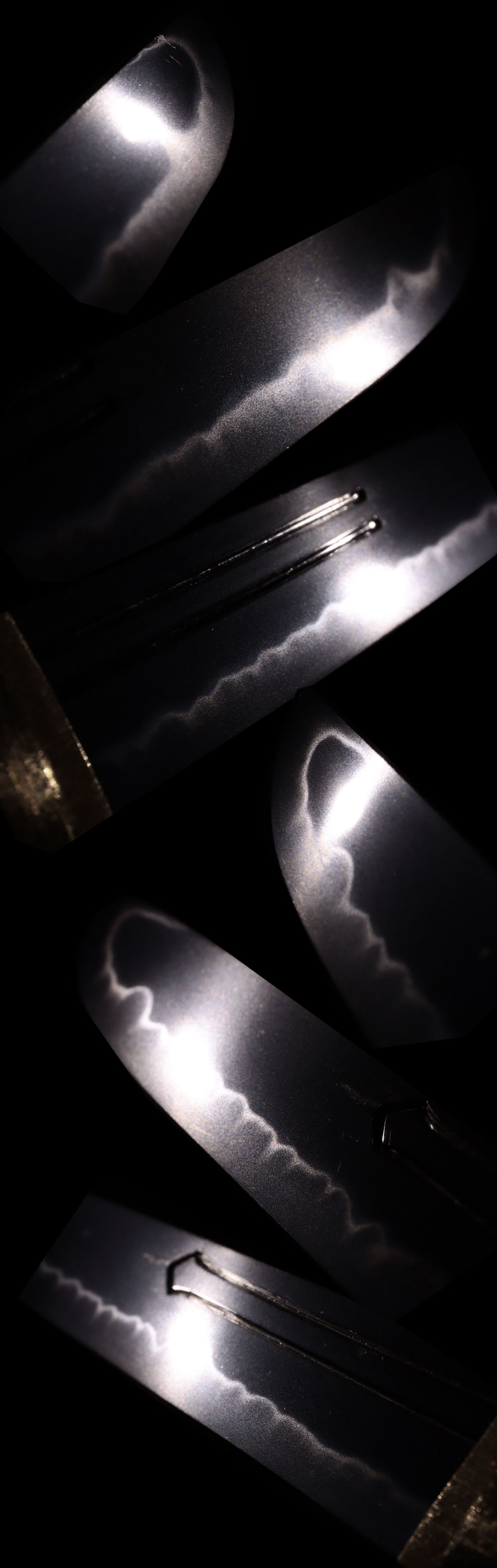
Jigane: Ko-itame hada. It forms an exceptionally beautiful steel surface.
Hamon: Nie-deki, gunome-midare, with gunome activity within the hamon, and the boshi turns back in a rounded form.
Features: Matsuyama ju Ryusen Nyudo Sadatsugu was the first swordsmith from Ehime Prefecture to be designated as an Important Intangible Cultural Property of Japan (Living National Treasure).
His production volume is small, and he made swords for shrines, votive offerings, and protective daggers for the Imperial family.
In 1938, he received the Prime Minister’s Award at the 1st Sword Exhibition.
After that, he continued forging many works as protective daggers, including one for Crown Princess Michiko on the occasion of her marriage to Crown Prince Akihito.
His polishing also produces works of remarkable strength and presence.
Koshirae: Aikuchi style mounting.
Saya (Scabbard): Paulownia crest in gold maki-e.
Mekugi: Plant motif design.
Aoi Art’s Comment: I once owned a tanto by Ryusen Nyudo Sadatsugu.
It was a work with a floral motif, delivered from Japan to Lieutenant General Uokawa in North Korea via South Korea.
The name of Lieutenant General Uokawa was inscribed in English, and it was a work from around 1949.
At that time, sword production was not permitted, so I believe it was made under special authorization.
Later, after Lieutenant General Uokawa passed away, I acquired the sword in the United States as part of my collection.
As time has passed, I have now obtained this work as well.
NBTHK Tokubetsu Hozon Token.
AoiArt estimation paper: Whole Oshigata.
Please note: the price does not include the shipping fees.
Price:2,000,000JPY
Order Form


Related Items:
 Tanto:Minase Jingu Hiromae Magara Ryukichi Saijin Kore, Sadatsugu Tanto Kore(NBTHK Hozon Token)
 Tanto: Amada Akitsugu (Living National Treasure, Important Intangible Cultural Property) Showa 44 Nen 2 Gatsu Hi (February 1969)(NBTHK Tokubetsu Hozon Token)
 Tanto:Fuyuhiro(NBTHK Hozon Token) (Koshirae: NBTHK Tokubetsu Hozon Tosogu)
 Katana: Miyairi Akihira Saku Kore An auspicious day in February, Showa 34 (1959), Made for Mr. Kunio Kanzawa (NBTHK Tokubetsu Hozon Token)
 Tanto:Kiyofusa Saku (Mukansa Swordsmith) Dated: An Auspicious Day in August, Year of Tsuchinoe-Inu(2018)
 Tanto: Sa-no-Yukihide (NBTHK Tokubetsu Hozon Token)