
Ordering Number:AS26093
Daisho:
(NBTHK Tokubetsu Hozon Token) (Koshirae: 61st Juyo Tosogu)
(Consignment Sale)
-----------------------
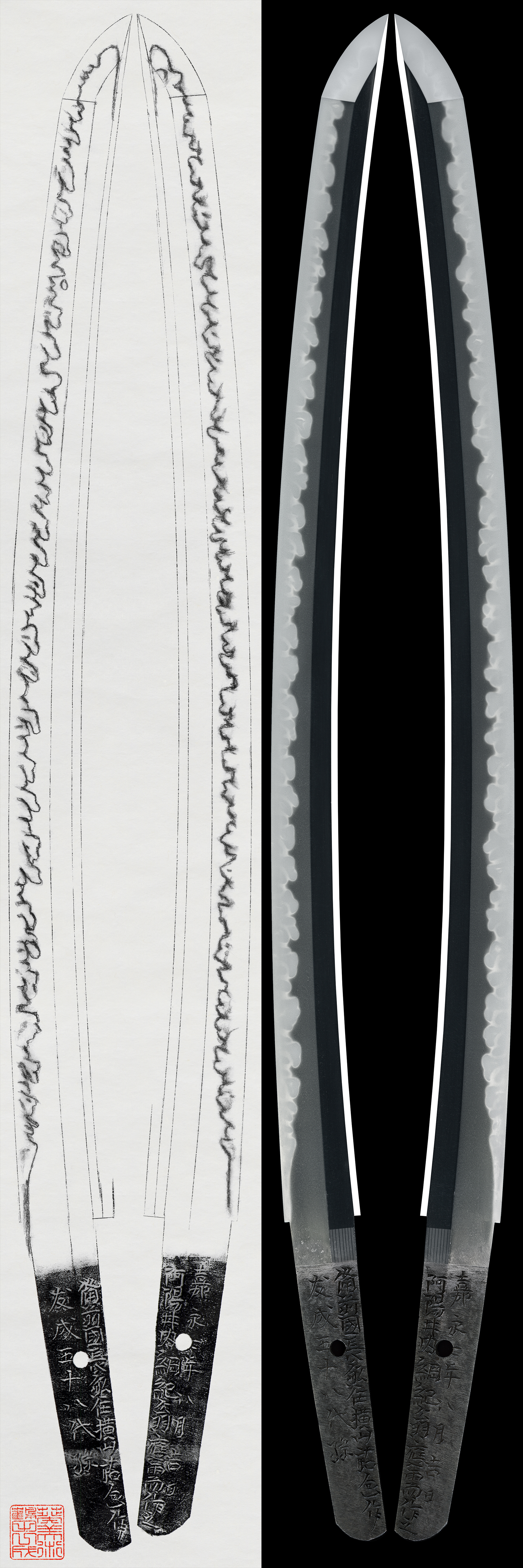
Dai:Katana in Shirasaya, with Koshirae (NBTHK Tokubetsu Hozon Token) (Koshirae: 61st NBTHK Juyo Tosogu)
Signature:Bizen no Kuni Osafune ju Yokoyama Sukekane saku.
58th descendant of Tomonari.
A lucky day in August, Kaei 7 (1854).
Made upon request of Mr. Iuchi Tsunanori of Awa Province.
備前国長船住横山祐包作
友成五十八代孫
嘉永七年八月吉日
阿陽井内綱紀翁応需作之
(We divide 4 sections for each sword as Saijyo Saku, Jyojyo Saku, Jyo Saku and Regular Saku).
This work is ranked as Jyojyo Saku for Yokoyama Sukekane.
Habaki: Gold-plated single habaki.
Blade Length: 68.64 cm (27.02 in).
Curvature: 2.12 cm (0.83 in).
Mekugi Hole: 1.
Width at Base (Motohaba): 2.98 cm (1.17 in).
Width at Tip (Sakihaba): 2.09 cm (0.82 in).
Thickness of rim (Kasane): 0.73 cm (0.29 in).
Era: Late Edo period, Kaei 7 (1854).
Shape: A well-proportioned katana with solid width and thickness.
Jigane: Fine ko-itame hada, well forged.
Hamon: Nie-deki with well-arranged choji-midare.
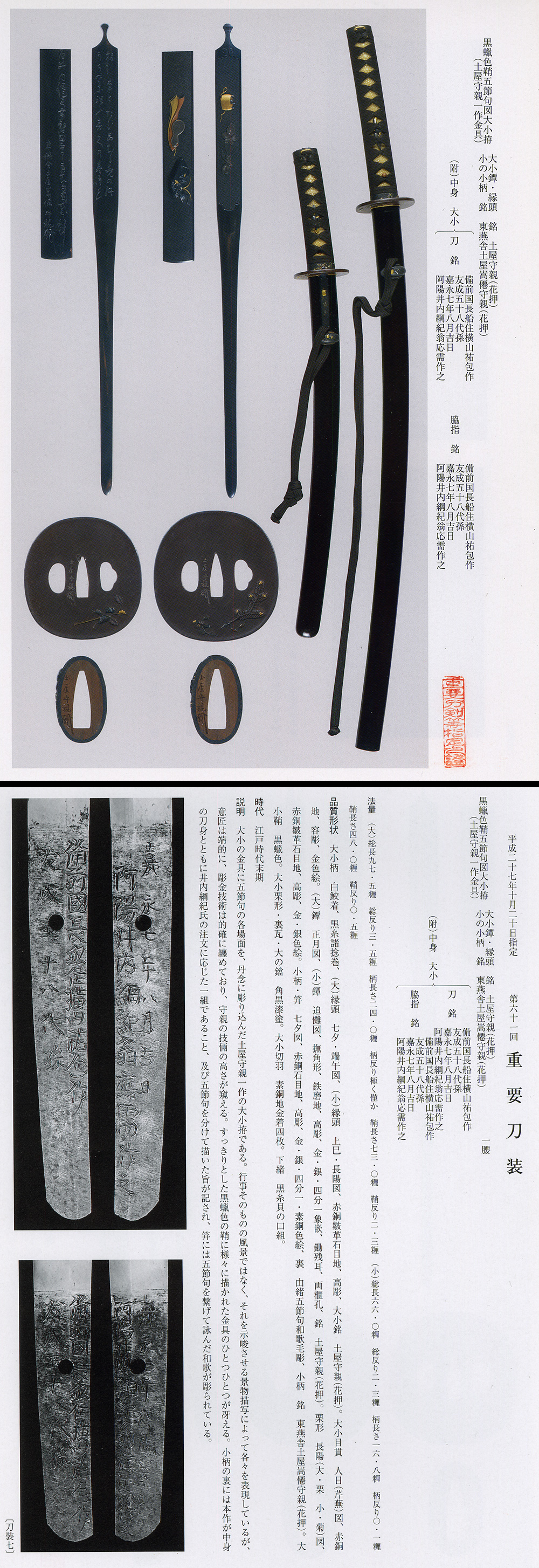
Koshirae: Black roiro lacquer saya with Five Seasonal Festivals motif Daisho koshirae (61st Juyo Tosogu), late Edo period.
Fuchikashira: Shakudo ground with Tanabata and Tango motifs. Signature: Tsuchiya Morichika (kao).
Menuki: Shakudo ground, Jinjitsu (seri and turnip) motif.
Tsuba: Mokko-shaped iron tsuba with New Year motif. Signature: Tsuchiya Morichika (kao).
Kurigata: Shakudo ground, Choyo (chestnut) motif.
-----------------------
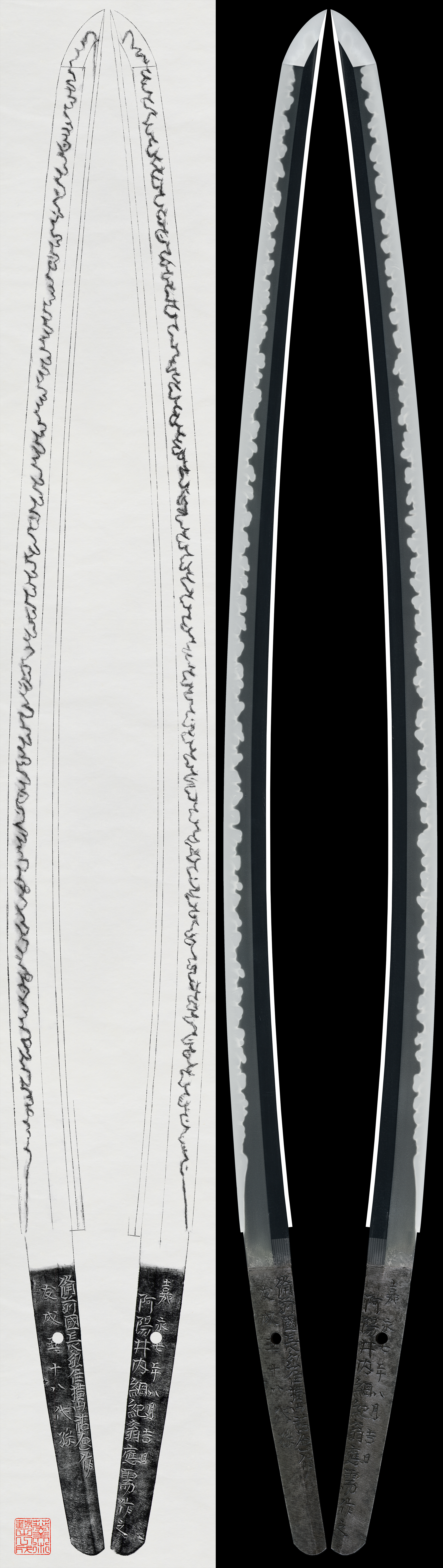
Sho:Wakizashi in Shirasaya, with Koshirae (NBTHK Tokubetsu Hozon Token) (Koshirae: 61st NBTHK Juyo Tosogu)
Signature:Bizen no Kuni Osafune ju Yokoyama Sukekane saku.
58th descendant of Tomonari.
A lucky day in August, Kaei 7 (1854).
Made upon request of Mr. Iuchi Tsunanori of Awa Province.
備前国長船住横山祐包作
友成五十八代孫
嘉永七年八月吉日
阿陽井内綱紀翁応需作之
(We divide 4 sections for each sword as Saijyo Saku, Jyojyo Saku, Jyo Saku and Regular Saku).
This work is ranked as Jyojyo Saku for Yokoyama Sukekane.
Habaki: Gold-plated single habaki.
Blade Length: 45.15 cm (17.78 in).
Curvature: 1.52 cm (0.60 in).
Mekugi Hole: 1.
Width at Base (Motohaba): 2.85 cm (1.12 in).
Width at Tip (Sakihaba): 2.10 cm (0.83 in).
Thickness of rim (Kasane): 0.73 cm (0.29 in).
Era: Late Edo period, Kaei 7 (1854).
Shape: A solidly constructed wakizashi typical of Yokoyama Sukekane.
Jigane: Fine ko-itame hada, well forged.
Hamon: Nie-deki with well-arranged choji-midare.
Koshirae: Black roiro lacquer saya with Five Seasonal Festivals motif Daisho koshirae (61st Juyo Tosogu), late Edo period.
Fuchikashira: Shakudo ground with Joshi and Choyo motifs. Signature: Tsuchiya Morichika (kao).
Menuki: Shakudo ground, Jinjitsu (seri and turnip) motif.
Tsuba: Iron ground with Tsuina motif. Signature: Tsuchiya Morichika (kao).
Kurigata: Shakudo ground, Choyo (chrysanthemum) motif.
Kogai: Shakudo ishime ground with Tanabata motif, kebori engraving.
Kozuka: Shakudo ishime ground with Tanabata motif, kebori engraving of waka related to the Five Seasonal Festivals. Signature: Toen-sha Tsuchiya Morichika (kao).
Kogatana.
-----------------------
Features: The Yokoyama school was founded by Yokoyama Sukehira and is known for producing tightly controlled choji-midare with a distinctive nioi. Sukekane inscribed himself as the 58th descendant of Tomonari on the tang, while Yokoyama Sukehira signed as the 56th descendant.
This daisho set was made in the same period for both blades and koshirae, and the blades were registered as daimyo property in 1951. It is an extremely rare work, made by Yokoyama Sukekane upon request from Mr. Iuchi Tsunanori. The koshirae is designated as Juyo Tosogu, and both katana and wakizashi are designated as NBTHK Tokubetsu Hozon Token. It is presumed to have been owned by a high-ranking daimyo.
The daisho koshirae is a unified work by Tsuchiya Morichika, with fittings carved to represent the Five Seasonal Festivals. Rather than depicting the events directly, each scene is expressed through evocative symbolic imagery. The reverse of the kozuka records that both the koshirae and blades were commissioned by Mr. Iuchi Tsunanori.
Tsuchiya Morichika trained for over ten years after entering the Tsuchiya school and was later permitted to use the Tsuchiya surname. He is प्रसिद्ध for carvings of flowers and birds, and all of his works are excellent. He later returned to Okayama and moved to Osaka during the Meiji period.
Daisho Koshirae: 61st NBTHK Juyo Tosogu.
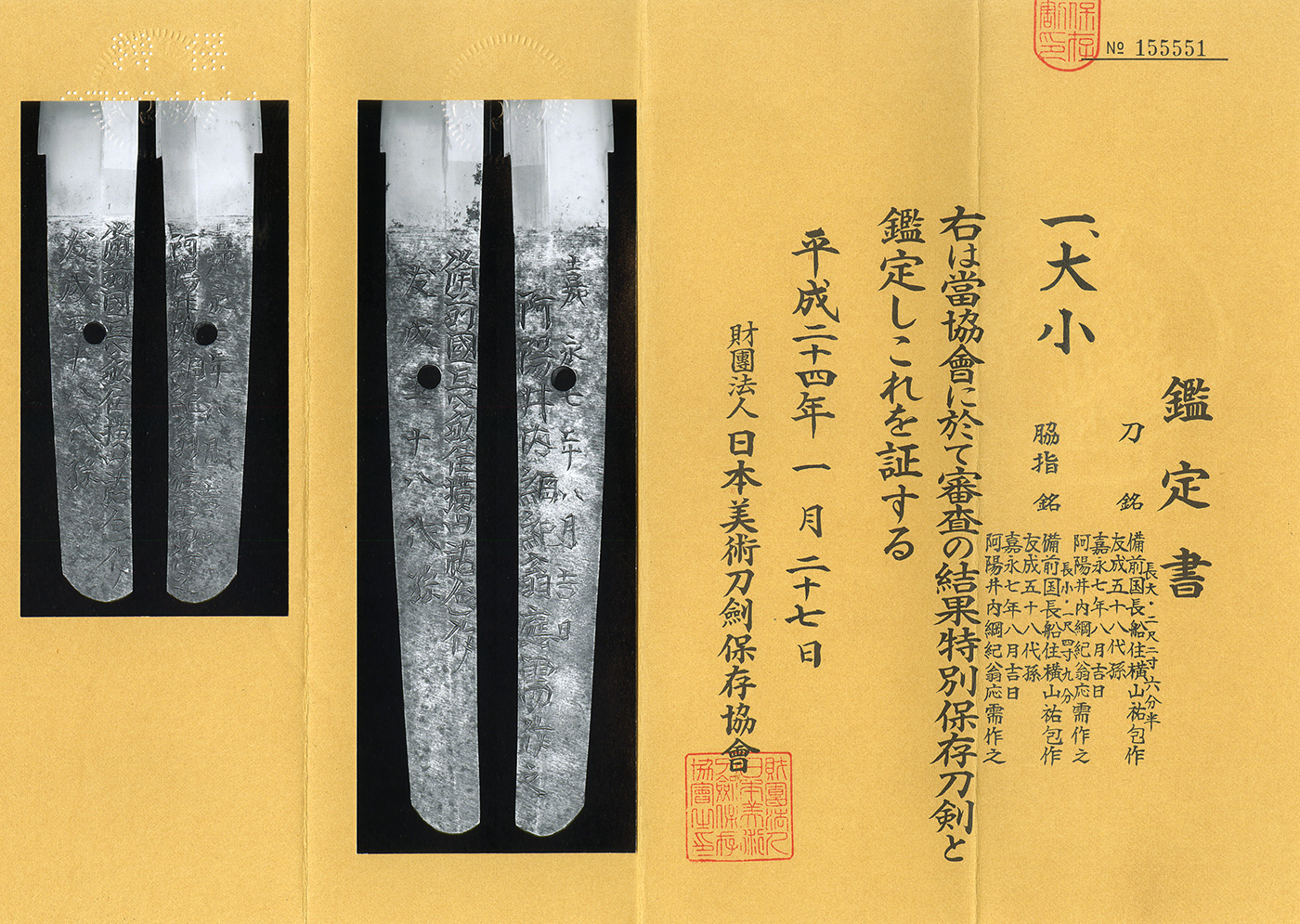
Daisho (Katana and Wakizashi): NBTHK Tokubetsu Hozon Token.
Aoi Art estimation paper: Whole Oshigata.
Shipping fee is not included in the price.
Auction Starting Price:5,000,000JPY
Place Bid



脇差







Related Items:
 Set of Tosogu:Tomei:Tsuba, Kozuka, Fuchi-Kashira, Menuki, Ura-gawara, Kurikata (NBTHK Juyo Tosogu, 65th): Millet
 Set of Tosogu (Kōgai, Kozuka, Menuki): Mumei (Unsigned – Attributed to Renjō:Kizukawa Motif (44th Juyo Tosogu) With Origami
 Kogai:Mumei(Unsigned)(Ko-goto)(22th Juyo Tosogu)
 Tachi: Norinari (Ko-Ichimonji)(69th NBTHK Juyo Token)
 Katana: Mumei(Rai Kunitoshi) with golden inscription by Hon'ami Mitsutada (25th NBTHK Tokubetsu Juyo Token)
 Set of Tosogu: Kōgai: Mumei (Unsigned, attributed to Renjō)) / Kozuka, Menuki: (Mon Renjō Mitsutaka (with kaō)(Designated 49th Juyo certificate))