
Ordering Number: AS25427
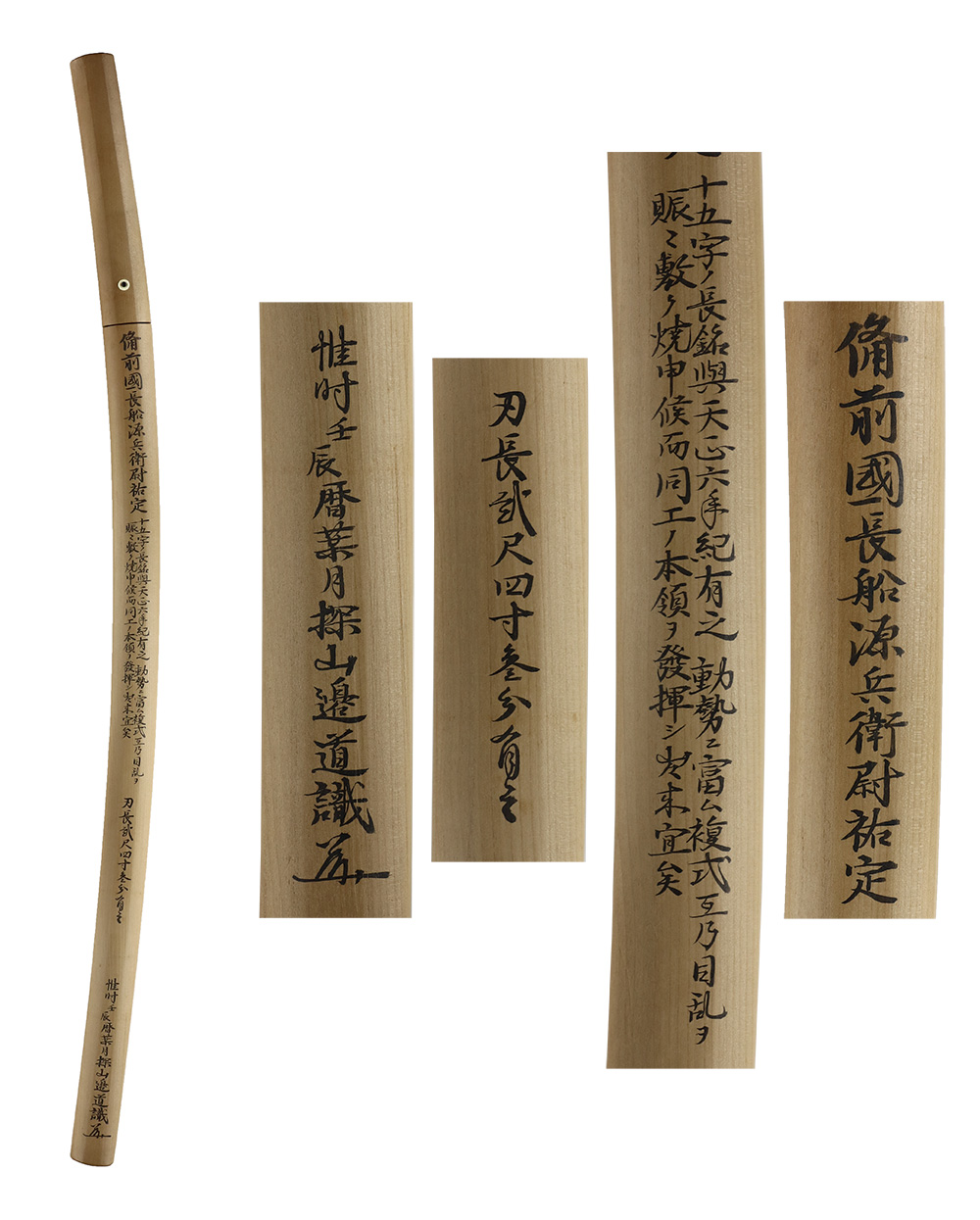
Wakizashi: in Shirasaya with Koshirae (NBTHK Tokubetsu Hozon Token) (NBTHK Tokubetsu Kicho Token)
Signature: Awataguchi Omi no Kami Tadatsuna
粟田口近江守忠綱
(We divide 4 sections for each sword as Saijyo Saku, Jyojyo Saku, Jyo Saku and Regular Saku).
This work is ranked as Jyojyo Saku among works by Awataguchi Omi no Kami Tadatsuna.
Habaki:Silver base. Gold is covered
Blade Length: 52.6 cm (20.71 in).
Curvature: 1.3 cm (0.51 in).
Mekugi Hole: 1.
Width at Base (Motohaba): 2.91 cm (1.15 in).
Width at Yokote: 1.88 cm (0.74 in).
Thickness of rim (Kasane): 0.74 cm (0.29 in).
Sword Weight: 530 g.
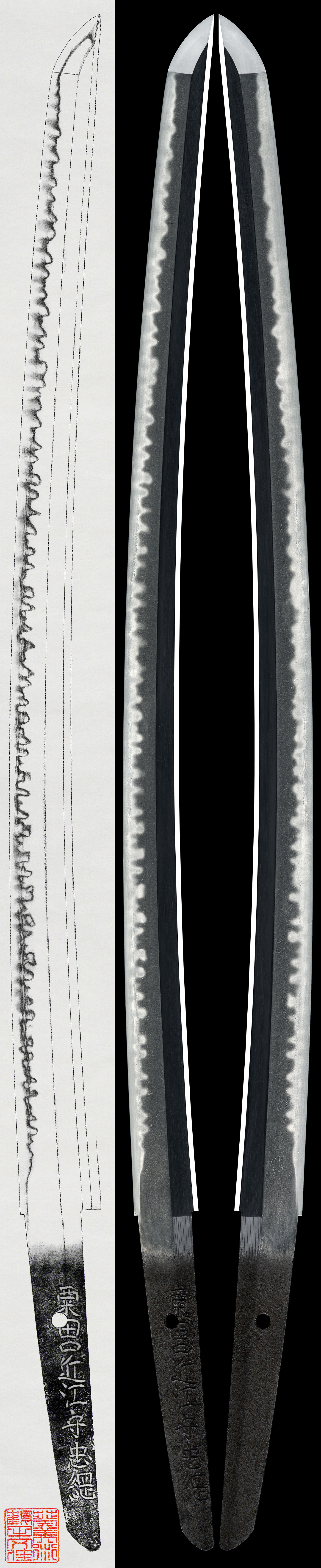
Shape: The blade has standard width and thickness, with slightly deep curvature and an extended kissaki.
Jigane: The ko-itame hada is well forged and tightly packed, showing a typical Osaka-style jigane.
Hamon: Ko-nie-deki gunome midare with a slightly deep nioiguchi that appears bright and clear.
Kinsuji activities are seen within the hamon, and the boshi turns back in a rounded form.
Features: Awataguchi Tadatsuna was a swordsmith active in Osaka during the mid-Edo period and belonged to the lineage of the prestigious Awataguchi school of Kyoto.
In particular, the second generation Tadatsuna became famous through an incident in the Tenmei era and is regarded as one of the representative Osaka swordsmiths of the 18th century.
Awataguchi Omi no Kami Tadatsuna was also known by the art name “Ikkanshi” and was highly esteemed as a master of horimono carvings.
He claimed descent from Awataguchi Kunituna of Kamakura-period Kyoto.
His father, the first-generation Tadatsuna, moved to Osaka and received the title “Omi no Kami.”
The second-generation Tadatsuna is especially well known.
On March 24, Tenmei 4 (1784), inside Edo Castle, Wakadoshiyori Tanuma Okitomo—the son of the senior councilor Tanuma Okitsugu—was assassinated by Sano Zenzaemon.
It is said that the weapon used in that attack was a large wakizashi made by the second-generation Tadatsuna.
At the time, Tanuma Okitsugu was widely known for corrupt politics involving bribery, and Sano was praised by the public as “Yonaoshi Daimyojin,” a restorer of justice.
Following this event, swords by the second-generation Tadatsuna gained great fame as symbols of justice and became objects of admiration for many people.
This piece is a rare hirazukuri blade with a length nearly equal to that of a katana.
Some works bear the reverse-side inscription “Asai,” and they are thought to be related to the Asai clan.
Koshirae:
Tsuba: Round iron tsuba. Signature: Kaneie.
Fuchikashira: Iron with gold inlay depicting flowing water and bamboo leaves.
Saya (Scabbard): Black roiro lacquer with line patterns.
Menuki: Shakudo ground with plant designs carved and finished with gold iro-e.
Aoi Art’s Comment: This is a healthy and well-made work by Awataguchi Omi no Kami Tadatsuna.
Both the hamon and the jigane are bright and clear, and the koshirae possesses a calm and refined elegance.
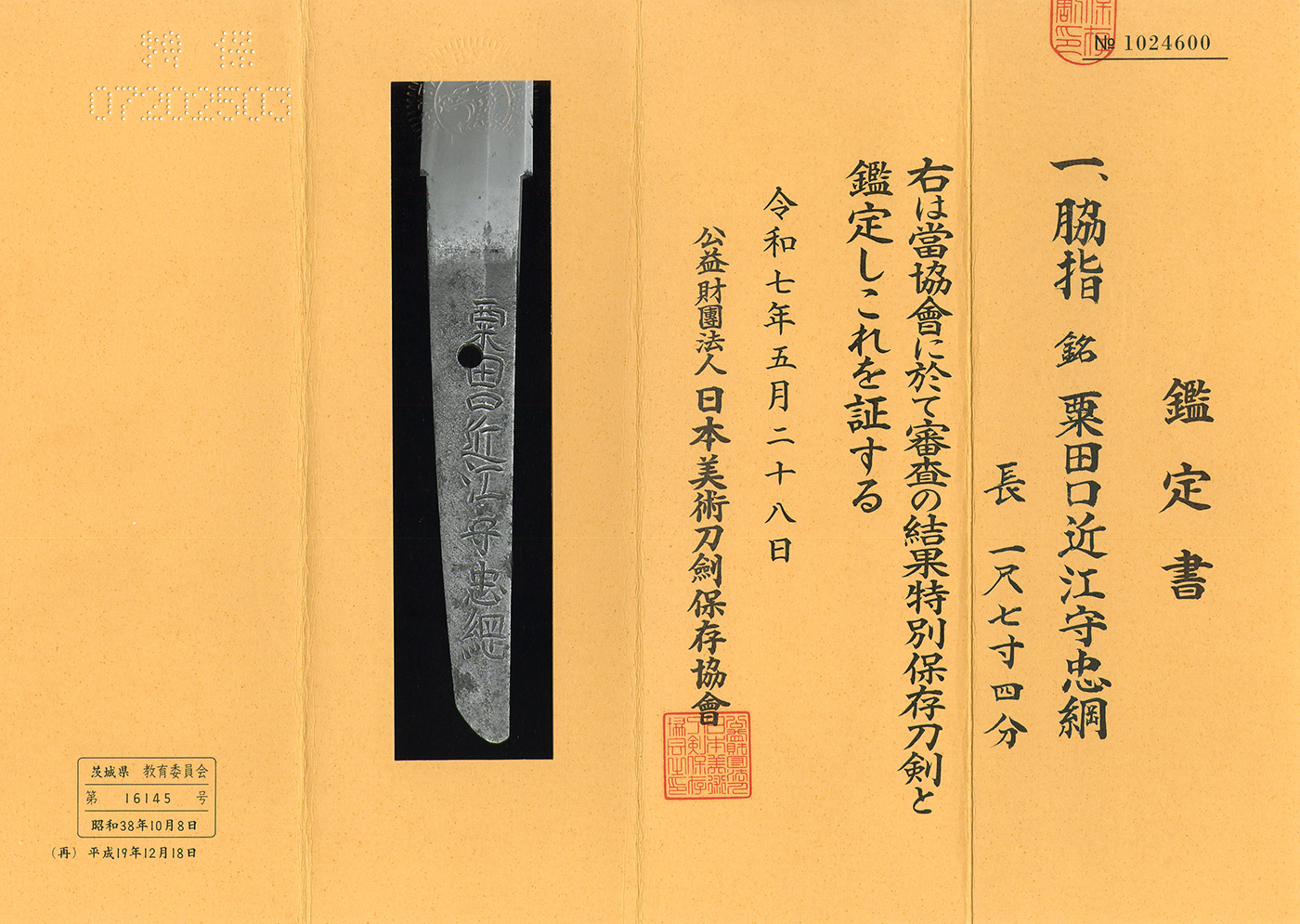
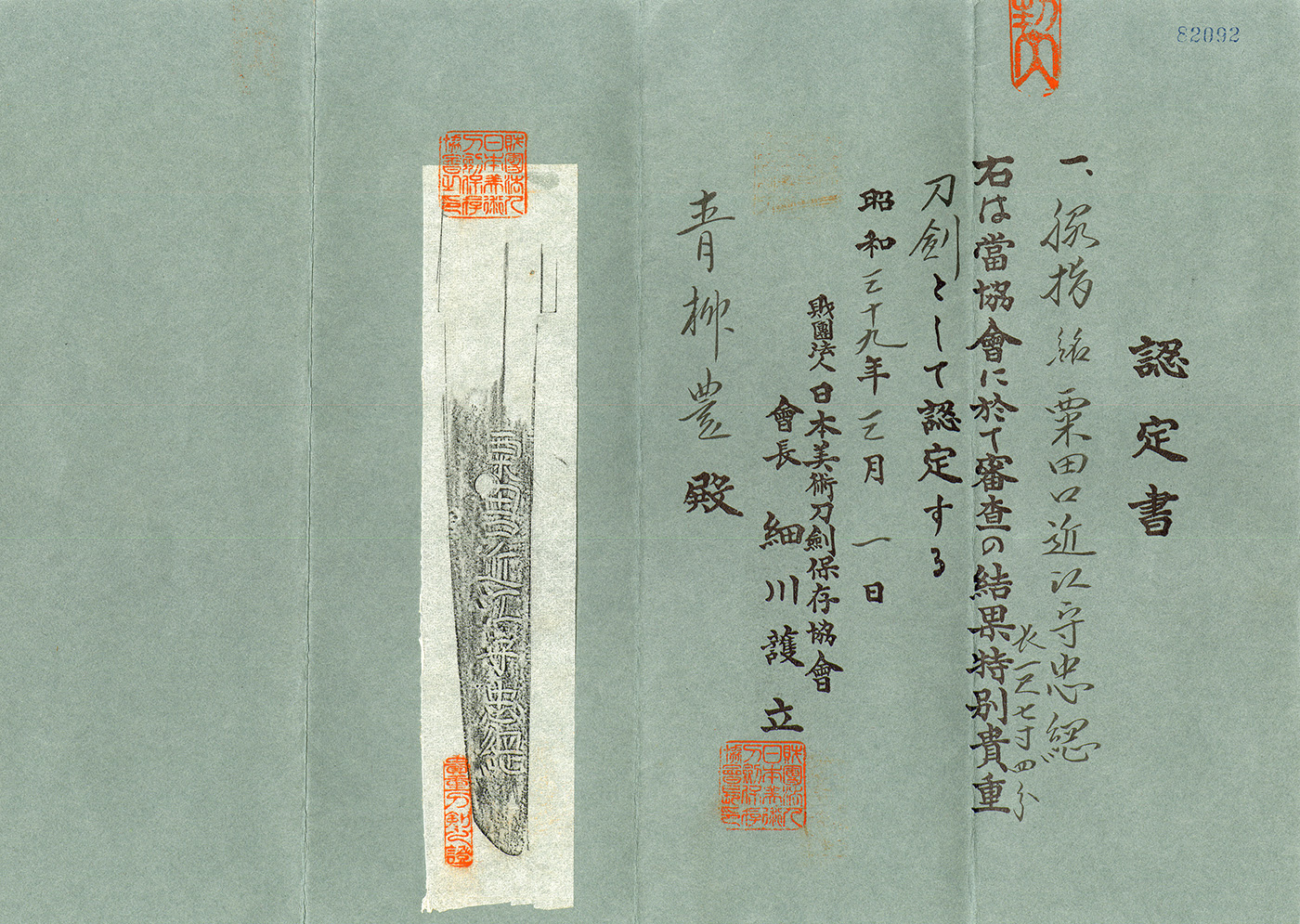
NBTHK Tokubetsu Hozon Token.
(NBTHK Tokubetsu Kicho Token).
AoiArt estimation paper: Whole Oshigata
Please note: the price does not include the shipping fees.
Auction Starting Price:700,000JPY
Place Bid




Related Items:
 Wakizashi:Awataguchi Omi no Kami Tadatuna (2nd generation)(NBTHK Hozon Token)
 Wakizashi: Ōmi Kami Hōjōji Tachibana Masahiro (2nd)(NBTHK Tokubetsu Hozon Token)
 Wakizashi:(Kikumon) Omi no Kami Hisamichi (First Generation) (NBTHK Tokubetsu Hozon Token)
 Wakizashi: Tanba no Kami Yoshimichi (Osaka, 3rd Generation)(NBTHK Tokubetsu Hozon Token)
 Wakizashi:Tanba no Kami Yoshimichi (Osaka 3rd) (NBTHK Hozon Token)
 Wakizashi: Motte Namban Tetsu Omi Kami Fujiwara Tsuguhiro Echizen Ju Shimosaka(NBTHK Tokubetsu Hozon Token)