
Ordering Number: AS25335
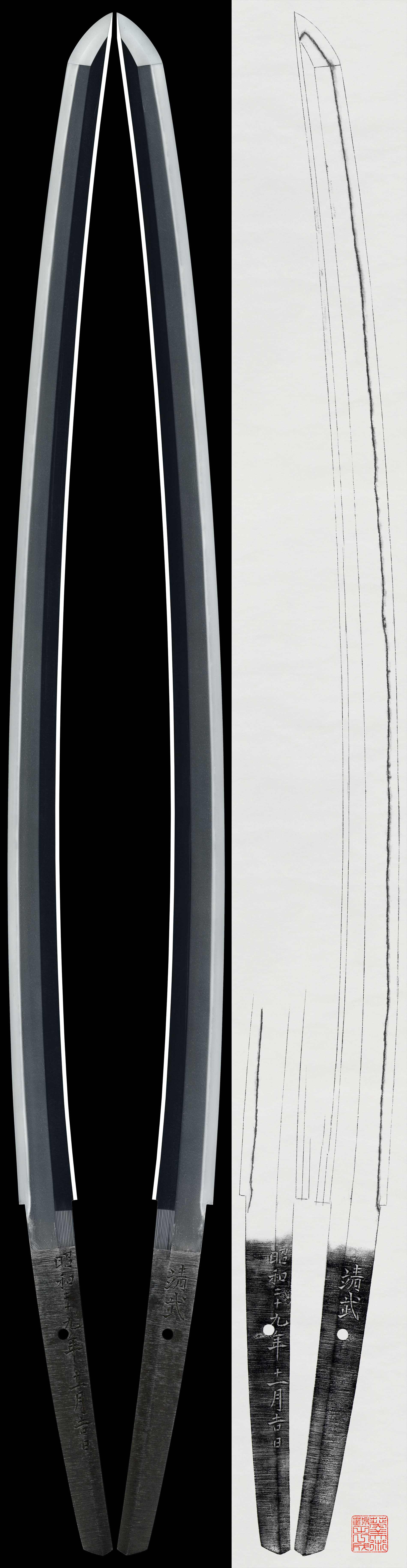
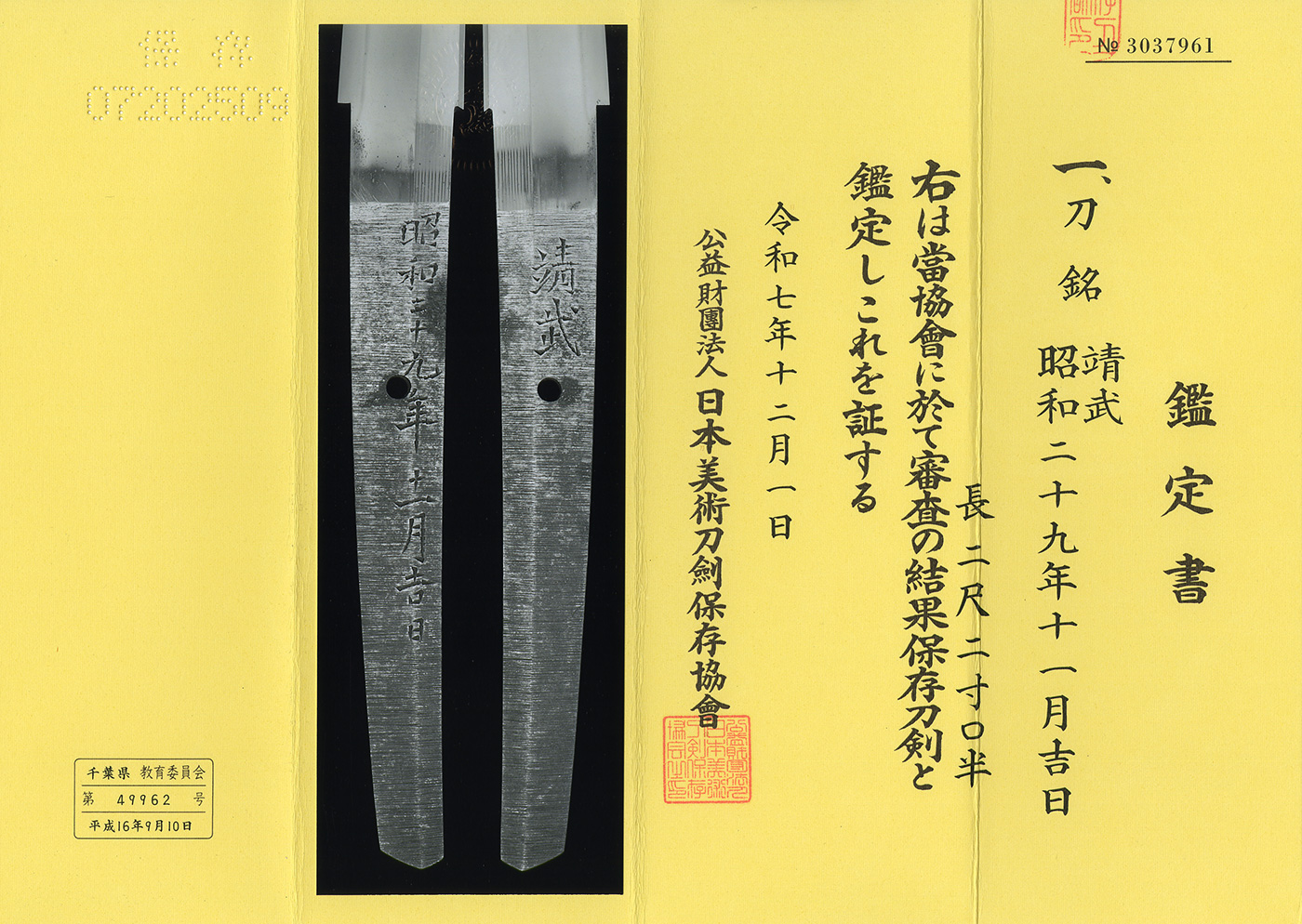
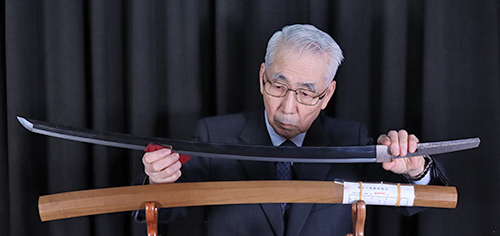
Tachi in Shirasaya (NBTHK Hozon Token).
Signature: Yasutake.
A lucky day in November, Showa 29 (1954).
靖武
昭和二十九年十一月吉日
(We divide 4 sections for each sword as Saijyo Saku, Jyojyo Saku, Jyo Saku and Regular Saku).
This work is ranked as Jyo Saku for Yasutake.
Habaki: Single layer silver.
Blade Length: 66.9 cm (26.34 in).
Curvature: 1.0 cm (0.39 in).
Mekugi Hole: 1.
Width at Base (Motohaba): 3.29 cm (1.30 in).
Width at Yokote (Sakihaba): 2.13 cm (0.84 in).
Thickness (Kasane): 0.82 cm (0.32 in).
Sword Weight: 745 grams.
Shape: Wide mihaba, thick kasane, deep curvature, and a slightly extended kissaki.
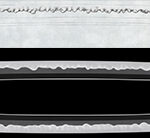
The edge at the hamachi remains considerably, showing the blade to be in healthy condition.
Jigane: Similar to Yasukuni-to, the jigane is finely forged and beautiful.
Hamon: Nie-deki, straight temper line with active ko-ashi, and the boshi turns back round.
Features: Yaguwa Yasutake was born in Yamagata Prefecture in 1909.
From 1935 he began forging swords at the Nihonto Tanrenkai within the precincts of Yasukuni Shrine.
In 1944 he was granted the name Yasutake by the Minister of the Army and became independent as a swordsmith, but due to Japan’s defeat he was not permitted to produce swords for some time.
He resumed sword forging in 1953.
After the war he studied under Tsukamoto Okimasa and continued making swords, and was certified as Mukansa swordsmith.
In 1981 he received the highest award, the Masamune Prize, at the Shinsaku Meito Exhibition.
He passed away in 1983.
Aoi Art’s Comment: This work is made in the same style as Yasukuni-to.
It is unclear whether materials remaining from before the war were used as they were, or whether it was made in imitation of blades produced at that time, but it closely resembles works of that earlier period.
This piece was made in 1954, when very few Yasukuni-to were being produced.
If it reflects prewar workmanship, it may be considered an unusual and distinctive example.
Historical Background: In 1954, on January 12, U.S. Secretary of State Dulles announced the policy of massive retaliation.
On January 21, the launching ceremony of the U.S. nuclear submarine Nautilus took place.
On March 28, at the Organization of American States conference, the U.S.-led Caracas Declaration to prevent international communist activities was adopted.
On April 13, the U.S. Atomic Energy Commission began a loyalty hearing of Dr. Oppenheimer, who opposed hydrogen bomb development, and on May 27 he was deemed a security risk.
On April 18, the Nasser administration was established in Egypt.
On April 26, the Geneva Conference was convened (until July 21) to discuss resolutions to the Korean and Vietnam issues.
NBTHK Hozon Token.
AoiArt estimation paper: Whole Oshigata.
Pleasenote:Thepricedoesnotincludetheinternationalshippingfees.AuctionStartingPrice:650,000JPY
PlaceBid




Related Items:
 Tachi: Sagami Koku Ju Masuda Yasuaki Saku (December 1971)(NBTHK Hozon Token)
 Katana: Bishu Nakaji Ju Moritsugu Saku (16th NBTHK Juyo Token)
 Tachi: Sanryūtei Ryōsanshi Masamine Saku Kore (Living National Treasure) Dated: August, Year of the Wood Rabbit (1975) (NBTHK Tokubetsu Hozon Token)
 Katana: Yasuoki(April, 1941)(NBTHK Tokubetsu Hozon Token)
 Katana : Kun Yonto Kurihara Akihide Saku Showa 18 nen 2 gatsu
 Katana:Minamoto Moriyoshi (Mukansa Swordsmith). (NBTHK Tokubetsu Hozon Token)