
Ordering Number: AS25454
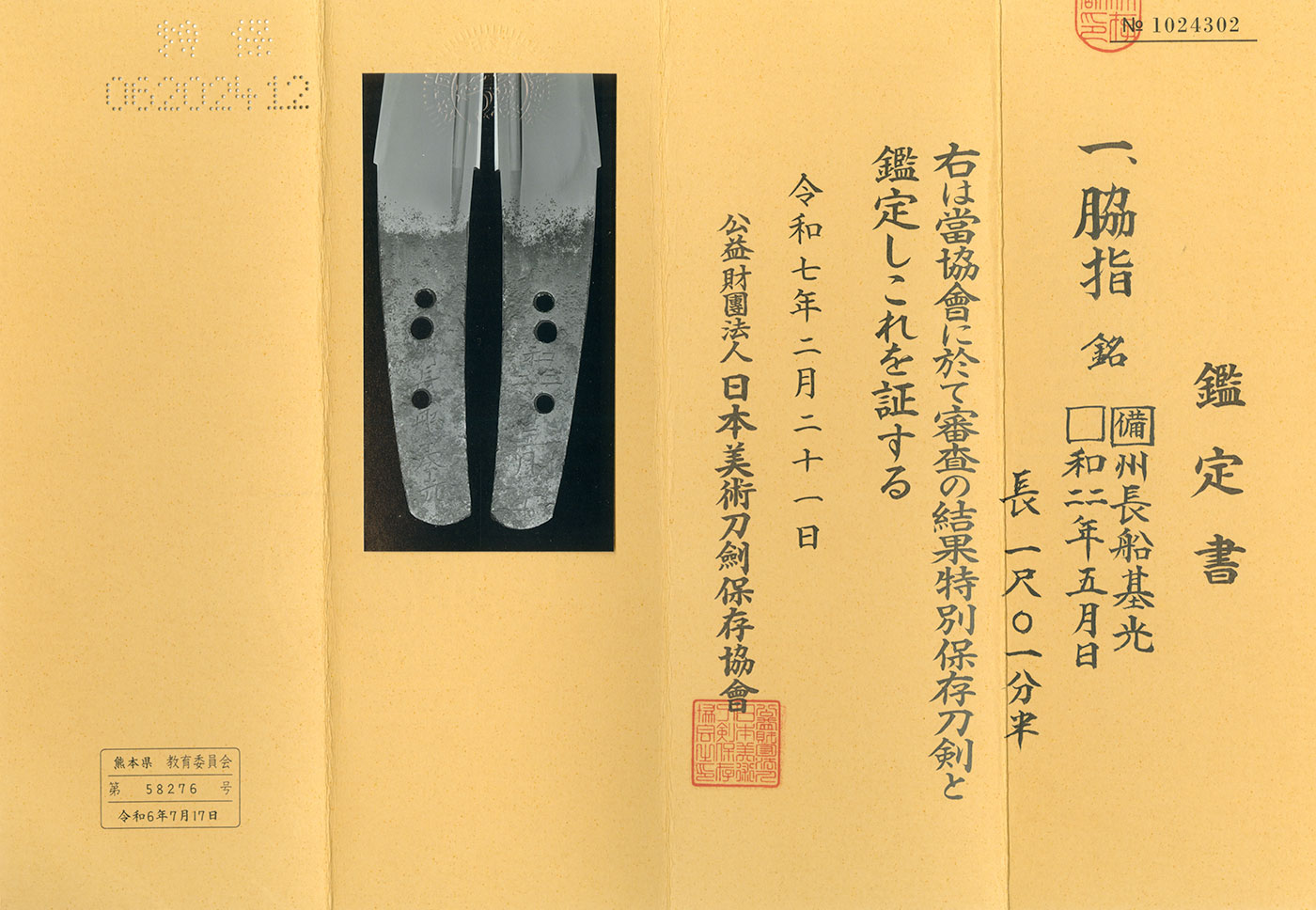
Wakizashi (Sunnobi Tanto): in Shirasaya with Koshirae (Tokubetsu Hozon Token)
Signature: Bishu Osafune Motomitsu
◻︎ Wa Shi Gatsu ◻︎ (Interpreted as: Bunna 4th year, 5th month [May, 1355])
We divide 4 sections for each sword as Saijyo Saku, Jyojyo Saku, Jyo Saku and Regular Saku.
This sword is ranked as Jyojyo Saku.
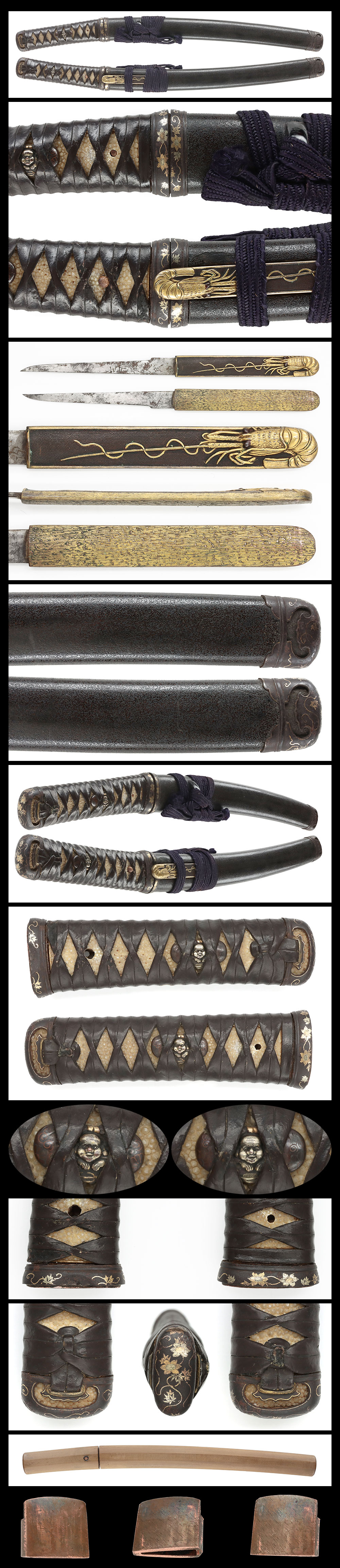
Habaki: Plain copper, single-layered
Blade Length: 30.8 cm (12.13 in)
Curvature: 0.4 cm (0.16 in)
Mekugi Hole: 3
Width at Base (Motohaba): 2.65 cm (1.04 in)
Thickness of rim (Kasane): 0.68 cm (0.27 in)
Sword Weight: 130 g
Shape:
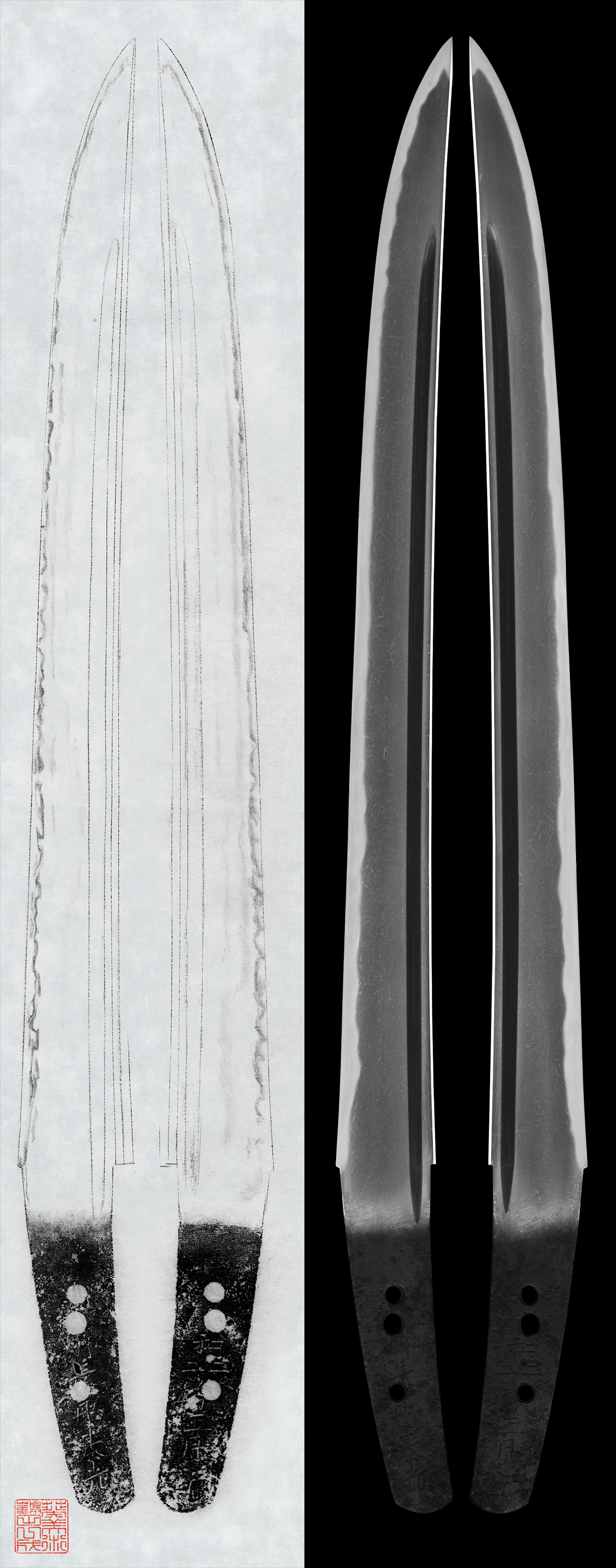
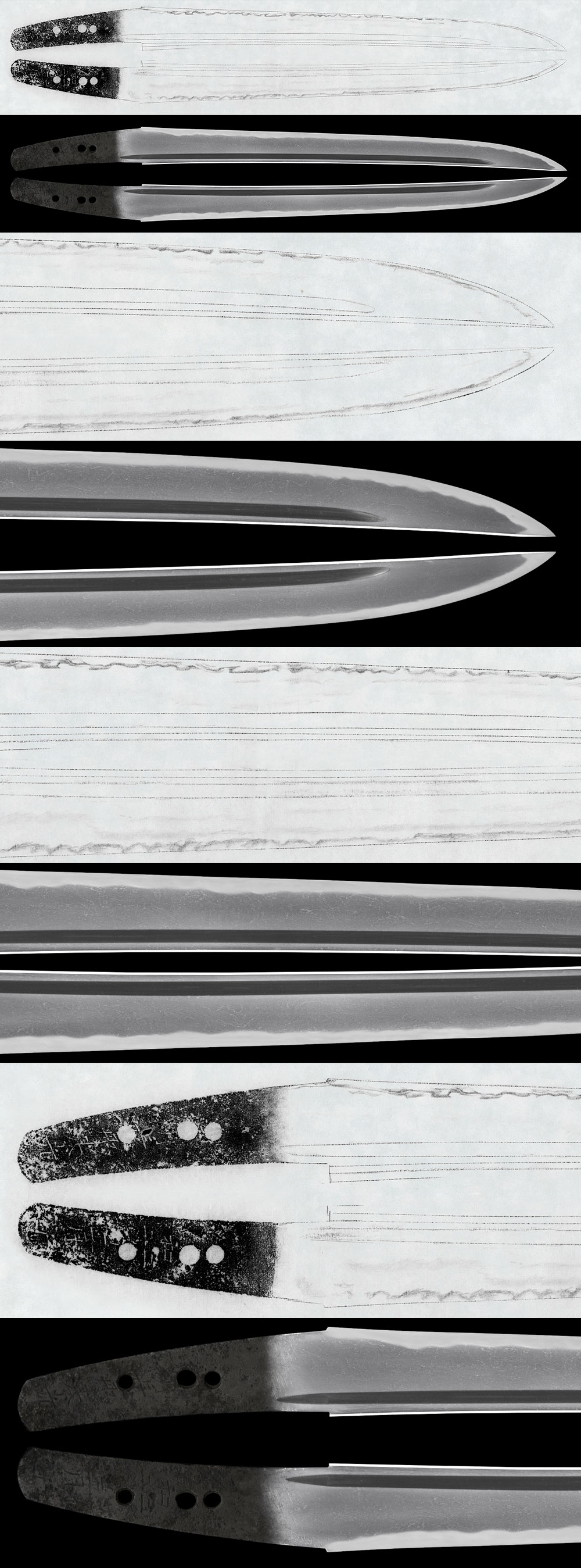
A slightly extended tanto with a slightly wide body and a blade length of 30.8 cm.
Both sides are carved with bohi (grooves).
Jigane:
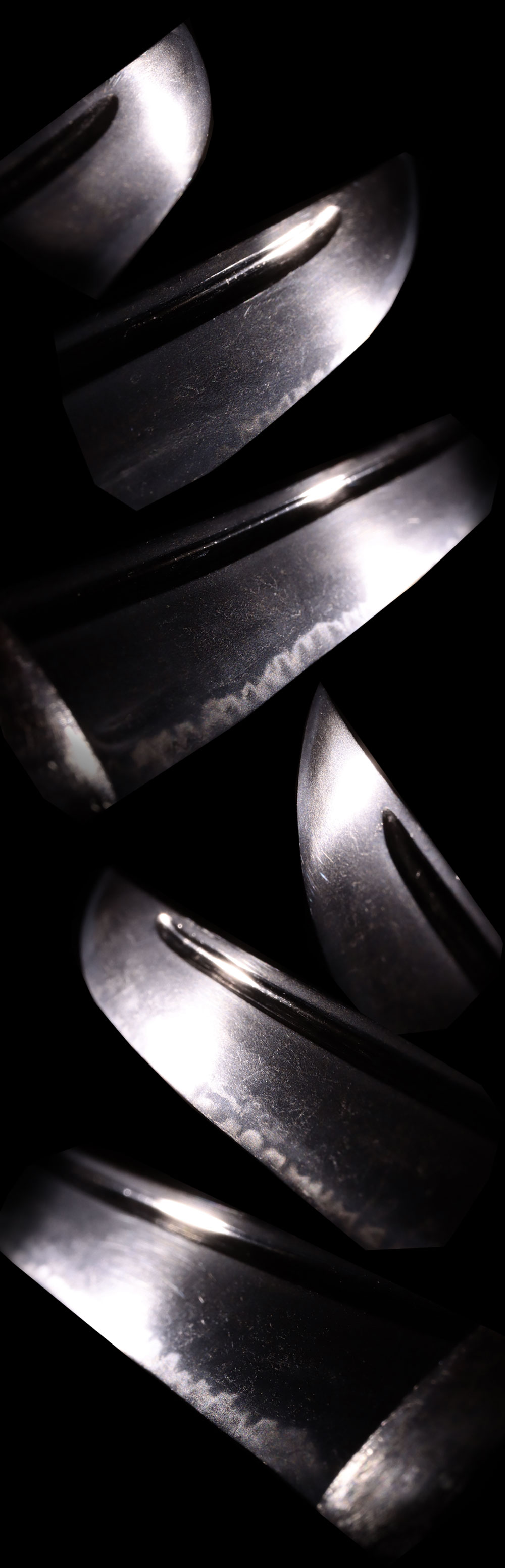
Well-forged small itame hada with a tight grain and a visible utsuri.
Hamon:
Nioi-deki with a gunome-midare pattern.
The boshi is pointed and returns in komaru style.
Features:
Bishu Osafune Motomitsu was an early Muromachi swordsmith active during the Nanbokucho period.
The hamon of this sword is listed in Fujishiro Sensei’s volume on Koto swords.
It displays a softly undulating gunome-midare pattern with prominent utsuri.
Koshirae: Aikuchi Koshirae
Menuki: Carved with human figures
Fuchikashira and Kojiri: Iron base inlaid with gold plant motifs
Saya (Scabbard): Black stone-textured lacquer (ishimeji)
Kozuka: Shakudo nanakoji base with a design of a spiny lobster, detailed with gold iroe
Comes with a kogatana (small knife)
Aoi Art’s Comment:
From the Kamakura to Nanbokucho period, the shape of tanto gradually changed.
Generally, the body became slightly wider and the thickness thinner.
Bizen swords often exhibit gently rounded gunome-midare patterns.
The date is interpreted as "Bunna 4th year, 5th month" (May, 1355), which predates the Enbun and Jōji eras.
Although the character for "Bun" is unclear, we interpreted it as Bunna rather than Jōji.
Historical Context:
This piece originates from Japan’s Nanbokucho period, a time of civil unrest during which two imperial courts—the Northern and Southern Courts—competed for legitimacy.
The Bunna era was used by the Northern Court after Ashikaga Takauji established the Muromachi Shogunate.
This era followed the Kan’ō Disturbance and marked intensifying conflict between the two courts.
Tokubetsu Hozon Token
Aoi Art Estimation Paper: Whole Oshigata included
Overseas shipping fee not included
Auction Starting Price:750,000JPY
Place Bid


Related Items:
 Wakizashi(Sunnobi Tanto):Hizen Koku Kawachi Daijo Fujiwara Masahiro(NBTHK Tokubetsu Hozon Token)
 Wakizashi: Bishu Osafune (partially cut) (Sue-Bizen)NBTHK Hozon Token)
 Wakizashi (Sunbobi Tanto): Seiryuken Moritoshi Date: Bunkyu 2 Mizunoe-Inu 9th Month (September 1862)(NBTHK Tokubetsu Hozon Token)
 Wakizashi:Bizen Koku Osafune Yosazaemon Sukesada(NBTHK Tokubetsu Hozon Token)
 Wakizashi:Mumei (Yamamura) (NBTHK Tokubetsu Hozon Token)
 Wakizashi(Sunnobi Tanto):Tsunahide(NBTHK Tokubetsu Hozon Token)