
Ordering number:AS25294
Tanto in Shirasaya with Koshirae (NBTHK Hozon Token)
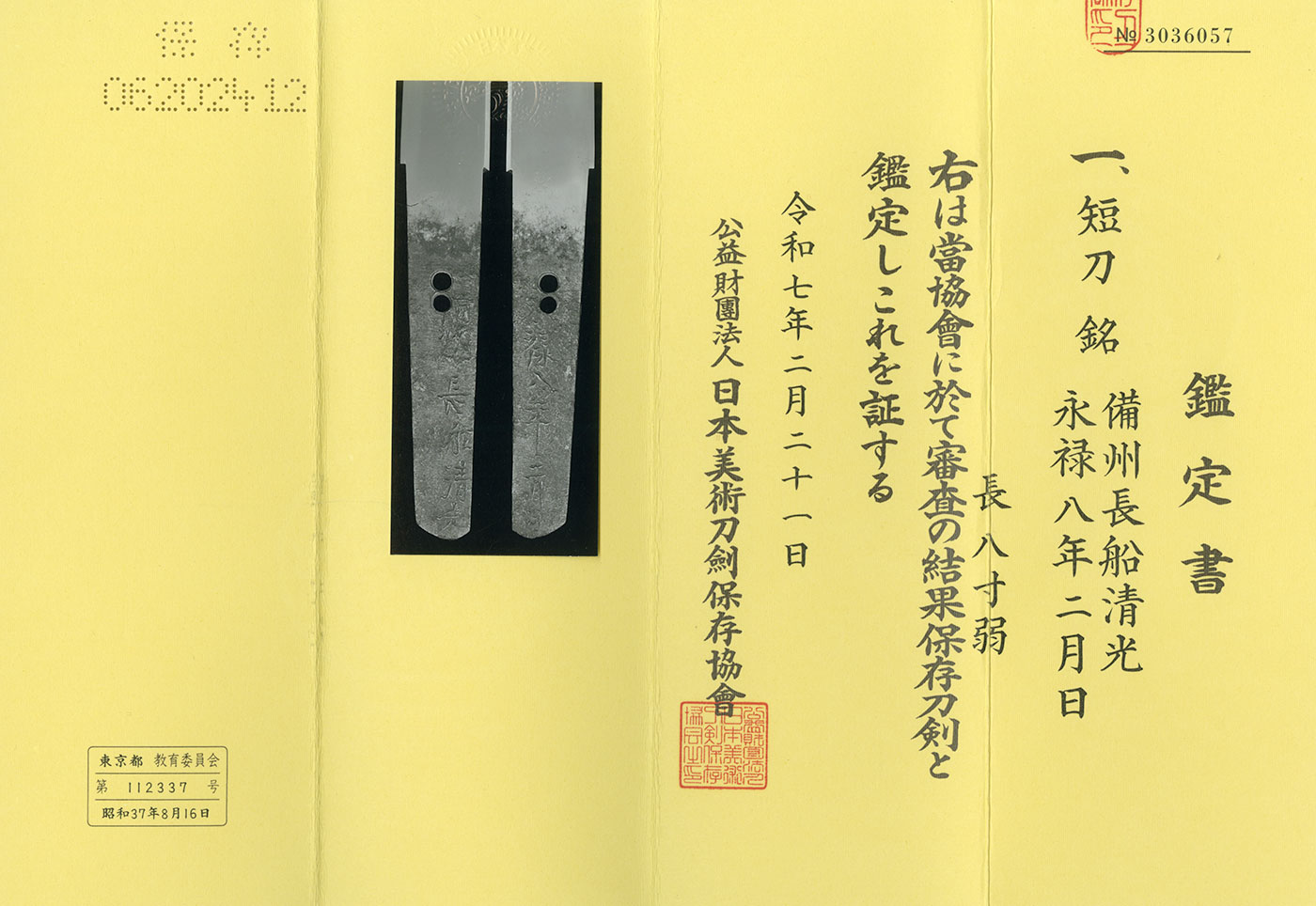
Signature: Bishu Osafune Kiyomitsu
Date: A day in February, 1565 (Eiroku 8)
備州長船清光
永禄八年二月日
We divide 4 sections for each sword as Saijyo Saku, Jyojyo Saku, Jyo Saku and Regular Saku.
This work is ranked as Jyojyo Saku for works by Bishu Osafune Kiyomitsu.
Habaki: Double-layered plain copper with gold and silver decoration
Blade Length: 24.2 cm (9.53 in)
Curvature: 0.2 cm (0.08 in)
Mekugi Hole: 2
Width at Base (Motohaba): 2.29 cm (0.90 in)
Thickness of Rim (Kasane): 0.66 cm (0.26 in)
Sword Weight: 165 grams
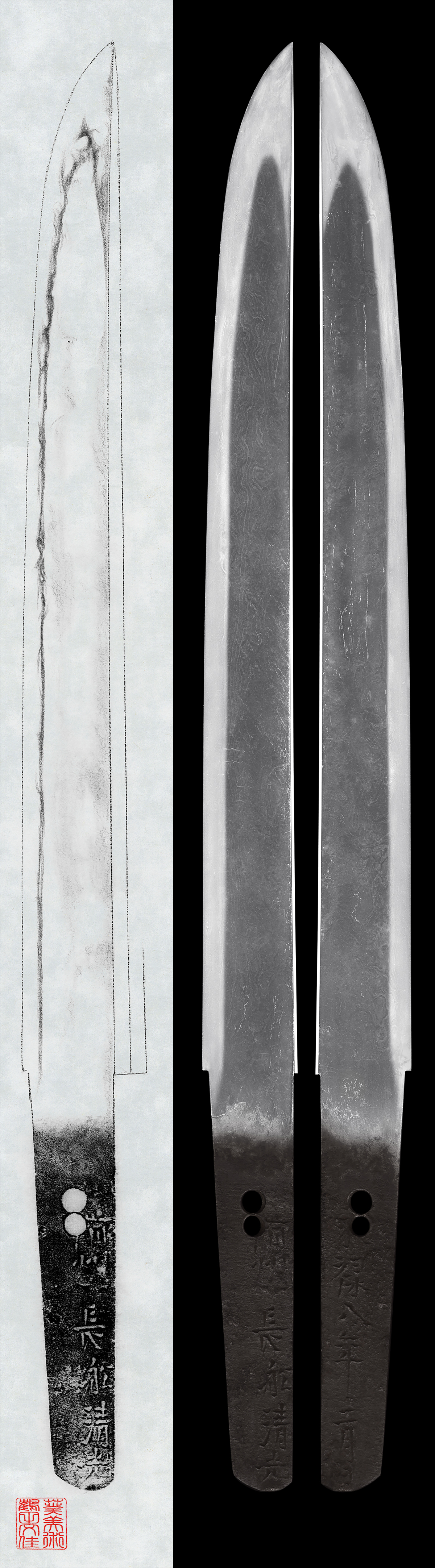
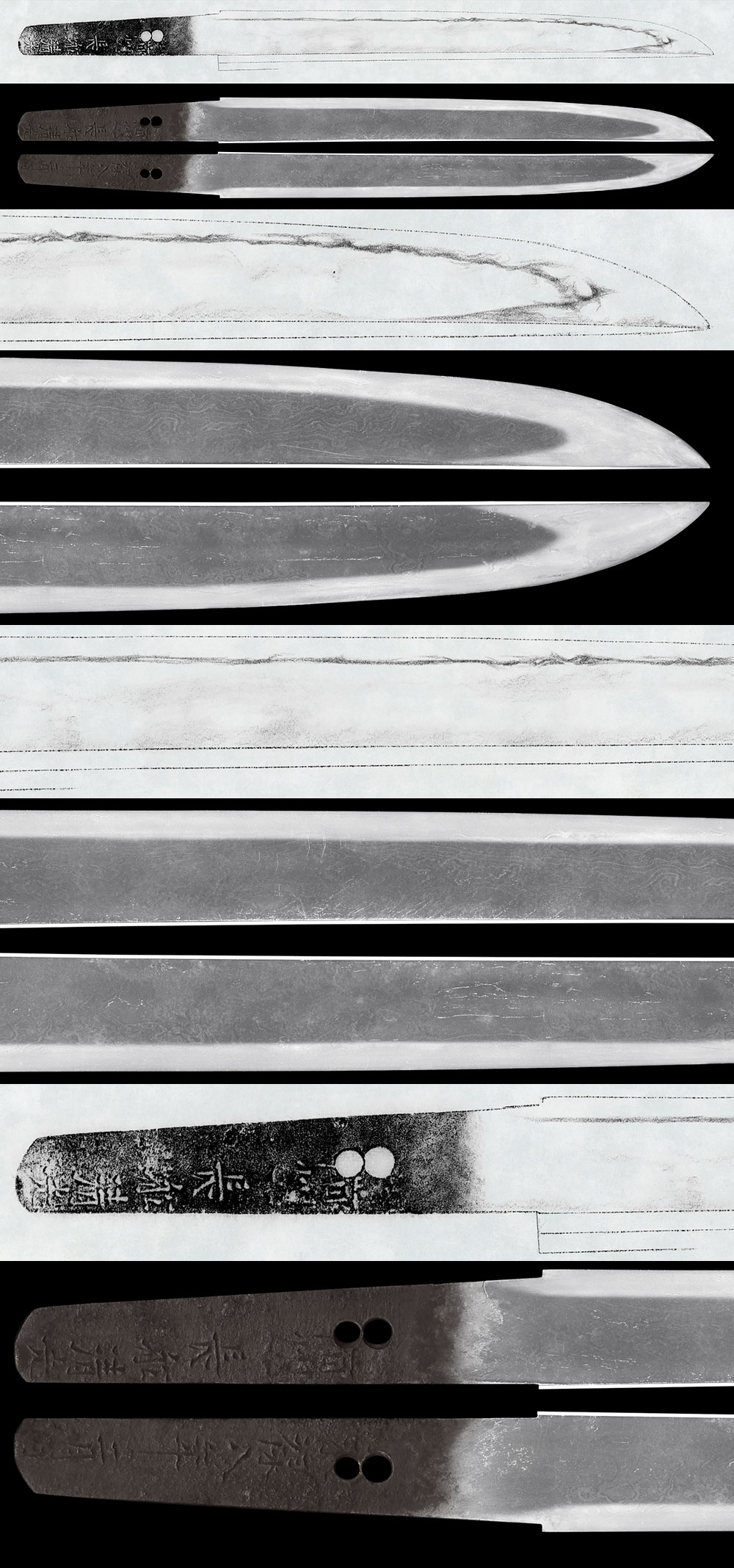
Shape: A wide-bodied and thick tanto by Bishu Osafune Kiyomitsu.
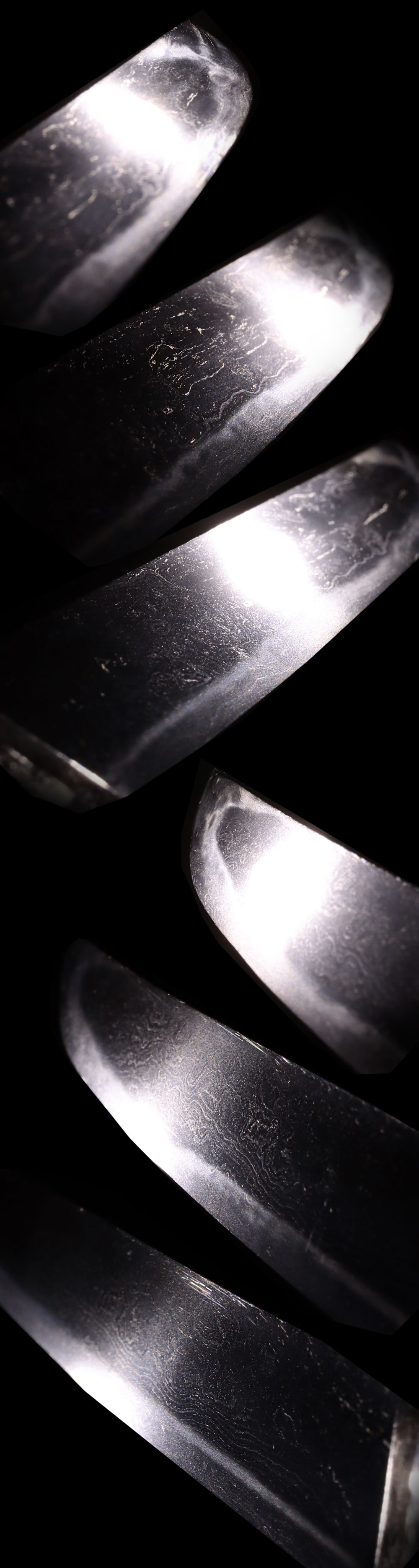
Jigane: Clearly visible hada; a good example of the texture from the Eiroku period. Ji-nie and utsuri are present.
Hamon: Nie-based with deep nioiguchi, soft ashi, a somewhat rough appearance with a double-layered boshi.
Features: In the late Muromachi period, Japan was in the midst of intense warfare between the Toyotomi and Tokugawa factions, with many battles fought using swords and tanto.
During this time, the production of tanto was active especially in Mino and Bizen, where smiths such as Sukesada and Kiyomitsu flourished.
However, after the wars ended, the demand for tanto decreased significantly.
In the Edo period, formal codes were established, and samurai began to carry a matched pair of long and short swords (daisho) when appearing before the shogun.
Much like today’s businessmen, many daimyo and their retainers were required to serve limited terms in Edo.
The country also adopted a policy of national isolation, which closed Japan off from the rest of the world.
This allowed unique Japanese culture and characteristics to develop.
The policy of alternate attendance (sankin-kotai) was an Edo period system enforced by the shogunate that required considerable financial expenditure.
It is said that the shogunate kept a close watch on these activities to ensure there was no waste or suspicious behavior.
The stability of the Edo period can be attributed to the presence of highly intelligent and capable administrators.
Koshirae:
Tsuka: Wrapped in black cord and lacquered.
Saya (Scabbard): Vermilion lacquered saya with black stripes.
Kozuka: Plain copper base engraved with a landscape motif.
Aoi Art’s Comment: This is a robust tanto with thick kasane made by Bishu Osafune Kiyomitsu.
Dated to a day in February, 1565 (Eiroku 8).
The “Eiroku Incident” occurred on May 19, 1565, when Ashikaga Yoshiteru, the 13th Shogun of the Muromachi shogunate, was attacked and killed at the Nijo Palace in Kyoto by the forces of Miyoshi Yoshitsugu and the Miyoshi Sanninshu (Three Miyoshi), including Matsunaga Hisahide.
It is also known as the “Eiroku Political Incident.”
After the Muromachi period and into the Edo period, tanto were no longer in practical use, and their production ceased.
As a result, existing tanto are rare today and are actively sought after by collectors.
Historical Context: A time of intense conflict between the Toyotomi and Tokugawa factions.
NBTHK Hozon Token
Aoi Art estimation paper
Whole Oshigata
*If you need polishing, additional fee is 20,000 JPY.
Please note: the price does not include the shipping fees.
Auction Starting Price:380,000JPY
Place Bid



Related Items:
 Tanto:Gassan Sadakatsu Kinsaku(Kao)(NBTHK Tokubetsu Hozon Token)
 Tanto: Amada Akitsugu (Living National Treasure, Important Intangible Cultural Property) Showa 44 Nen 2 Gatsu Hi (February 1969)(NBTHK Tokubetsu Hozon Token)
 Tanto:Nobukuni (Chikushi) (NBTHK Hozon Token)
 Tanto:Yoshimitsu(NBTHK Hozon Token)
 Tanto:Chikuzen no Kami Nobuhide Meiji 9 Nen 8 Gatsu Hi (August, 1876)(NBTHK Tokubetsu Hozon Token)
 Tanto: Kuni_(Sue Enju)(NBTHK Hozon Token)