
Ordering Number: AS26123
Wakizashi in Shirasaya (NBTHK Tokubetsu Hozon Token)
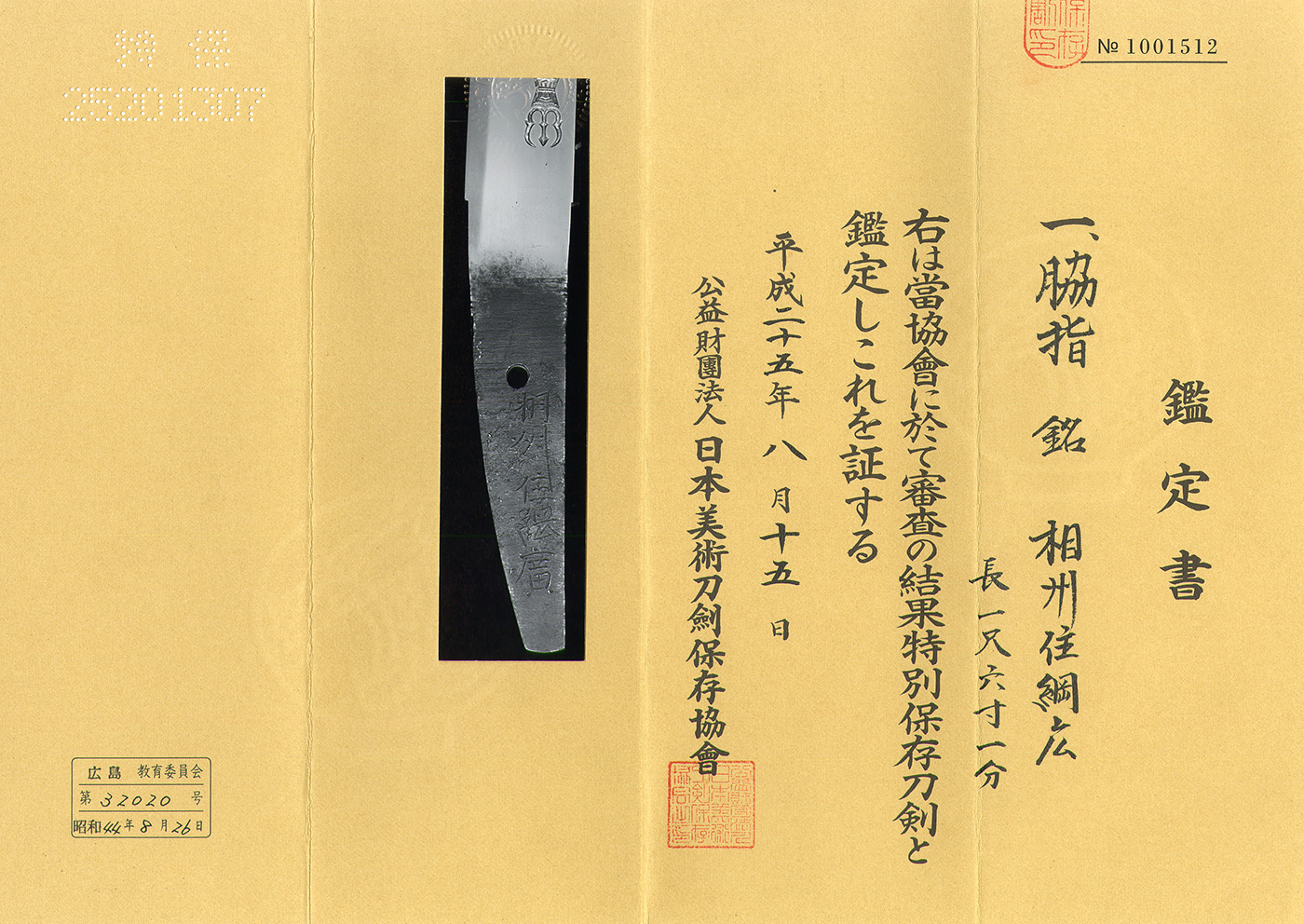
Signature: Soshu Ju Tsunahiro 相州住綱広
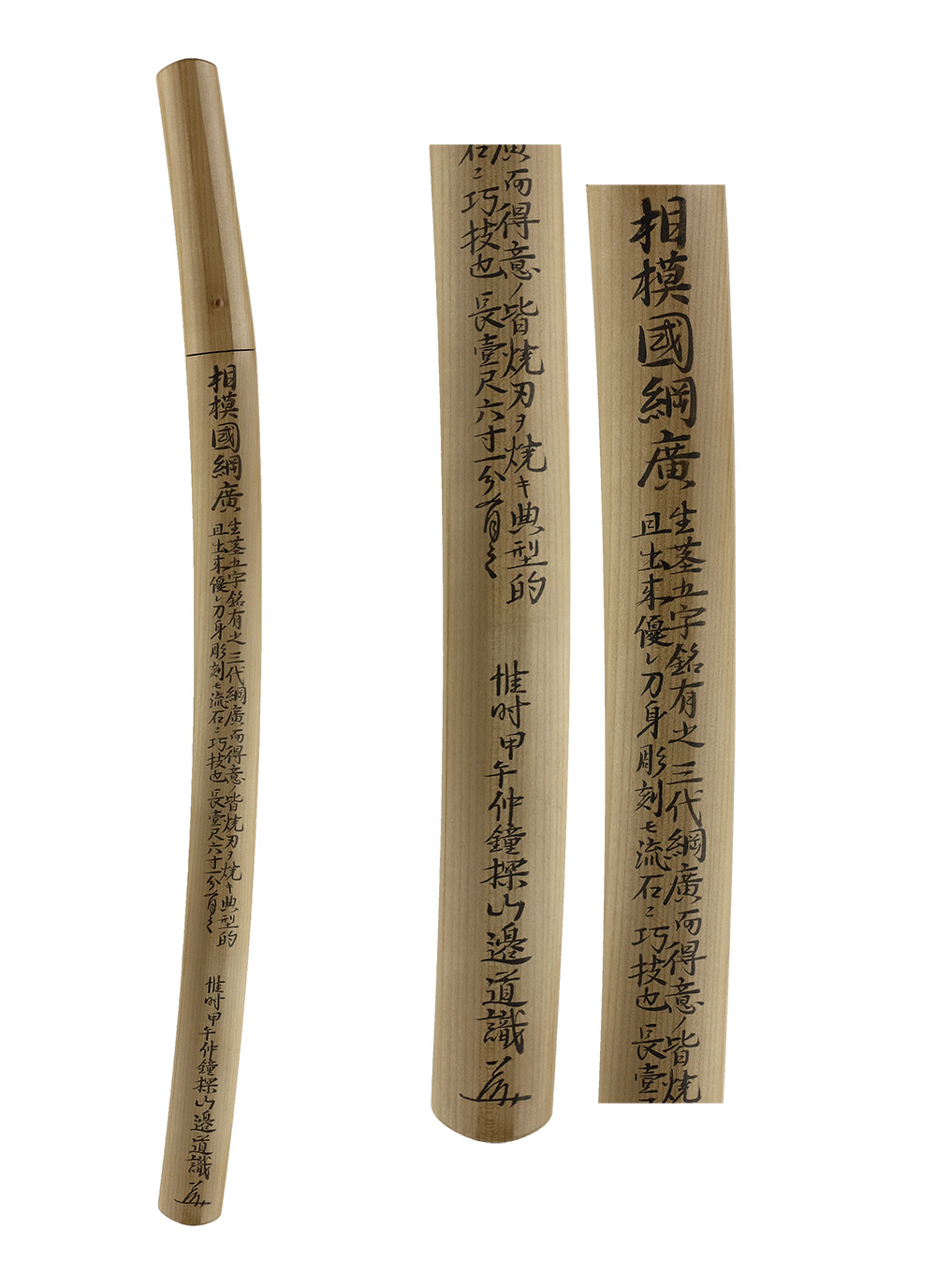
Sayagaki: Sagami-no-kuni Tsunahiro
The tang (Nakago) is ubu (original, unshortened) and bears a five-character signature. This sword was made by the third generation Tsunahiro, who was particularly skilled in producing Hitatsura hamon. The workmanship is representative of his style and of exceptionally high quality, while the carvings on the blade are also remarkably refined and skillfully executed.
November, 2014
Tanzan
(We divide 4 sections for each sword as Saijyo Saku, Jyojyo Saku, Jyo Saku and Regular Saku).
This work is ranked as Jyojyo Saku among works by Soshu Ju Tsunahiro.
Habaki: gold and shakudo plated habaki
Blade Length: 48.7cm (19.17in)
Curvature: 1.2cm (0.47in)
Mekugi-ana: 1
Motohaba: 3.12cm (1.23in)
Kasane: 0.63cm (0.25in)
Weight: 405g
Era: the end of Muromachi period, circa 1600
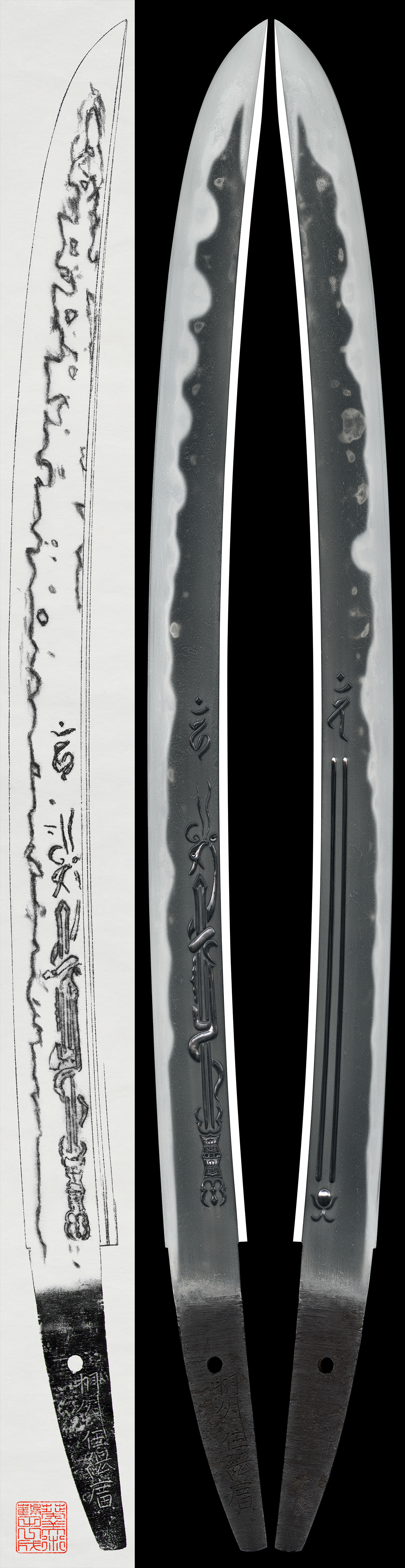
Shape: slightly wide and thin blade. The front side is carved with a So-no-kurikara (stylized dragon coiled around a sword)and bonji (sanskrit character), while the back side features bonji, gomabashi grooves, and a rendai(lotus pedestal) carving.
Jigane: Koitame and Moku with fine Chikei.
Hamon: Gunome , Notare and Yahazu-ba. The lower half of the hamon is dominated by nioi, while the upper half is rich in nie with abundant tobiyaki. The boshi turns back in midare style, and hardening is also applied along the mune side. The boshi turns back in midare style, and Hamon is applied along the mune side.
Features: Sue-Koto: Ryo Wazamono: Jyo Saku: Sagami
Soshu Tsunahiro was a swordsmith from Sagami active in the late Muromachi period. The first generation was invited to Odawara by Hojo Ujitsuna, where he was granted the character “Tsuna” and changed his name to Tsunahiro. The third-generation Tsunahiro worked from the end of Muromachi to the early Edo period, and was also invited by Tsugaru Tamenobu, lord of the Tsugaru domain, to forge swords in Mutsu Province.
He was well known for producing hitatsura temper patterns and was also highly skilled in horimono carvings.
NBTHK Tokubetsu Hozon Certificate
AoiArt estimation paper: Whole Oshigata
Please note: The price does not include the international shipping fees.
Auction Starting Price:1,600,000JPY
Place Bid



Related Items:
 Wakizashi: (Kirikomi-mei) Ecchu Kami Takahira Saku Kore(NBTHK Hozon Token)
 Wakizashi : Taira Nagamori 平長盛 (11th NBTHK Juyo Token)
 Wakizashi:(Kikumon) Omi no Kami Hisamichi (First Generation) (NBTHK Tokubetsu Hozon Token)
 Wakizashi:Kawabe Gihachiro Fujiwara Masahide (Kokuin). (NBTHK Tokubetsu Hozon Token)
 Wakizashi:Tajima Kami Hōjōji Tachibana Sadakuni (NBTHK Tokubetsu Hozon Token)
 Wakizashi: Sanryu Masamine(1987) carved by Jitoan Senshu(NBTHK Tokubetsu Hozon Token)