
Ordering Number: AS26579
Katana in Shirasaya (NBTHK Hozon Token) (Consignment Sale)
Signature: Mumei (Unsigned), attributed to Kanabo.
無銘(金房)
(We divide 4 sections for each sword as Saijyo Saku, Jyojyo Saku, Jyo Saku and Regular Saku).
This blade is ranked as Jyo Saku among works attributed to the Kanabo School.
Habaki: Double gold-foiled habaki.
Blade Length: 67.7 cm (26.65 in).
Curvature: 1.3 cm (0.51 in).
Mekugi Hole: 2.
Width at Base (Motohaba): 3.15 cm (1.24 in).
Width at Yokote: 2.1 cm (0.83 in).
Thickness of rim (Kasane): 0.63 cm (0.25 in).
Sword Weight: 730 g.
Era: Muromachi period.
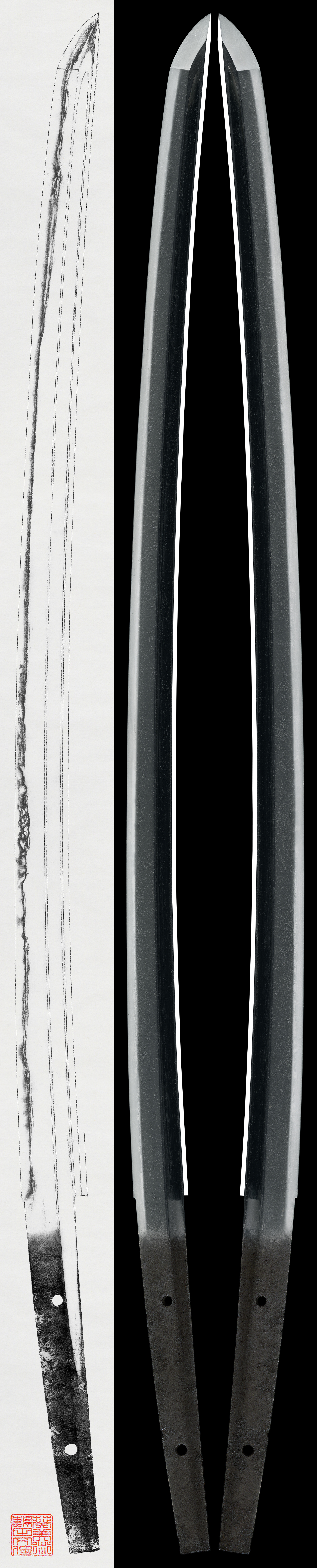
Shape: A well-proportioned katana that has undergone suriage (shortening) and machi-okuri (relocation of the notches).
The blade has relatively deep curvature and an elongated kissaki.
Bo-hi grooves are carved on both sides of the blade.
Jigane: Beautifully refined and well-forged ko-itame hada with clearly visible grain patterns.
Hamon: Suguha mixed with ko-gunome, featuring ashi activity.
The boshi displays midarekomi.
Features: The Kanabo School was a group of Japanese swordsmiths based in Nara (Nanto), Yamato Province, who were active from the late Muromachi period (Sengoku period) through the Edo period (Shinto period).
This particular katana displays the distinctive hamon of the Kanabo School, featuring ko-gunome-midare with abundant ko-ashi activity.
The blade also has an elongated boshi, further enhancing its distinctive appearance.
Historical Background:
Practicality and Excellent Cutting Ability: The Kanabo School specialized in swords designed for actual combat, emphasizing strength, durability, and excellent cutting performance rather than decorative appearance.
During the late Koto period, their swords were highly regarded as Wazamono, known for their exceptional sharpness and cutting ability.
Outstanding Production of Yari and Naginata: In addition to tachi and uchigatana, the Kanabo School was particularly skilled in producing naginata and yari.
Among their notable works were jumonji-yari (cross-shaped spears), including those associated with Kakuzenbo In'ei, the founder of the Hozoin-ryu school of spear fighting.
Representative swordsmiths of the school include Nanto Ju Kanabo Hyoe no Jo Masatsugu, Masanaga, and Masasada.
Their works are characterized by wide mihaba, thick kasane, and robust construction, reflecting their emphasis on strength and practical use.
The jigane often displays flowing itame or mokume hada mixed with masame, producing a prominent grain pattern.
Many examples also feature abundant ji-nie, contributing to the distinctive appearance of the steel.
NBTHK Hozon Token (Certificate awaiting issuance).
AoiArt estimation paper: Whole Oshigata.
Overseas shipping is charged separately.
Auction Starting Price: 400,000 JPY




Related Items:
 Katana:Mumei (Taima 当麻) (61st NBTHK Juyo Token)
 Katana: Minamoto Moriyoshi (NBTHK Tokubetsu Hozon Token)
 Katana: Nagasone Okisato Nyudo Kotetsu with Saidan-mei(45th NBTHK Juyo Token)
 Katana: Mumei(Unsigned, Hosho school)(the 23th Juyo Token)
 Katana: Hida no Kami Fujiwara Ujifusa (signature cut off below) (NBTHK Tokubetsu Hozon Token)
 Katana: Mumei (Attributed to Ōmiya Morikage)(the 15th Juyo Token)