
Ordering Number: AS25733
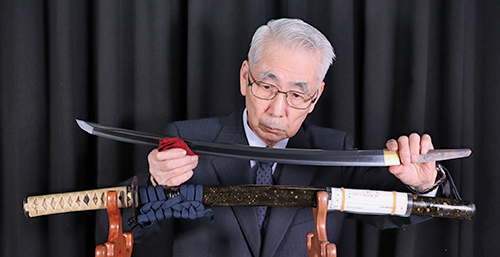
Wakizashi in Koshirae.
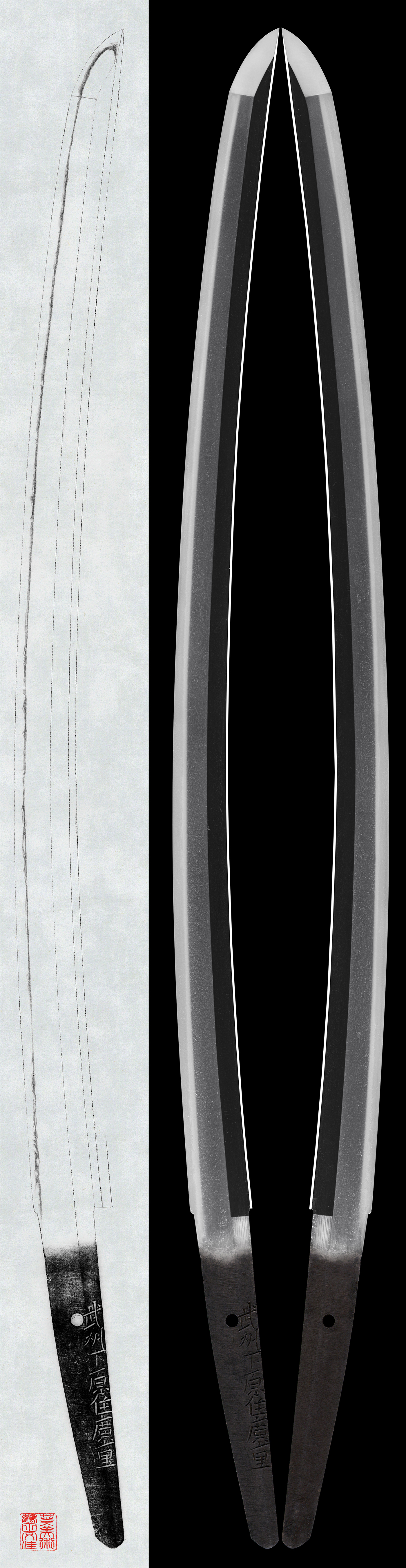
Signature: Bushu Shitahara Ju Hiroshige (guaranteed authentic).
武州下原住廣重(正真保証)
Shinto: Chusaku: Musashi.
(We divide 4 sections for each sword as Saijyo Saku, Jyojyo Saku, Jyo Saku and Regular Saku).
This work is ranked as Jyo Saku for Bushu Shitahara Ju Hiroshige.
Habaki: Gold-plated single habaki.
Blade Length: 52.2 cm (20.55 in).
Curvature: 1.7 cm (0.67 in).
Mekugi Hole: 1.
Width at Base (Motohaba): 2.87 cm (1.13 in).
Width at Yokote: 1.92 cm (0.76 in).
Thickness of rim (Kasane): 0.66 cm (0.26 in).
Sword Weight: 450 grams.
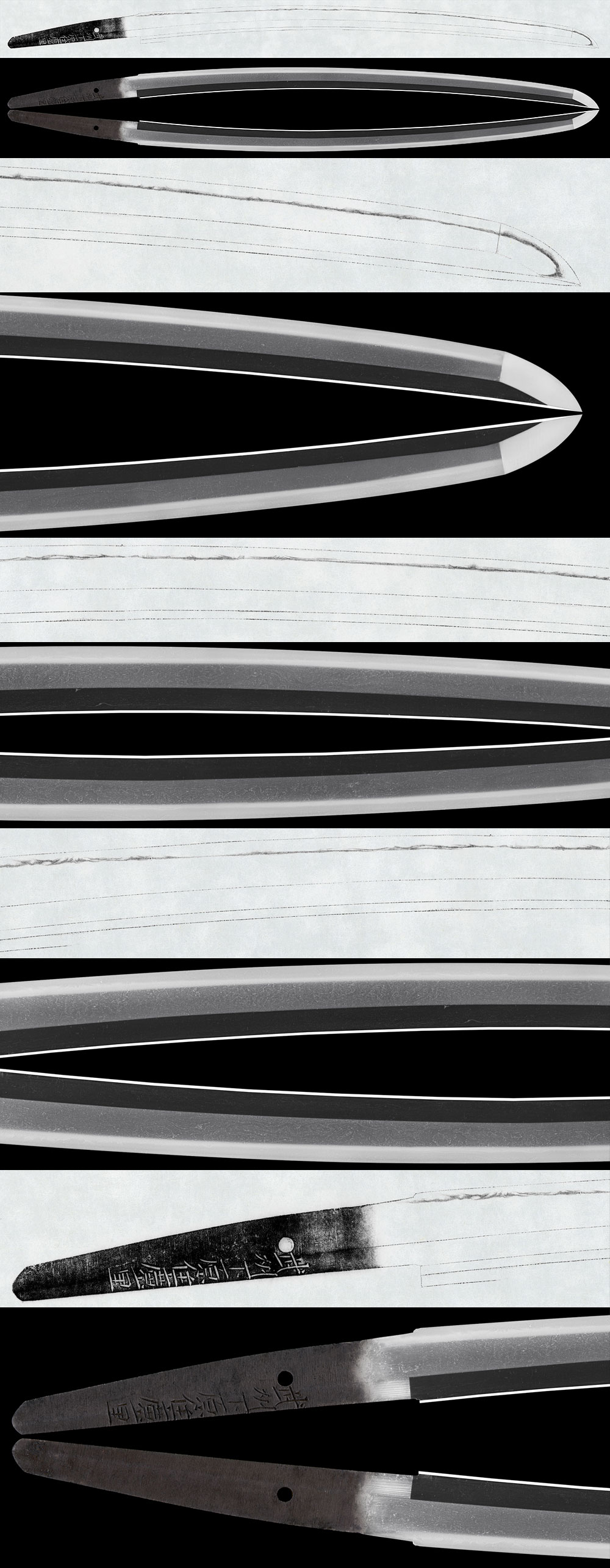
Shape: A wakizashi with substantial width and thickness, deep curvature, and a slightly elongated kissaki.
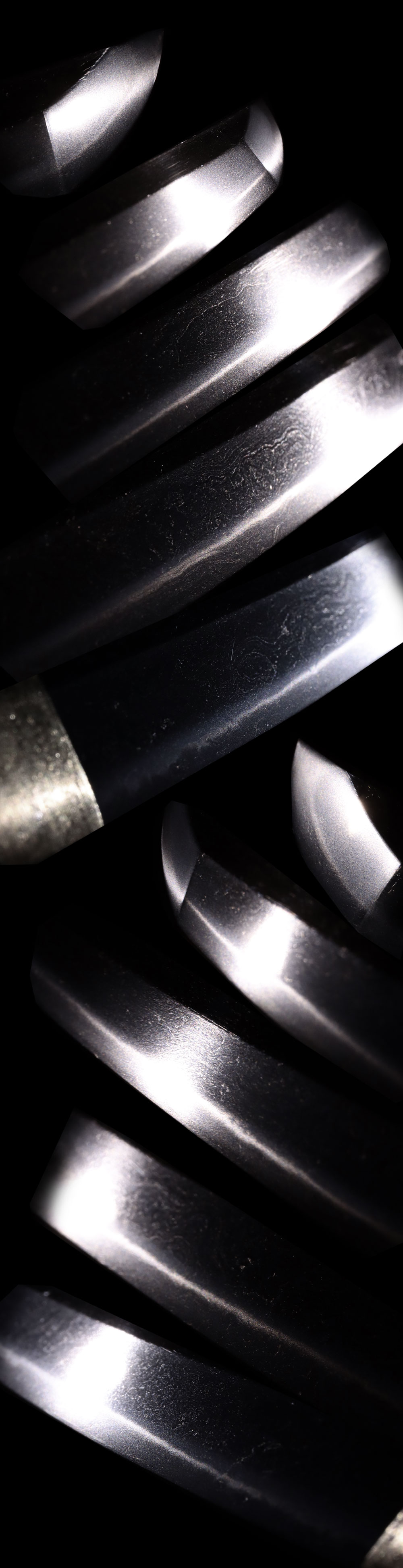
Jigane: A rare example of Yakumo forging, sometimes seen in famous swordsmiths from the Tohoku region.
Hamon: Suguha with intermittent hardened areas along the hamon.
The boshi turns back in a rounded manner.
Features: Bushu Shitahara Ju Hiroshige was a swordsmith active around present-day Hachioji.
Among the most famous works connected with this tradition is the sword of Musashi Taro Yasukuni, well known through the film and novel “Daibosatsu Toge.”
Yasukuni belonged to the Bushu Shitahara school of swordsmiths.
He was born in Hachioji in 1650 as the son of Yamamoto Kinzaemon Hiroshige.
He was first known as Yamamoto Tota Hiroshige and later took the name Yasukuni.
In 1685, he studied under Omura Kaboku, a swordsmith of Musashi Province.
He later resided in Azabu and then traveled to Mito, where he forged swords under the order of Tokugawa Mitsukuni and is said to have been granted the name Musashi Taro.
In 1719, together with his son Yamamoto Kozo, he performed sword forging before Shogun Yoshimune at the Ohama Palace and received ten pieces of silver as a reward.
Later he adopted the name Yamamoto Bokuyu and passed away on August 15, 1730, at the age of 81.
In the novel “Daibosatsu Toge,” his sword became famous as the beloved blade of the protagonist Tsukue Ryunosuke (played by Kataoka Chiezo), further increasing its popularity.
His grave, designated as a historic site by Hachioji City, is located in Kunutada Archaeological Park.
The omote side bears a carving of Kusanagi Kurikara, while the ura side is engraved with the phrase “Issho yume no gotoshi, tareka hyakunen no yowai wo tamotan.”
“Life is like a dream; who can preserve a lifespan of one hundred years?” from Volume 11 of the Soga Monogatari.
This work is a rare example of Yakumo forging.
Koshirae:
Tsuba: An irregularly shaped iron tsuba carved with leaves.
Fuchikashira: Shakudo nanako ground carved with leaves and decorated with gold iroe.
Saya (Scabbard): Black roiro lacquer saya inlaid with shells.
Menuki: Subject unidentified.
Kozuka: Shakudo nanako ground carved with trees and decorated with gold iroe.
Without kogatana.
Aoi Art’s Comment: Yakumo forging, often seen in works of the Bushu Shitahara school, is also frequently found in Aizu swords.
AoiArt estimation paper: Whole Oshigata.
*Overseas shipping fee not included.
Please note: the price does not include the shipping fees.
Auction Starting Price:300,000JPY
Place Bid



Related Items:
 Wakizashi:Oite Bushu Efu Enju Taro Muneyoshi(judged as Tamba)(NBTHK Tokubetsu Hozon Token)(NBTHK Tokubetsu Kicho Token)
 Wakizashi: Hishu Kawachi no Kami Fujiwara Masahiro (NBTHK Tokubetsu Hozon Token)
 Wakizashi : Shirakawa Kashin Masashige(NBTHK Tokubetsu Hozon Token)
 Wakizashi (Long Tanto): Hizen Koku Kawachi Daijo Fujiwara Masahiro(NBTHK Tokubetsu Hozon Token)
 Wakizashi :Hida no Kami Ujifusa(NBTHK Hozon Token)
 Wakizashi:Kawabe Gihachiro Fujiwara Masahide (Kokuin). (NBTHK Tokubetsu Hozon Token)