
Ordering Number: 25289
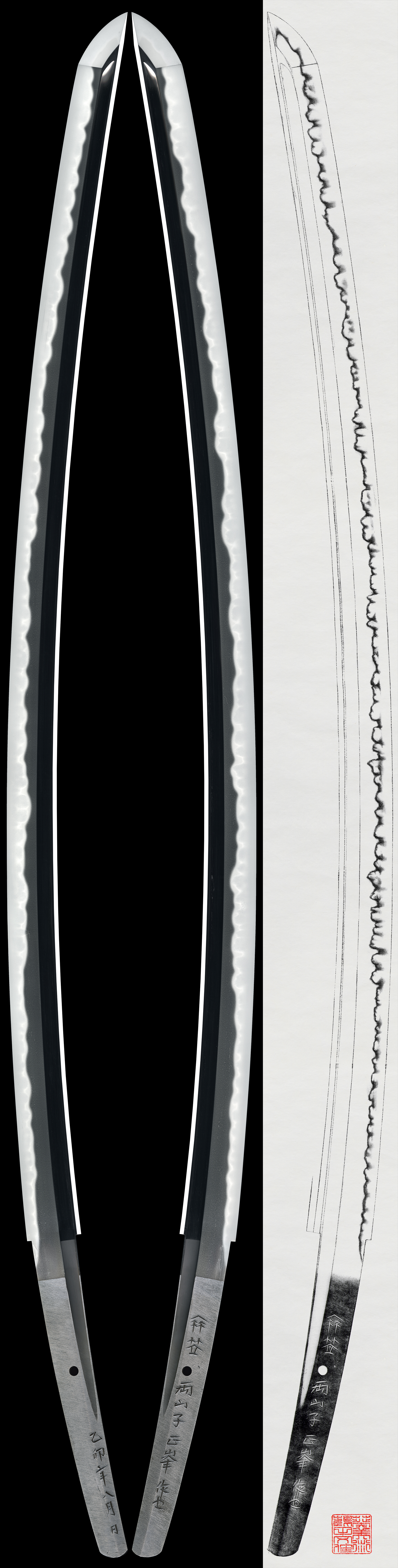
Tachi: in Shirasaya (NBTHK Tokubetsu Hozon Token)
Signature: Sanryūtei Ryōsanshi Masamine Saku Kore (Living National Treasure)
Dated: August, Year of the Wood Rabbit (1975)
傘笠 両山子正峯作之(人間国宝)
乙卯年八月日
We divide 4 sections for each sword as Saijyo Saku, Jyojyo Saku, Jyo Saku and Regular Saku.
This work is ranked as Jyo Saku among the works of Masamine.
Habaki: Solid gold
Weight: 46 g, with a very small amount of silver used
Blade Length: 74.0 cm (29.13 in)
Curvature: 3.0 cm (1.18 in)
Mekugi Hole: 1
Width at Base (Motohaba): 3.23 cm (1.27 in)
Width at Tip: 2.41 cm (0.95 in)
Thickness of rim (Kasane): 0.76 cm (0.30 in)
Sword Weight: 900 g
Era: Showa 50 (1975)
Shape:Wide blade with thick kasane, bohi carved on both sides.
Deep curvature, with a relatively wide boshi.
Jigane:Well-forged ko-itame hada forming a fine and refined steel surface.
Hamon:Nie-based gunome-midare with variations in height.
Thick nioiguchi with a midarekomi boshi.
Features: Sumitani Masamine (real name: Yoichiro) was born in Taisho 10 (1921) in Matto City, Ishikawa Prefecture.
After graduating from Ritsumeikan University in 1941, he entered the university’s Japanese sword forging research center and studied under Sakurai Masayuki.
He began independent sword research in 1942.
After the war, he was officially recognized as a swordsmith in 1954.
In 1956, he established his smithy “Sanryūtei” in his hometown Matto, where this sword was also forged.
In 1966, he became a mukansa swordsmith and a judge in exhibitions.
He made sacred swords for the Ise Grand Shrine in 1964, 1966, 1969, and 1989.
His work was closely connected with the imperial family, having crafted ceremonial swords for Emperor Akihito's enthronement in 1990, and protective daggers for Princess Mako (1991), Crown Princess Masako (1993), and Princess Kako (1994).
Aoi Art’s Comment: From the first Sword Forging Techniques Exhibition in 1955, he submitted works continuously for 38 sessions.
He pursued the Bizen tradition, perfected the so-called “Sumitani Chōji,” and led the revival of chōji hamon in modern swordsmithing.
This piece also exhibits a vigorous and dynamic hamon.
He researched Kamakura-period steelmaking and produced his own steel, resulting in tasteful, classically styled jigane.
In addition to the Bizen tradition, he also left excellent works in the Soshu tradition, and even produced kodogu such as small swords and tantos with mountings.
In 1981, he became the fourth swordsmith to be designated a Living National Treasure.
He passed away in December 1998.
NBTHK Tokubetsu Hozon Token
AoiArt estimation paper: Whole Oshigata
Please note: The price does not include the international shipping fees.
Price:2,850,000JPY
Order Form




Related Items:
 Katana: Miyairi Akihira Saku Kore An auspicious day in February, Showa 34 (1959), Made for Mr. Kunio Kanzawa (NBTHK Tokubetsu Hozon Token)
 Katana:Minamoto Moriyoshi (Mukansa Swordsmith)(1990)(NBTHK Tokubetsu Hozon Token)
 Katana : Tame Otsuka Kazunobu Kun Sekido Unju Korekazu Seitan saku kore (23th NBTHK Juyo Certificate)
 Katana:Mino Koku Okachiyama Sanroku Junin Fujiwara Nagasada. August, 1866. Made at Aoyama in Edo. (NBTHK Tokubetsu Hozon Token)
 Katana: Hokinosuke Taira Ason Masayuki(NBTHK Tokubetsu Hozon Token)
 Katana: Chikushu Ju So Tsutomu(NBTHK Tokubetsu Hozon Token)