
Ordering Number: AS26240 (Consignment Sale).
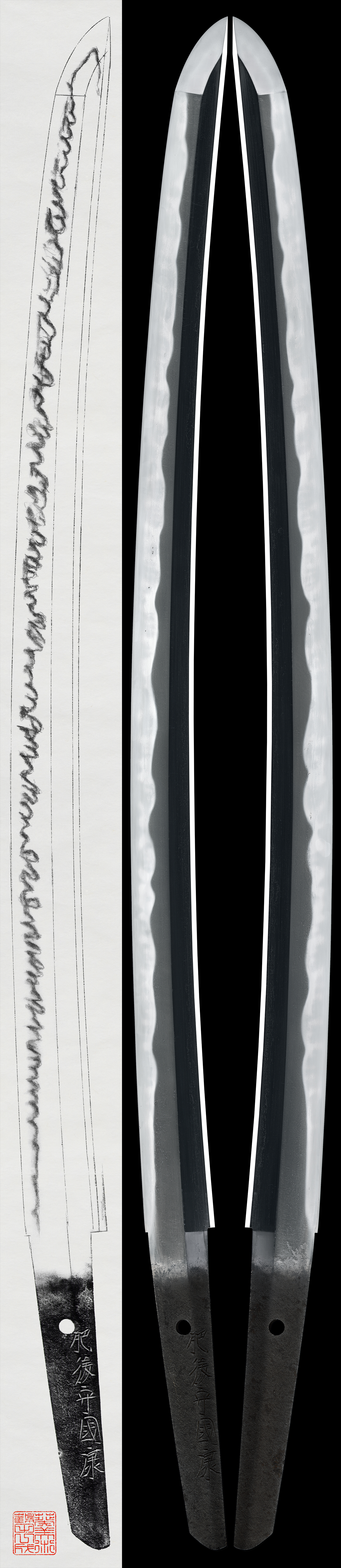
WAkizashi in Shirasaya with Koshirae (NBTHK Hozon Token).
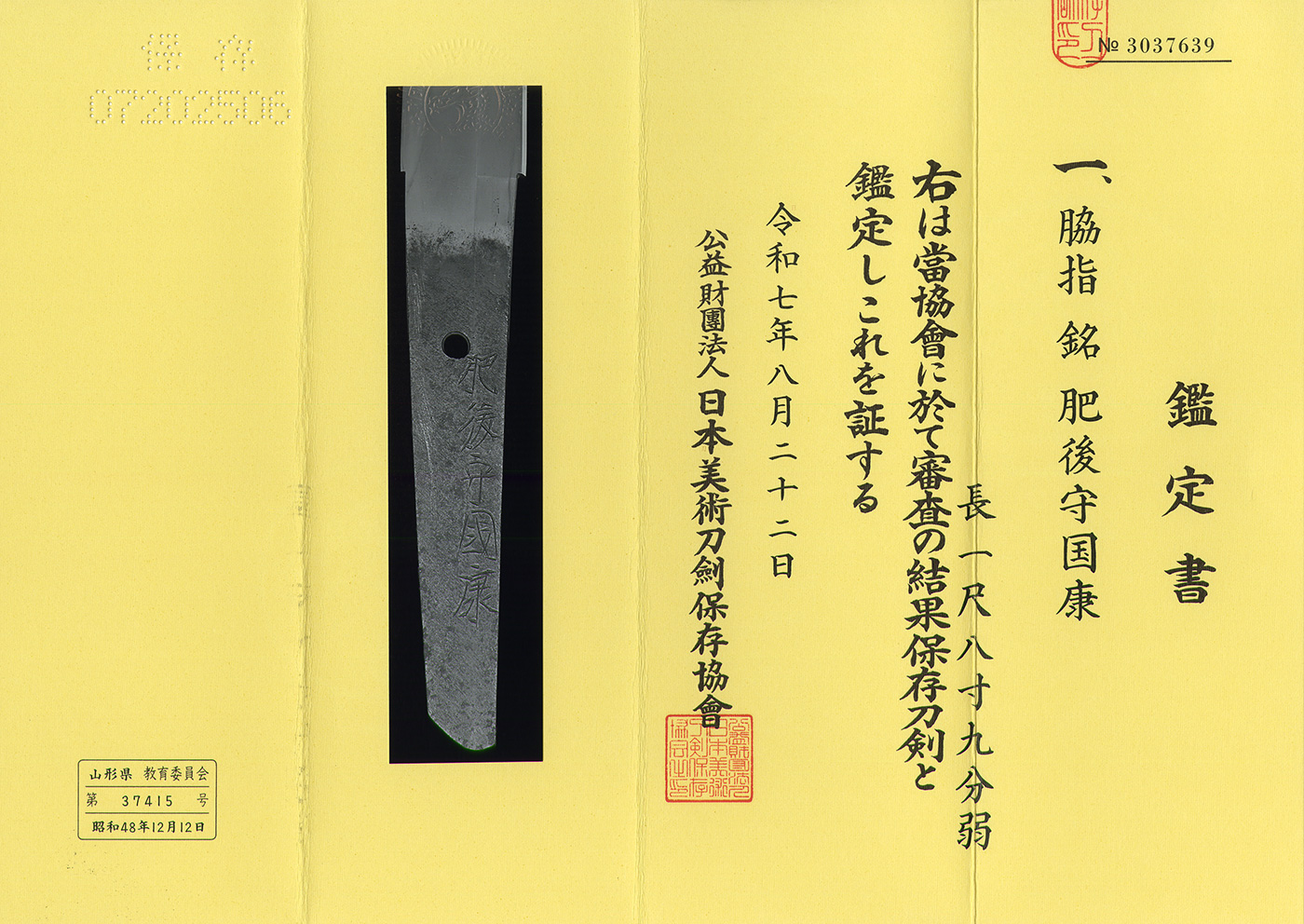
Signature: Higo no Kami Kuniyasu.
肥後守国康
Shinto: O-Wazamono: Jyo Saku, Settsu.
(We divide 4 sections for each sword as Saijyo Saku, Jyojyo Saku, Jyo Saku and Regular Saku).
The workmanship of this sword is ranked as Jyojyo Saku among the works of Higo no Kami Kuniyasu.
Habaki: Single-piece plain copper habaki.
Blade Length: 57.2 cm (22.52 in).
Curvature: 1.4 cm (0.55 in).
Mekugi Hole: 1.
Width at Base (Motohaba): 3.27 cm (1.29 in).
Width at Yokote (Sakihaba): 2.22 cm (0.87 in).
Thickness of rim (Kasane): 0.74 cm (0.29 in).
Sword Weight: 670 g.
Era: Edo period, around the Kanbun era (1661-1673).
Shape: A sword with a wide mihaba, solid kasane, ample curvature, and an extended kissaki, giving it an excellent overall shape.
Jigane: Well-forged ko-itame hada with refined and high-quality steel.
Hamon: Suguha near the hamachi, transitioning into gunome-midare toward the tip.
In the middle section of the blade, 2-3 extremely small particles of different steel can be seen within the temper line.
They are not particularly noticeable.
The hamon resembles that of the second-generation Kunisuke (Naka-Kawachi).
The boshi narrows and returns in a rounded form.
Features: Higo no Kami Kuniyasu was the son of the first-generation Kawachi no Kami Kunisuke and is one of the representative master smiths of the Osaka Shinto tradition.
This work closely resembles the style of his elder brother, the second-generation Kunisuke.
Koshirae:.
Tsuba: Round tate-maru shaped shakudo nanako-ground tsuba carved with flowering plants and decorated with gold iroe.
Fuchikashira: Shakudo ground carved with a fence motif and decorated with gold iroe.
Saya (Scabbard): Uro-style saya.
Menuki: Dragons in high relief with gold decoration.
Kozuka: Shakudo nanako ground carved with a Chinese story scene and decorated with gold iroe.
Kogatana: Signature: Shizu Saburo Kaneuji (gimei).
Historical Background: By the Kanbun era of the Edo period (1661-1673), swords came to be appreciated not only for cutting performance but also for their signatures, carvings, tameshimei inscriptions, and aesthetic features such as utsuri.
Higo no Kami Kuniyasu was highly regarded for his brilliant hamon and excellent cutting ability.
NBTHK Hozon Token.
AoiArt estimation paper: Whole Oshigata.
*Please note: The price does not include shipping fees.
Please note: the price does not include the shipping fees.
Auction Starting Price:560,000JPY
Place Bid





Related Items:
 Wakizashi: Higashiyama ju Yoshihira (NBTHK Tokubetsu Hozon Token)
 Wakizashi:Dewa Kami Fujiwara Sukenobu (NBTHK Tokubetsu Hozon Token)
 Wakizashi:Bishu Osafune Norimitsu (4th generation) Dated: February, Eikyo 5 (1433) (NBTHK Tokubetsu Hozon Token)
 Wakizashi :Hida no Kami Ujifusa(NBTHK Hozon Token)
 Wakizashi:Awataguchi Omi no Kami Tadatuna (2nd generation)(NBTHK Hozon Token)
 Wakizashi:Mishina Tango Kami Mago Naoyoshi (NBTHK Tokubetsu Hozon Token)